


Economic sentiment refers to individuals’ beliefs and expectations about the state of the economy. Naturally, sentiment influences consumer behavior and, therefore, has important effects on the economy. But relatively little is known about the drivers of consumer sentiment. Faced with endless signals about the economy and limited attention, what do consumers choose to focus on when forming their beliefs?
In recent research that is forthcoming in the Review of Economics and Statistics, we examine the role of gas price fluctuations in shaping consumer sentiment. The research focuses on gas prices because they are known for being highly salient. That is, since many Americans purchase gas frequently, and they even more frequently see its price posted on large signs, gas prices could behave as a barometer for understanding the economy. Gas prices are also quite volatile, and large swings in prices tend to capture Americans’ attention.
The Use of Gallup Data to Provide Insight on Economic Sentiment
Data on consumer sentiment used in this study is from the Gallup Daily tracking survey, which surveyed roughly 1,000 adults each day by telephone between 2008 and 2017. The study examined the responses to two questions: “How would you rate economic conditions in this country today: as excellent, good, only fair, or poor?” and “Right now, do you think that economic conditions in this country, as a whole, are getting better or getting worse?” The combined responses to these two questions were used to construct a sentiment score for each respondent.
The high frequency of the Gallup Daily tracking survey for the time period studied, and its large sample of respondents from across the country, were crucial for the analysis. Moreover, the data is a step up from prior studies that have been constrained by a smaller sample and a lower, usually monthly, frequency. These two features allowed the quantification of how demographically adjusted individuals in the same state update their beliefs about the national economy in response to different state gasoline prices. Using the combined data, it was found that increases in state gas prices made individuals more pessimistic about the national economy over the period studied. That held even after controlling for national factors and the growth in state gross domestic product.
One of the other advantages of the Gallup Daily tracking survey was its detailed demographic characteristics, including geography down to the ZIP code level. Because macroeconomists have been studying how different types of consumers might be more versus less responsive to fluctuations in their external environment, we can conduct specific tests in the data. For example, one of our hypotheses is that current consumers who grew up during the 1970s are more likely to associate higher gas prices with a worse economy. We find evidence for the hypothesis: consumer sentiment responds 50% stronger for consumers born before 1965 (i.e., those who were teenagers by the late 1970s) than for consumers born after.
The research also explores how long these fluctuations in gas prices affect economic sentiment. For example, the figure below shows that increases in state gas prices have the largest in magnitude (most negative) effect after three days, and it remains negative for 33 days, although it becomes statistically indistinguishable from zero after eight days. Our interpretation is that consumers observe gas prices quite frequently, so sentiment responds to gas price changes within a few days.
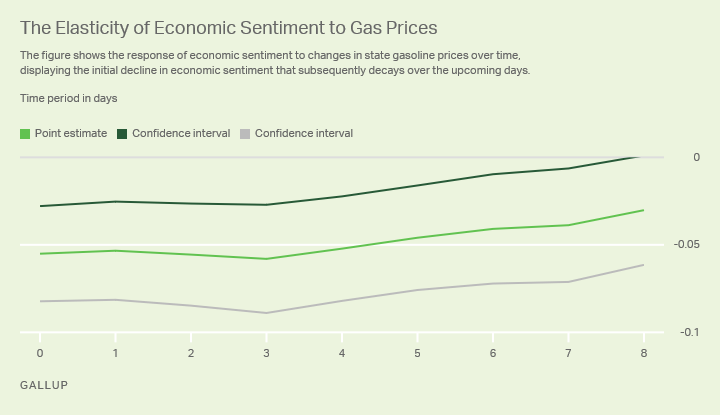
Line graph. The elasticity of Americans economic sentiment on gas prices over time. The greatest impact on Americans economic sentiment comes three days after an increase in the price of gasoline.
Implications
These results are important because they not only help reveal why and how consumers think about the economy and what they respond to, but they also guide the types of models that we build within the research community to quantify the effects of public policy. Specifically, these results suggest that consumers are selective about the information that they pay attention to and that they might extrapolate off noisy signals. That is, even though gas prices are not actually predictive of economic activity, if people believe that they are, then they will still make decisions as if gas prices are informative about the macroeconomy. Understanding how consumers form expectations, and the ways that this process might differ across demographic brackets, political affiliation, and more, is essential in the quantitative modeling of the economy and how what people think affects realized behavior.
From 2008-2017, Gallup monitored its Economic Confidence ratings through the Gallup Daily tracking survey. Since then, it has been asked monthly as part of the Gallup Poll Social Series.
Carola Binder is an assistant professor in the Department of Economics at Haverford College and an Associate Editor at the Journal of Money, Credit, and Banking.
Christos A. Makridis is an assistant research professor at Arizona State University, a non-resident fellow at Baylor University, a digital fellow at the MIT Sloan School of Management, and a senior adviser at Gallup.







