

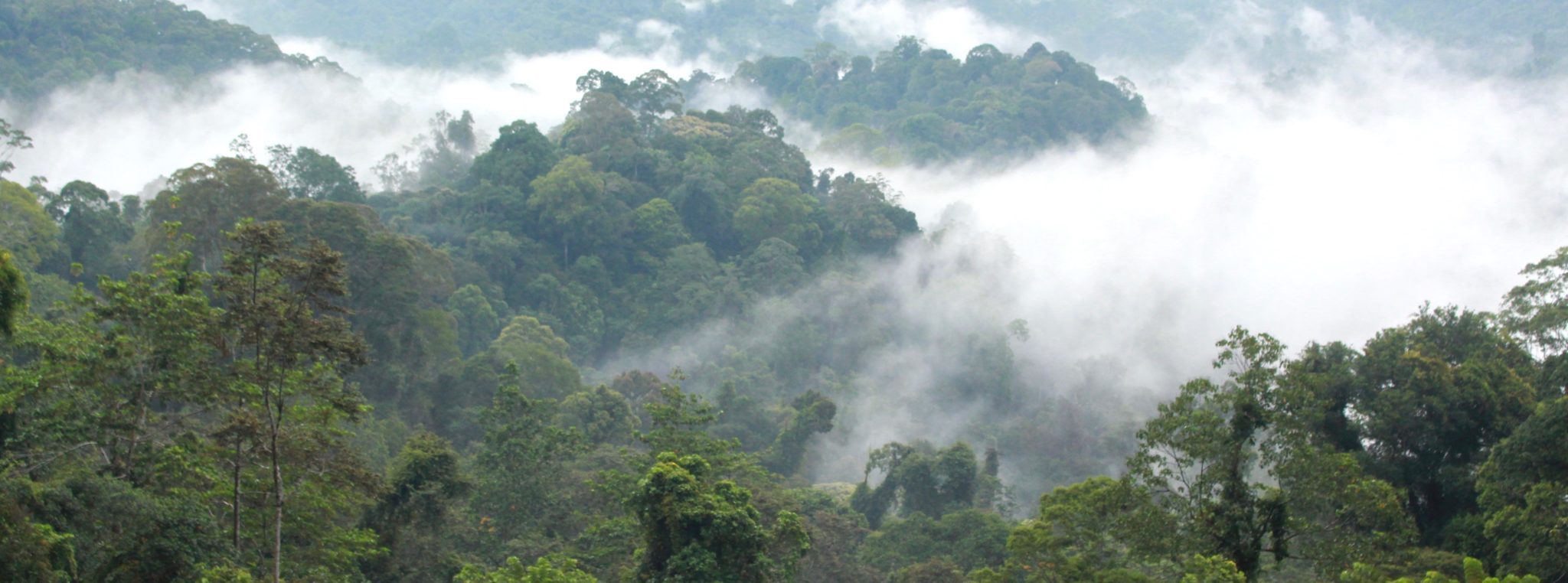
On a field visit to the Baram region of Malaysia’s Sarawak state on the island of Borneo, we approach the Penan village of Long Sepigen. Like most villages of the Penan people, Long Sepigen is only accessible on foot or by boat.
We’re here as part of a team from The Borneo Project to visit our field technicians for the Baram Heritage Survey – a project that hires Indigenous citizen scientists to patrol and monitor their own lands. The Borneo Project has worked in Sarawak for almost 30 years, supporting Indigenous communities in their attempts to protect their land from logging and palm oil interests.
As our boats arrive, we unload our luggage wrapped in garbage bags onto the banks of the Selungo River. We made the trip between two bouts of heavy rain and hold little hope for the contents of our soggy packs. But our cache of smartphones is safe in a drybag, ready to be used by our field technicians for the survey. We dry off and settle into our home for the night, a basic but comfortable two-story wooden structure. My colleague Jettie and I get the upstairs room with huge windows overlooking the river, garden and fruit trees bright with rambutan.
Long Sepigen was established in the 1970s. Before that, the Penan people were nomadic, relying solely on the rainforest for their survival. But even in their more settled lifestyle, the forest is vital for every aspect of Penan life – from food and water to medicine and spiritual protection. An average villager can identify more than 200 species of plants, knowing which ones work as sandpaper and which as ghost repellant, which can make papers for rolling cigarettes and which give poison for blowpipe darts.
Spirits are high off the back of an excellent fruit and hunting season. Men from the village have been hunting overnight, and they’ve made a fire in a barrel outside our door to grill a freshly caught wild boar, filling the air with fragrant smoke. After a quick shower we meet with our field technicians for this village cluster – Sejalee and Robert, two other hunters who can walk for days through the forest with no difficulty. Together, they are one of the three teams involved in the survey, in charge of monitoring Penan land shared by three Penan villages up and down the Selungo river. Over coffee and crackers, we discuss the pangolin and gibbon signs they encountered during the initial stages of the survey.
Each village cluster has cleared walking paths for data collection on four transects measuring four kilometers each in length. Three were randomly generated, and the fourth transect was selected by communities based on their own research goals – namely community forest areas they have protected from logging and wish to monitor, or, alternatively, areas of forest that are still in their primary state.
Field technicians for the survey walk these four transects every month, but calling it walking is something of an understatement on this terrain. The thickly forested Baram region is carved out of limestone mountains, landscaped by loose leafy forest trails, dipterocarp roots and mossy streams. Snaking its way through the middle is the mighty Baram River, the life source for dozens of villages, around 20,000 Indigenous people, and innumerable endemic animal and plant species. The upper Baram region is the largest area of unprotected and intact forest left in Sarawak, and like many places of high ecological value, it is a race against time to establish protected areas before timber companies obtain or act on their logging licenses.
Field technicians monitor for sightings and signs of the spectacular array of primates, felines, reptiles, birds and other creatures that share this land. Using the Baram Heritage Survey smartphone app, the techs feed these sightings into a database to be analyzed by local researchers at UNIMAS and international researchers at the University of California, Berkeley.
Sejalee keeps meticulous notes of every sighting and runs us through his notebook jottings of what he has found so far. Field technicians like Sejalee, who have lived their entire lives by these forests, have no trouble spotting sun bear claw marks, or mud rubbed on trees as a sign of deer, or pangolin nests. They can distinguish between the sounds of the six different hornbills that live in the Baram region and can, of course, tell which poo belongs to whom.


Although we trained the technicians to use our app, their understanding of the forest was key to the app’s design and is vital to the survey’s success. Our eight field technicians across three village clusters, though geographically close, have different cultures, different languages and different ways of viewing the forest. Technicians are not only finding different animals in their geographical areas, but they are also identifying them in completely different ways.
For example, one set of technicians with heavy leaf-fall on their transects can’t rely on animal tracks, so instead have given us a bevy of animal signs based on sound and smell. Or, despite the app having more than five ways to mark sightings of wild boar, every month our technicians are finding new sighting methods to add. This month, it was the sound of two male boar battling it out for territorial dominance.
In the morning we walk up the river to a small waterfall, slippery with moss. After chatting with our field technicians, it is tempting to peer in every nook and cranny in the hopes of making our own great discoveries. Though the survey is in its infancy, it is clear that the Selungo river – and the whole Baram region – is brimming with life and worthy of protection. Simple technology teamed with traditional ecological knowledge can produce abundant and exciting results for science and for conservation, and we hope our field technicians’ small discoveries add up into a rich tapestry of data, strong enough to save this land from the chainsaws and bulldozers that place it under threat.
Fiona McAlpine is the communications and media manager for The Borneo Project.







