

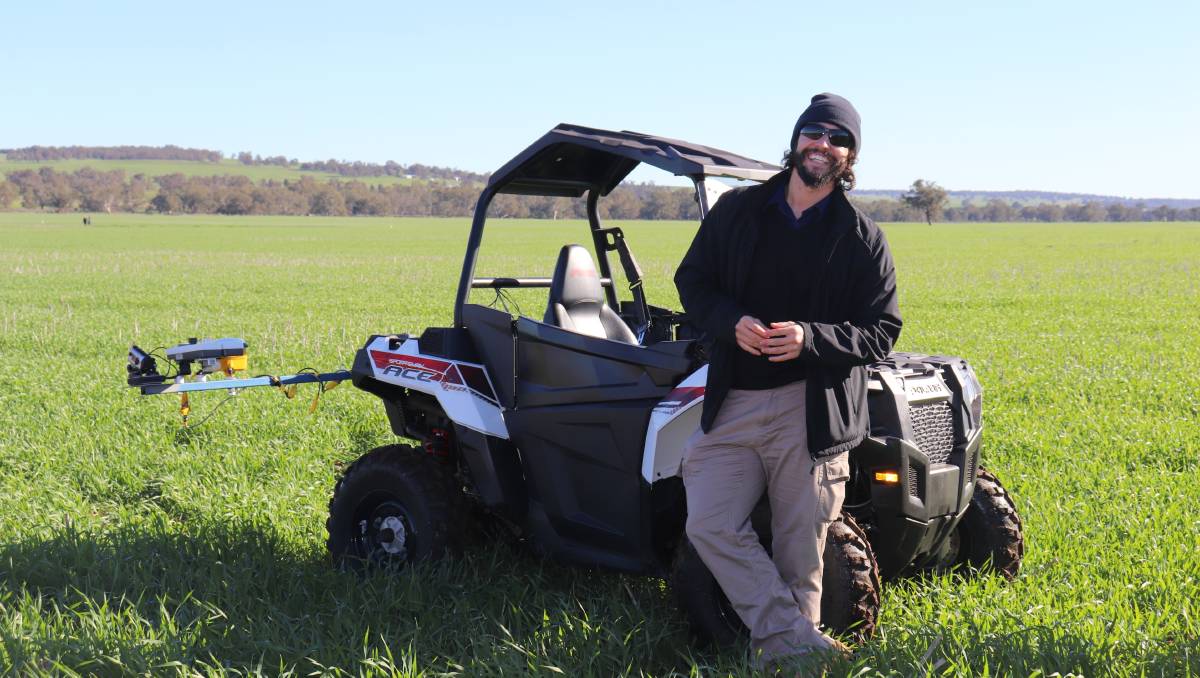
A PROJECT being conducted by CSIRO and the Grains Research and Development Corporation, among other partners, is focused on improving the efficiency and profitability of applied nitrogen through a sensing, decision and application platform.
The Future Farm project aims to create a reliable estimate of percentage nitrogen in a wheat crop, using sensors and machine learning, to inform an in-crop application of nitrogen fertiliser.
Mid-season nitrogen decisions are crucial for crop management and profitability, with many tools and decision aids having been developed to help inform a nitrogen decision.
Most of these tools rely on making an assessment based on tissue analysis at mid-season to determine plant nitrogen status and future requirements, with the fertiliser requirement then calculated from these variables to determine the demand.
CSIRO postdoctoral research fellow Jonathan Richetti said unfortunately it could be difficult to identify the nitrogen demand across an entire paddock.
“Crop sensors and information like normalised difference vegetation index (NDVI) have been commonly used to calibrate a relationship between the vegetation index and potential yield using a linear regression,” Dr Richetti said.
“From this, a nitrogen demand can be calculated and used to inform a fertiliser recommendation, however Colao and Bramley (2019) showed that such sensor calibration, that is the relationship between the vegetation index (usually the NDVI) used and the yield, is site-year specific.
“The implication is that the demand estimate generated from other paddocks, or seasons, is likely to be incorrect in the current year.”
Because of that, linear regressions are not enough to pick up the complexity of nitrogen decisions.
In the trials, the ability to predict percentage nitrogen in the crop using a range of different crop sensors and different approaches to machine learning was evaluated.
In the preliminary study, fertiliser decisions were based on whether the crop met a critical percentage nitrogen threshold of four per cent.
As part of the project, many fields were monitored around the country, three of which were in Western Australia, including Dandaragan and Kalannie.
Dr Richetti said that in each paddock two (N-rich and N-farmer) or three strips (N-rich, where N-rich is the double of N-farmer, N-minus, and N-farmer practice) were set and at least two samples in each strip were collected depending on the size of the paddock.
“Each sample consisted of one square metre, first scanned with a commercial proximal crop sensor and then cut and sent to an independent private laboratory to assess aboveground plant nitrogen concentration,” he said.
“To address the mid-season N decision, that is to identify if a site needed mid-season intervention, a stressed nitrogen content threshold of four per cent was considered based on Australian guidelines.
“The random forest algorithm (RF), a machine learning method, was used to identify the most important predictors with a Recursive Feature Elimination (RFE) to assess percentage nitrogen and then a logistic regression was performed with the optimum predictors to assess the need for mid-season nitrogen application.”
From the RF and RFE algorithms, the optimum predictors were determined as being Red Edge (RE) and Simplified Canopy Chlorophyll Content Index (SCCCI), with those the logistic regression showed that the Red Edge reflectance was the significant predictor.
“This result is a combination of the best of both worlds, the high accuracy of machine learning with the interpretability of the traditional methods,” Dr Richetti said.
“The RF showed that the Red Edge and Simplified canopy chlorophyll content index were the optimum predictors of percentage nitrogen, while the logistic regression showed that only Red Edge was significant at identifying the need of mid-season nitrogen in wheat.
“When tested against laboratory data the model accuracy was 96 per cent, so the model was able to correctly determine 96pc of the time if the wheat was stressed and in need of more nitrogen.”
This methodology can help farmers use red edge reflectance and SCCCI as indication of nitrogen deficiency or sufficiency in wheat.
The next step is to investigate the benefit of combining more prediction variables, such as soil moisture, into multivariate models to support improved, site-specific nitrogen fertiliser decision-making.
The ultimate aim is to develop a framework to accurately predict the response to applied nitrogen using various layers of on and off-farm data.







