

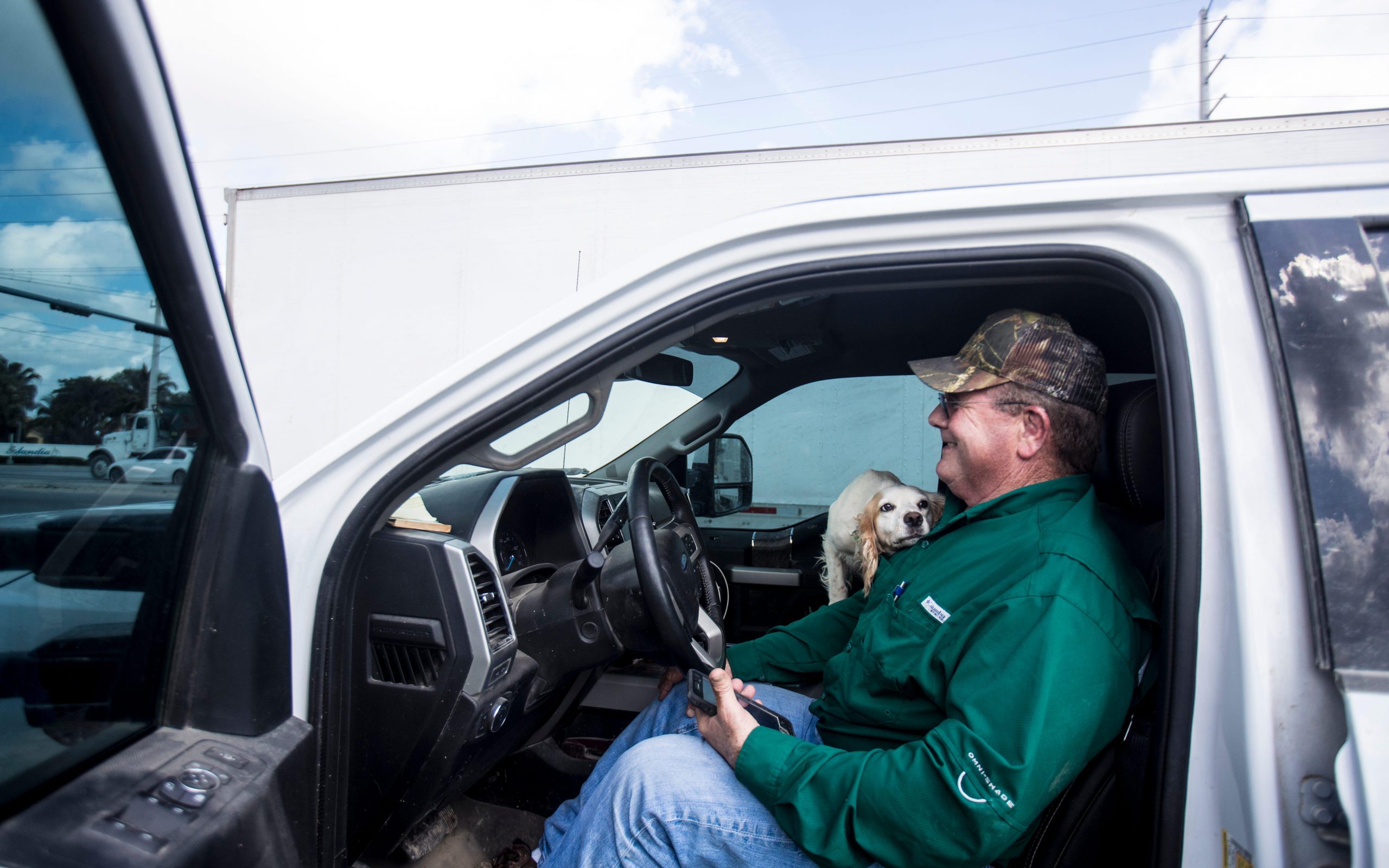
John Alger parked his dusty cotton-white Ford F-350 crew cab truck near a corn field at the northwest corner of Exit 9 along the Florida Turnpike near Homestead.
He opened the driver’s side door and held back his two female English Cocker Spaniels, Suzie, a chocolate colored 6-year-old and Prissy, a 2-year-old piebald.
Alger rents this 22-acre field from a local hospital and has farmed it for 10 years.
“If we had a bigger storm surge this could all be affected out here,” he said while walking along the western edge of the property on a 90-degree winter day.
“You can see the water table,” he said while bending down and pointing to a football sized hole in the ground. “This is still at the natural level. And right now this is good water.”
The water table is literally 2 feet beneath the surface here, and Alger has already lost a 350-acre farm field to saltwater when massive Hurricane Irma pushed ocean water from Biscayne Bay up into the canal drainage system and onto the field.
Florida tourism struggles under grip of COVID-19
He farms within a few miles of the coast and within a few feet of the groundwater, which is constantly battling with ocean water as saltwater continues to assault the surficial aquifers along the Southeast coast of Florida.
Oceans waters have been pushing inland for decades here, and conditions are expected to worsen as sea levels continue to rise and larger, more powerful tropical storms and hurricanes pound the region.
Saltwater is chasing people like Alger and seeping and slamming into Florida with more regularity, threatening drinking water supplies, farm fields and the largest ecological restoration project on the planet.
Ocean water is moving in laterally, brackish water is pushing upwards from underneath and more frequent and intense hurricanes are ruining once-prosperous coastal farms.
“They say the Romans salted the fields of their enemies and now I now why,” Alger said while checking on the overgrown field he once farmed for green beans. “It works.”
He’s mostly a corn grower, but he also plants “snap” beans, and landscaping trees and plants for new homes and communities being built in the sprawling Miami area.
But he said climate change is crushing his business in another way: Because there haven’t been heavy freezes in the historic Everglades in a decade, there’s more competition in certain crops from other farmers further north in Florida.
And climate change and sea level rise are expected to make tropical storms and hurricanes like Irma stronger and more frequent.
The National Oceanic and Atmospheric Administration, or NOAA, lists tropical storms and hurricanes as already being the most costly natural disaster in the United States, causing $23.5 billion of damage annually between 1980 and 2019.
Nearly $44 billion is lost annually to natural events, according to NOAA, and tropical storms and hurricanes account for about 54 percent of that total.
Those numbers are expected to go up as more intense and frequent storms hit Florida and the Southeastern United States.
More storms means Alger’s fields will be more vulnerable.
He’s thinking about getting out of the farming business because he’s lost so much over the past few years.
Although he’s not convinced humans are the cause, the climate, he said, is changing. And with it comes more competition.
It’s warmer now that it was even a decade ago, and that’s allowed farmers in the Lake Okeechobee to move into the winter corn growing season.
The Belle Glade area, he said, saw regular freezes before 2010, that farmers there were afraid to plant corn in the winter because they could lose the crop to cold weather.
That’s not the case now, he said, and that has caused corn prices to plummet.
But Alger’s problems have been a long time coming.
Climate experts have been predicting for decades that global temperatures are on the rise.
Sea level rise in Florida has been measured for about a century but the United States Geological Survey.
“This was happening even before people began to recognize that sea level rise was occurring,” said Jim Beever, a retired climate planner and biologist. “All along (the west) coast we’ve had saltwater intrusion, so the wells the old-timers used are no longer viable. Then you have saltwater moving in laterally from the coast. And it’s a problem with all Florida coasts because out geology is porous limestone.”
Beever knows the issues farmers and builders are facing on the highly urbanized southeast coast of Florida.
He helped several East Coast communities develop climate change and sea level rise adaptation plans.
“You’ll see over and over again people who have a freshwater well in some rural community who now get salinated as the saltwater moves in, and then they try to go deeper to try to find freshwater,” Beever said. “But eventually the saltwater is going to move into the system.”
The situation is similar on the southwest coast of Florida, but not quite on the scale of what the East Coast is seeing because that area is much more populated and developed.
“Most of the aquifers had a head that was discharging to tidal water and as cities and municipalities and counties and (agriculture) started using water close to the coast, it drew down that head and that allowed the saltwater intrusion to come in,” said Greg Rawl, a hydrology consultant in Fort Myers.
These realities make it more difficult and costly for municipalities and water utilities to supply drinking water to Floridians, even though much of the state sees about 5 feet of rain each year.
Much of that rain washes off the landscape as fast as a gravity-driven network of canals and ditches allow, so water that once recharged coastal surface-level aquifers no longer sits on the land for long periods of time.
That means the groundwater aquifers do not receive the recharge they need each year, and fighting off sea level rise becomes even more difficult.
The historic Everglades stretches from just south of Orlando to the Florida Keys and includes 16 counties.
Intrusion problems started when the Everglades was ditched and largely drained a century ago to create dry land for farming and urbanization.
A massive earthen dam was built around Lake Okeechobee to hold back the liquid heart of the Everglades, and the groundwater table throughout much of South Florida dropped several feet.
The idea was to hold back Lake Okeechobee waters to provide irrigation water for farmers and potable water to developed areas during the dry winter season.
During the rainy summer months the strategy switched to flood protection.
The massive drainage system was designed to efficiently move water off the landscape to keep farm fields and towns from flooding.
It worked. Too well in some regards.
Freshwater that once pushed against the sea is now largely locked in reservoirs or is moved through the canal and drainage system.
Historically, East Coast development has been largely dependent on the relatively shallow Biscayne Aquifer, which is beneath the surficial or groundwater aquifer.
But too many people pulling too much water puts the Biscayne at risk because less freshwater in the aquifer means less pressure to combat the saltwater intrusion.
Then there’s the fact that the drainage system was built with draining the Everglades in mind.
“The system as a whole has limited capacity when looking at sea level rise, but we have to bring more water to the coast to keep the (freshwater) elevations high,” said Carolina Maran, the South Florida Water Management District’s top climate change resiliency planner. “If you don’t keep water in the canals, it will contaminate the well fields.”
The water management district, with help from other government agencies, manages the network of canals and ditches to keep this part of the Sunshine State from flooding and to help provide drinking water to urbanized areas.
Some fear we may have altered daily rain patterns by driving rain water off the landscape.
“(Climate change) could help or hurt, and I don’t think that we really know at this point which way that is going,” said Rawl, the Fort Myers consultant. “In some areas we’ve seen a a decline in rainfall, but is that due to global warming or urbanization because there’s less water to evaporate back into the atmosphere.”
With Florida growing by 900 or so residents a day, supply is also becoming an issue for urbanized uses.
Amy Baker, director of the Legislature’s Economic and Demographic Research, said earlier this year that demand for water in Florida will surpass supply in a few years. And that’s for a state that sees upwards of 5 feet of rain in year.
“Water, water, every where, And all the boards did shrink; Water, water, every where, Nor any drop to drink,” Samuel Taylor Coleridge’s classic “The Rime of the Ancient Mariner” sums up the situation.
Saltwater is moving inland, upwards and will be thrust upon the state by larger and more frequent tropical storms and hurricanes.
Beever, the retired climate change planner, said the public seems to think freshwater is unlimited, that just because it’s been available in the past means that it will be available in the future.
“In general humans are bad at managing water everywhere and it’s in part because of the concept that there’s always going to be more water when there’s not,” he said.
Looking back on his career, which started in the 1970s, Beever said he thought humanity would be better prepared for these changes.
He said he didn’t expect an anti-science political movement would dominate public discussion and slow down modern adaptations that would help slow and even reverse some of these changes.
“I expected that we would be much better dealing with nature and environmental issues,” Beever said. “We wouldn’t have the water quality problems we have today and we wouldn’t see people being purposefully ignorant.”
Alger, the farmer, said climate change is a reality.
Even though he’s a conservative who’s on the fence about whether or not man is influencing sea level rise, saltwater intrusion and climate change, Alger knows the changes are real.
He’s living it.
Alger’s never seen former vice president Al Gore’s Oscar winning “An Inconvenient Truth”, a then-controversial 2006 documentary about climate change.
But still, he uses the film as a climatological measuring stick, a political joke that sometimes hits too close to home.
“We may leave another 80 (acres) due to market decline,” he said in a text with USA Today. “Northern growers (near Lake Okeechobee) have started much earlier. There’s a lack of fear in freezes. Al Gore is winning!”
Connect with this reporter: @ChadGillisNP on Twitter.
This article originally appeared on Fort Myers News-Press: Florida farmers battle rising water and salt as sea water floods fields







