


- A researcher spotted off-season flowering in poplar (Populus deltoides) trees in Kapurthala, Punjab in 2019.
- Digging into the weather data, the research team found unusually high rainfall in May 2019 in Kapurthala indicating that there might be a correlation between the unusual rainfall and off-season flowering and that their observations provide early clues of changing climate conditions.
- Though several reports of off-season flowering in plants exist in the literature, long-term phenological records on Indian plants are missing and much needed to establish links between changing climate and off-season flowering.
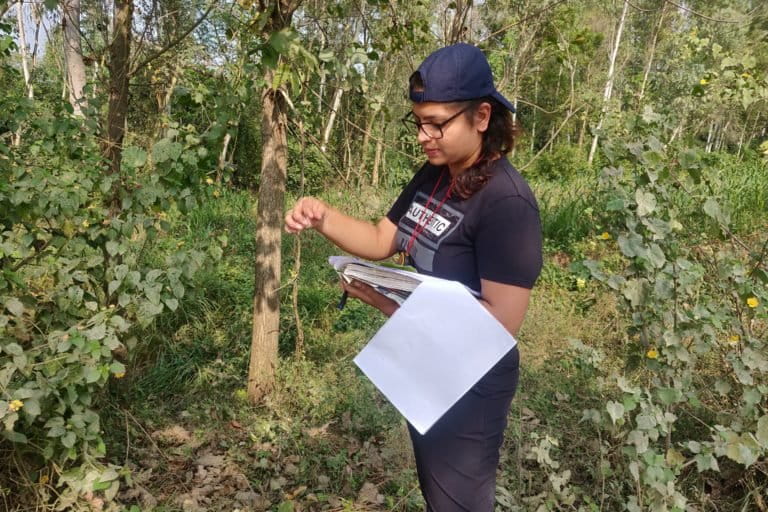
In October 2019, a few months into her Ph.D. at the Forest Research Institute, Dehradun, Garima Thapliyal set out on a field survey to Punjab, Haryana, Uttarakhand and Uttar Pradesh. Her task was to collect leaves from the Populus deltoides or Poplar trees. She and her colleagues at the lab would study the RNA inside those leaves.
Making her way across the four states, when Thapliyal arrived in Kapurthala in Punjab, she met with a surprise. While surveying Poplar trees growing on a lemongrass plantation (in Kapurthala), she found some trees had borne flowers. Of the thirty-two Poplar trees in the plantation, flowers had appeared on five. Poplar trees are known to flower in the months of March and April and not in October. This off-season flowering took Thapliyal by surprise. When she brought it up with the farmers on the field, they weren’t surprised and said that they had noticed this sort of off-season flowering earlier too.
Once back in her lab, Thapliyal, her Ph.D. supervisor Maneesh Bhandari and other colleagues started investigating the reasons that could have triggered the Poplar trees to flower early. A look at the rainfall pattern in Kapurthala in the past five-years provided some clues. There was a trend of increase in rainfall from 2014 to 2019. Particularly in the July-September period, rainfall increased from 373.1 mm in 2014 to 598.7 mm in 2018. Interestingly, in 2019, the cumulative rainfall for the same three-month period was less (236.2 mm) but an unusually high rainfall of 911.2 mm was observed in May. May is usually a month of very little rainfall.
The researchers have published their findings in the International Journal of Biometeorology where they say, their observations provide “early clues of changing climatic conditions that have altered the flowering pattern of Poplar deltoides.” Encouraged by the results of their preliminary investigations, Bhandari and Thapliyal are now looking forward to repeating the survey in the same places in 2020 again.
Weather patterns and flowering
Plants usually bear flowers only when the season is right. They have finely tuned internal mechanisms to sense the change in temperature, humidity and other external factors. “Our measurement devices, (thermometer, hygrometer) can go wrong but not plants. They are very-well attuned to changes in weather”, says Sanjeev Chauhan, Head of Department of Forestry and Natural Resources, Punjab Agricultural University Ludhiana. Chauhan was not associated with this study.
This sort of off-season flowering is an “open example” of changing weather patterns, he added. During his field work, he has observed such off-season flowers in not just Poplar, but also in Bauhinia (kachnar in Hindi) and Delonix (gulmohar in Hindi).
An internet search on the subject reveals several examples of off-season (both early and late) flowering in plants in India. A 2014 study reported that Rhododendron – a key plant in the central Himalayan region – is now flowering months earlier than it used to a hundred-years-ago. A recent news report from southern India says important fruit-bearing trees, like mango, jackfruit, nutmeg, and cashew are experiencing a change in the flowering season.
Another 2019 study from Mizoram in eastern India, reports phenological shifts in as many as six species of trees growing in the semi-evergreen forest of Mizoram University Campus in Aizawl. Phenology refers to the timing of important events – flowering, fruiting, shedding and emergence of leaves – in a plant’s life cycle. It is closely tied with the weather and climate conditions. When phenological shifts happen, there are consequences, not just for the affected plant but also for organisms that depend on that plant.
More study needed to establish climate change and off-season flowering links
Uttam K. Sahoo, Dean at Department of Forestry, Mizoram University, Aizwal, who has studied phenological shifts in forest trees in Mizoram said, “It is a fact that the climate is changing. However, the phenological response of tree species to climatic variability/uncertainty is a complex matter. Besides temperature and other microclimate, there are other events that may affect early/late setting of flowers/fruits”. The present study on Poplar deltoides is “based on a narrow geographical area.” Also, “the climate data presented in the paper is for a short 5-6 years’ duration, which is too short to really know if there is a climate change in the area. Generally, climate change studies refer to phenological events that span over a period of more than 25-30 years.”
The idea of maintaining long-term phenological records of plants and animals has found favour with the global scientific community. Several initiatives (such as, in the U.S. and Europe) have been set up to monitor phenological changes. U.S.A’s National Phenology Network was set up in 2007 and it now maintains phenology data on 1389 species, which includes, large trees, small plants, insects, bats and more.
Though several reports of changing phenological behaviour in plants exist in the scientific literature, a nation-wide effort to study such changes over a long period of time is much needed.

An Indian initiative maintaining phenological records for trees on a long-term basis, and perhaps the only one, is SeasonWatch. A citizen science initiative, SeasonWatch uses community sourced data to create a record of seasonal changes in over a hundred different types of trees. Some of the common trees monitored are mango, flame of the forest, laburnum, neem etc. Unfortunately, Poplar is not one of the trees included in SeasonWatch’s list.
Long-term phenological observations can act as indicators of climate change and also help us manage ecosystems in a much better way. In a biodiverse country like India, studying these changes in all the different geographical regions gives an indication of how each region is changing.
Banner image: Poplar trees. Photo by Vikas Bishnoi/Wikimedia Commons.







