

The post-pandemic Indian economy could resurrect itself by prioritising Sustainable Development – as the SDGs not only embody various capitals, but also hold immense potential for business opportunities. This needs to be realised through global partnerships and more private sector involvement in the domestic economy.
Besides generating a health crisis in most countries across the world, the coronavirus pandemic has also harshly affected the socio-economic scenario in many developing countries, such as India. In this context, it becomes necessary to introspect on the Agenda 2030 devoted towards fulfilling the United Nation’s Sustainable Development Goals (SDGs) 2015. Although these global goals that define contemporary sustainable development initially had a deadline of 2030, there is no doubt that the COVID-19 pandemic will upend not only that timeline but also the processes involved in reaching these targets. For India, renewed focus on the SDGs is particularly important as a concrete step to systematically recover the dwindling economy.
SDGs enshrine different types of capital
Through the decades, sustainability has been focussed on transcending from intra-generational to inter-generational equity. The resources that form the basis of human livelihood and well-being are found in the form of various capitals required for operationalising economies across the world.
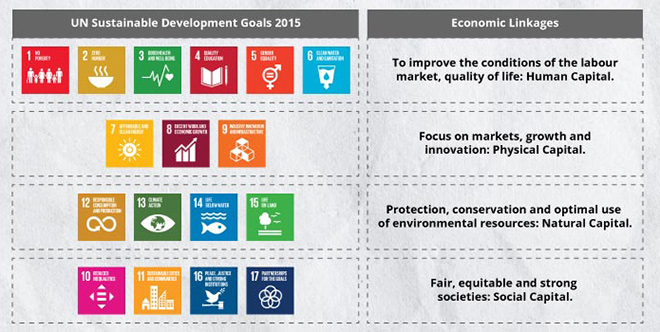
Achieving the SDGs is essential for restoring the post-COVID Indian economy because this could enable conditions for businesses to flourish. This is because these goals are essentially interlinked with different types of capital, as outlined in the following table. The SDGs aim at boosting the potentially available capital that upgrades both input and output market conditions.
The SDGs-business nexus
For countries such as India, the financial gap in implementing the SDGs has always been huge, and is bound to be aggravated by the ensuing economic losses from the coronavirus disaster and the successive lockdowns. Hence, during such circumstances, crowding in the private sector and assistance from the Multilateral Development Banks are seen as crucial instruments to realise the sustainability goals. Although the SDGs cannot be realised without businesses, the reverse causality of how these SDGs drive businesses needs to be acknowledged as well.
The sustainability goals aid businesses in –
a) Decreasing the long-term environmental, political, and social risks,
b) Enhancing transparent governance in tackling sustainability risks and impacts,
c) Creation of new business opportunities that are aligned with the SDGs,
d) Deepening public and private partnership networks which improves market resilience and competitiveness.
The following figure depicts a steady increase in India’s SDG and Ease-of-Doing Business (EoDB) indices in the last five years, establishing indicative evidence of interrelationship between the two.
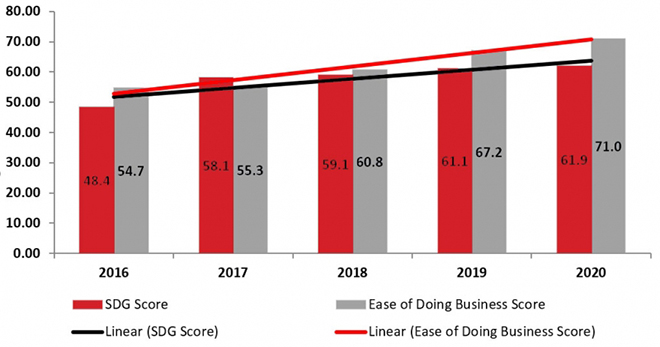
A study by Observer Research Foundation suggests strong econometric evidence where the Indian state-wise SDG scores are also statistically significant in explaining the states’ EoDB and FDI inflows. Log-linear regression results suggests that the SDG index positively contributes to EoDB scores with a slope coefficient of 0.801 at 1 per cent level of significance and adjusted R2 (0.322) values.
The SDG index also has a statistically significant (at 1 per cent level) and positive impact on per-capita FDI with a slope coefficient of 1.194 and adjusted R2 (0.597) values. Hence, SDG parameters could also help the governments to plan their relative development trajectories in the post-pandemic situation – in terms of a holistic variable that reflects much more than the myopic GDP-growth-rate ‘fetishism’.
The Business and Sustainable Development Commission recognises immense business opportunities associated with the SDGs and estimates their aggregate global potential value at US$ 12 trillion in 2030 at current prices. The largest portion of these business solutions lies in developing economies with large markets, such as India. Public-private partnerships associated with these businesses, at both national and international levels, leveraging on individual comparative advantages, are the way forward in catalysing the long-run growth of the fragile Indian markets.
Changing global economic order
This Covid-19 crisis is a strong stimulus for India to look towards regional groupings such as BIMSTEC, SAARC and ASEAN for issue-based objectives – an achievement of the SDGs – to make the economies self-sufficient.
In conclusion, we must note that the inter-dependence between the SDGs and business has immense implications in terms of local action and national policy to cope with the economic ruins from the pandemic. SDGs would not only promote new business opportunities, but more importantly, they would also help in sustaining conducive investment climate in the country. Integrating SDGs in the national development agenda will also have immense implications for contemporary India’s flagship Make-in-India Programme and Atmanirbar Bharat Abhiyan.
This commentary originally appeared in India Inc. Group.







