


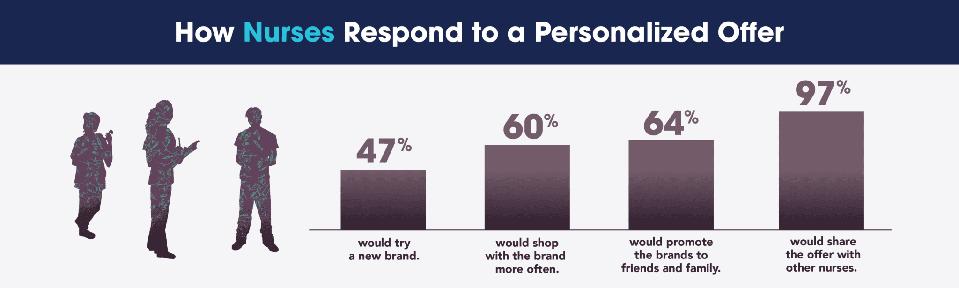
When Chipotle wanted to activate a special offer for Nurses Week, they turned to SheerID for the … [+]
SheerID
In April, Chipotle announced their 4Heroes buy one, give one program to support healthcare heroes across the U.S. But did you ever wonder how Chipotle and other companies are able to verify if the person on the receiving end is actually a healthcare professional? Thanks to Jake Weatherly and the team at SheerID, you do not have to worry. SheerID is the leader in identity marketing, allowing companies to instantly verify eligibility for consumer tribes like nurses, teachers, and college students. I sat down with Jake to learn more about the inspiration for starting the company and why they believe consent-based marketing will be the future of engaging with consumers.
Dave Knox: What was the inspiration behind starting SheerID?
Jake Weatherly: I have a father-in-law who is a military veteran, and my wife is an elementary school teacher. I started to see very similar experiences as they were being marketed to by brands as either a “thank you for your service” or “thank you for what you do in the community.” And then we started to look at the landscape more broadly and saw tons of programs out there specifically designed for college students, for corporate employees, and other consumer groups like first-responders. The list goes on and on.
But we also saw that not only were there a ton of these programs, but the programs were simultaneously full of friction and fraud. Take for example a military program where an organization is saying, “Thank you for your service. Here’s a special offer.” The military service members would get excited about that… until it was time to prove eligibility. These organizations were asking military service members to show up in person with highly sensitive personally identifiable information, like the DD 214, which is the form that the DOD (Department of Defense) issues as you separate from military service, that includes things like your social security number, where you were stationed, all of your certifications, and, in some cases, even your blood type. And so it was just a really strange kind of last mile where brands were effectively saying, “Thank you for your service. Now, please provide us super sensitive information to prove that you are eligible for this special military program.”
I also saw the same thing with my wife as it was time to get the classroom ready during back-to-school and stores were offering special pricing for teachers as a thank you. These programs are great but then the cashier would ask her to show her pay stub from the school to prove she was a teacher. We saw tons of friction, relying really heavily on in-person experience. But we also found the opposite problem where it was really easy to game these programs and claim that you were a student by using an old student ID or a .edu email address that you keep.
So, my co-founder David and I took a step back and asked, “what if there were a software platform that was connected in real time to the authoritative data?” For a student, think about a connection to the actual enrollment database at the university or college. A system where that individual can raise her hand and say, “I want you to check this about me, because I’m excited about what’s on the other side.” We started to pursue these data relationships in 2011 while going to market with a digital verification platform that was real-time, took the friction out of the equation for those who are eligible, but stopped all this fraud from occurring. We have grown the company with that kind of two-sided approach to what’s right for the consumer, we bring them to a brand with invited personalization, and keep fraud out of the equation.
Knox: When you look at the brands that are doing these offers, what is the appeal of an offer to a specific consumer group?
Weatherly: It is almost like a translation service from the old school segmentation, psychographics and demographics approach, to a truer form of personalized marketing where one caters to a group of people that could be defined as a consumer tribe. Think about the highly coveted 18 to 24-year-old market segment globally. The new generation of customers for many brands is Gen Z. They’re a little bit more difficult to engage and authenticity is really important. They do not look at one another and say, “Hey, we’re all in the 18 to 24-year old club.” What we found is college students do associate with one another and recognize one another as part of a tribe. And so messaging, creating a program and inviting college students to participate in something that is truly exclusive to them really sparks word-of-mouth. And, it also creates an opportunity to work with them on their terms. The cultivation, the loyalty, and the word of mouth spreads organically among the tribe. The same psychology holds true for other consumer tribes like the military, teachers or first responders. When a brand in effect says, “We want to reward you for the particular work that you do,” it resonates really powerfully with the members of the tribe.
Knox: What’s an example of a brand that has really been able to use SheerID to reach one of these specific audiences?
Weatherly: In 2014, we launched with the Spotify team a 50% discount for Spotify streaming services exclusive to college students. And since then we have taken that program global. More recently, the team at Chipotle approached us as they were preparing to give away burritos to nurses and doctors on Nurses Day. We worked with them really quickly to build a pay-it-forward program. And what that means is, everybody who was ordering from Chipotle had the opportunity to nominate a frontline healthcare worker to get a free meal. And in about two hours, we processed over 100,000 free burritos that went to nurses and doctors who are helping during this pandemic.
Knox: With growing privacy concerns among consumers, it seems like this is an opportune time to do more in the way of consent-based marketing. What are your thoughts on that?
Weatherly: There is no doubt in my mind that consent-based marketing is where digital marketing is headed. We recently commissioned a report from Forrester Consulting on the topic of personalization and privacy. Their top-line finding was that personalization was the top strategic initiative for B2C marketers. Marketers are really struggling to collect and manage and act on data. That’s the bad news. The good news is that brands are now discovering that consumers are willing to provide information on who they are what they are interested in, if there’s a clear reason to do so. That is, if there’s compelling and measurable value on the other side. Brands like Spotify are creating new relationships with millions of consumers who share an affiliation, such as being a student. For other brands, a tribe could consist of an occupation or life stage, such as being a senior. Members consent to be verified that they’re part of the tribe in exchange for a personalized offer for their specific consumer group. Through this approach, consumers have control over the personalized marketing experience and their data.
In addition to building trust with the consumer, it also gives the marketer high quality data they can trust for future communications. As marketers, we know that third-party data is notoriously inaccurate, compared to self-attested consumer-generated data. So, I think we’re headed toward a future where marketers rely more on consumer-generated data. I also think marketers will increasingly gravite towards various forms of “invited personalization,” and less on what might be called “surveillance marketing.” Gone will be the days of buying data, appending a record, crossing your fingers that there is some level of accuracy there and then following somebody in the digital world until they convert.
Knox: Does this approach work best for one-time offers or more ongoing relationships with a tribe of consumers?
Weatherly: We definitely find that an evergreen program that is “always on” is the best way to go. However, we also support customers that do campaign-based marketing. A lot of times they’ll start with a pilot program as a test. And then other times it comes down to the uniqueness of the campaign or marketing calendar specific to a given tribe. So, for example, think about how you might approach active duty military and veterans at specific points throughout the year with an offer to the tribe. You might choose to double down during Veterans Day weekend, 4th of July, as well as on some of the less-publicized days that are important to this group, such as the anniversary of the formation of the Marines. These are the moments when these kinds of programs are top of mind. And, thus a really good time to come in with a campaign in order to gauge the value of marketing to the tribe.
We also find that our customers have a lot of success when they celebrate the special times in the lives of their customers. For example, think about getting ready to go to college as a freshman. Think about all of the things that you have to do after high school graduation – obviously pre-pandemic – under the assumption that campuses are going to open up and kids are going to move into dorms and apartments. There are all those purchases that you are making, all of that prep. As a marketer, there is a window of time with that unique audience where if you can work with students and you can work with households by offering valuable and unique offers, you can create customers for life.
Knox: You mentioned that one of your goals was to stop the fraud of old school programs. What percentage are you seeing get denied when a person’s trying to request an offer, but they don’t necessarily qualify?
Weatherly: In some of these consumer tribes, you can chalk it up to kind of little white lies vs fraud. Many people have an old .edu email address, even though they are not enrolled. And when .edu is asked for, they will put it in and give it a shot. Sometimes it’s actually the person behind the cash register who does not want to confront the customer and question their eligibility. It’s interesting how far people will go to get into a special program. So there are lots of different ways that we see fraudsters, whether individual consumers or more sophisticated fraud rings where they are trying to get in and get discounted products, or coupon codes that they can sell on some secondary market. Or, in other cases, get free tickets to an event that they can then sell and charge for. I mean, it goes on and on and as these programs and these offers get more valuable, and as we work with higher profile brands, we definitely see the more sophisticated fraudsters come in and try to find holes in the armor.
Across all of our consumer tribes, roughly 35% of attempts are fraudulent. Based on the brands we serve, we estimate the margin savings on preventing or eliminating this fraud is literally several billion dollars each year. But, preventing fraud is only part of the solution that we provide for brands and consumers. The bigger story is how we help brands build relationships with new customers based on honoring the individual’s service or status in society. We’ve brought tens of millions of consumers together with brands every year. And we expect that trend to continue to multiply.







