


In recent years, considerable attention has been given to how Facebook collects and uses its users’ data. One of the ways the popular online platform collects and categorizes user data is through ad preference pages. The pages list users’ perceived interests – which are generated by the site’s algorithm – and are available for users to review their presumed hobbies, characteristics and traits. These categories, for example, might include the users’ political leanings or their cultural interests.
In a Pew Research Center survey conducted Sept. 4-Oct. 1, 2018, Facebook users were directed to open and review their own ad preference page in order to complete the survey. That survey found that roughly nine-in-ten U.S. adults who use Facebook reported that they had information compiled about them on their Facebook ad preferences page. But a new analysis of this data finds that how Facebook categorizes these users, when it comes to the number of categories and their accuracy, varies by how often someone uses the platform.
Here are key findings from that analysis:
1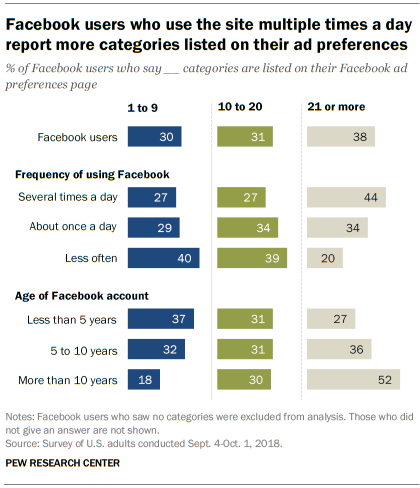 Frequent Facebook use – as well as having an account for a longer period of time – generally results in more ad categories. Nearly four-in-ten Facebook users (37%) who saw categories listed on their ad preferences page found 21 or more categories, whereas 30% found one to nine categories. When accounting for how often they use the site, some 44% of Facebook users who said they use the site several times a day reported finding 21 or more categories listed on the ad preferences page, compared with 34% of those who use the site once a day and 20% of those who said they use the site less often.
There are also differences when it comes to how long a user has been on Facebook. The longer a person has had an account on the platform, the more categories Facebook lists for them. About half of users with Facebook accounts that were more than a decade old (52%) at the time of the survey reported finding 21 or more categories listed on their ad preferences page. In comparison, 36% of accounts 5 to 10 years old and 27% of accounts less than 5 years old had more than 20 categories listed. About a third of accounts less than a decade old had fewer than 10 categories listed on the ad preferences page, whereas only 18% of accounts over a decade old had fewer than 10 categories listed.
2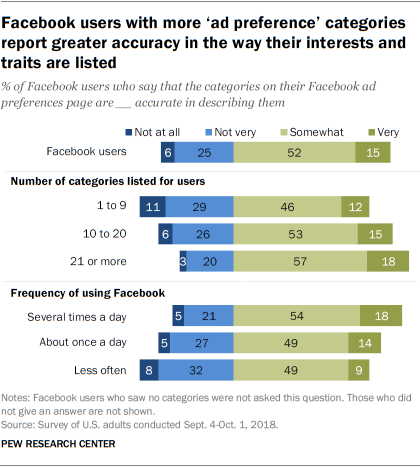 Having more categories and frequently using Facebook are associated with greater accuracy. Three-quarters of Facebook users with 21 or more categories said these categories are very or somewhat accurate. But for users reporting fewer than 10 categories shown for them, that share dropped to about six-in-ten (58%).
Similarly, adults who use Facebook multiple times a day were more likely to say that the information on the ad preferences page at least somewhat accurately represents them than people who don’t use Facebook daily (72% vs. 58%). However, fewer than 20% of users – regardless of the frequency with which they use Facebook – said the categories are “very” accurate.
There are no differences related to perceived accuracy of the assigned categories based on the age of a user’s Facebook account. Adults who have had a Facebook account for a longer period of time have provided Facebook’s algorithm with data over a longer period, but there is a possibility that older information may be less relevant when it comes to the user’s current interests. About two-thirds of adults in each group – accounts less than 5 years old (69%), 5 to 10 years (66%) and 10 or more (67%) – reported that the information is at least somewhat accurate.
3Changing privacy settings does not appear to affect the amount or accuracy of categories. Facebook allows users to change their privacy settings to manage who can see their site activity and how their data can be used. There are no substantial differences in the number of ad preference categories listed for a user or the accuracy of those categories based on having changed privacy settings in the past year. (Many privacy settings on Facebook only change what other users can see regarding someone’s activities on Facebook. They do not prevent Facebook from seeing this activity or using it to make ad preference listings for advertisers.)
According to Facebook’s website, users can change or delete targeted advertising preferences on their ad preferences page. However, only 14% of Facebook users surveyed knew this page existed prior to completing this survey. Those who reported having changed their privacy settings in the past year were more likely than those who hadn’t changed them to have known about the ad preferences page (17% vs. 10%), but they were still in the minority of users. This suggests that people who said they had changed their privacy settings in the past year were likely not referring to ad preference settings.
4Those who use Facebook frequently and those who feel they are listed accurately in its ad preference categories are more comfortable with the ad preferences listed about them. Roughly four-in-ten users said they are at least somewhat comfortable with this list being made. Those who use Facebook several times a day were somewhat more likely to report comfort with the existence of this list than non-daily users (44% vs. 34%). In addition, half of users who found the list at least somewhat accurate were at least somewhat comfortable with this list being made (52%), compared with 21% of those who felt the categories describe them not very or not at all accurately.
Note: See full topline results and methodology.







