

The true number of coronavirus cases in the U.S. could be anywhere from six to 24 times higher than the confirmed number of cases, depending on location, according to a large federal study that relied on data from 10 U.S. cities and states.
The vast majority of Americans, however, are still vulnerable to Covid-19.
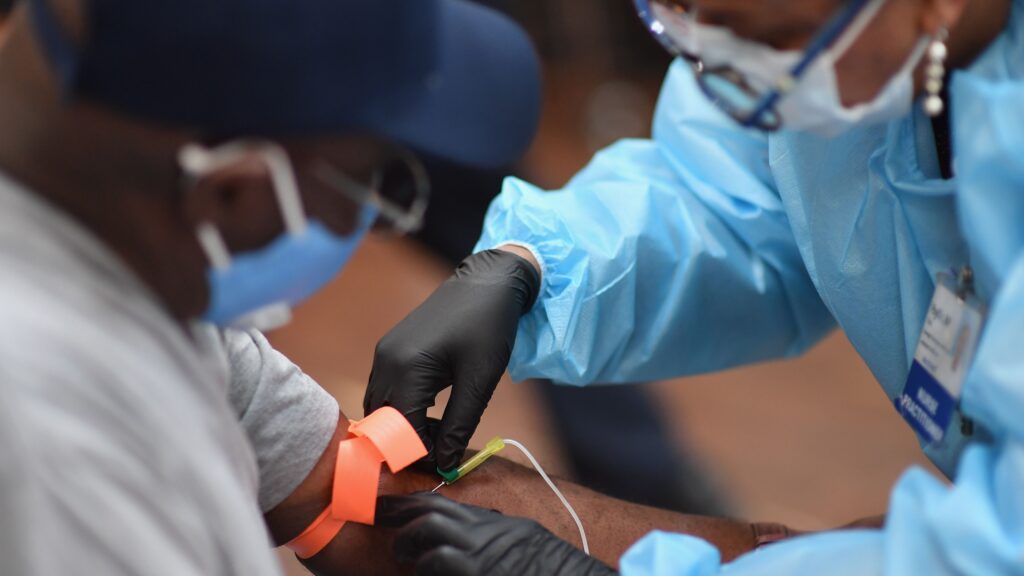
The study, published Tuesday in JAMA Internal Medicine, relied on serological tests — blood screens that search for antibodies to the virus and that determine whether someone was previously infected. They are different from diagnostic tests, which only detect people who currently have the virus, called SARS-CoV-2.
advertisement
Overall, an estimated 1% of people in the San Francisco Bay Area have had Covid-19, while 6.9% of people in New York City have, according to the paper’s authors, who included researchers at the Centers for Disease Control and Prevention and state health departments. In seven of the 10 sites, the estimated number of cases was 10 times the number of reported cases.
The study was based on tests from more than 16,000 people across the 10 sites, but one limitation is that it relies on old data. The San Francisco samples were collected from April 23 to 27, while the New York tests were on blood from March 23 to April 1. The latest tests were conducted in May, and a lot can change during two months in the course of an outbreak. In South Florida, for example, researchers estimated that 1.9% of the population had antibodies to the virus. But that figure is based on samples collected from April 6 to 10, and given the spread of the virus since then in the state, the number now would certainly be some amount higher.
advertisement
Still, the data reflect what CDC Director Robert Redfield recently said — that true case numbers are 10 times higher than confirmed diagnoses. Confirmed cases in the U.S. stand at more than 3.8 million.
The data underscore two other points: that testing in the U.S. is not capturing the full scope of the outbreak, and that even hard-hit communities are not close to reaching a herd immunity threshold — where enough people are immune from the virus (which scientists expect will happen for some amount of time after an initial infection) to slow down its spread to the point that unprotected people have a natural buffer.
“The study rebukes the idea that current population-wide levels of acquired immunity (so-called herd immunity) will pose any substantial impediment to the propagation of SARS-CoV-2 in the U.S., at least for now,” infectious disease experts Tyler Brown and Rochelle Walensky of Massachusetts General Hospital wrote in an editorial accompanying the study. Experts estimate that 60% to 70% of people in a given area would need to be protected from the virus — either through recovering from an infection or vaccination — to reach herd immunity.
Other locations included in the study and the estimated levels of antibodies in their residents:
- Western Washington: 1.1%
- Louisiana: 5.8%
- The Philadelphia area: 3.2%
- Missouri: 2.7%
- Utah: 2.2%
- Connecticut: 4.9%
- The Minneapolis-St. Paul area: 2.4%
Overall, the researchers found that there was no association between infection rates and age or sex.
The results fit with other serosurveys that have found just a few percent of people in a given place have been infected with the SARS-CoV-2 virus, which causes the disease Covid-19. There have been a few outliers: One study in the hard-hit Boston suburb of Chelsea estimated that 30% of people had been exposed to the virus, while another survey in a German town where a carnival drove an outbreak found 14% of residents had antibodies.
Still, the new study landed on different estimates for New York City than a state-run survey released in April, which found that 1 in 5 people in the city had antibodies. The disparate results highlight how study design — such as how participants are recruited or what blood samples are included — can influence findings.
The new study relied on leftover blood samples collected from patients who sought medical care for any reason from March through May. Because so many appointments and procedures were canceled then, and because so many people were avoiding medical care during stay-at-home periods, the samples “are likely not representative of a typical prepandemic cohort,” Brown and Walensky wrote.
Experts note that the inability of diagnostic testing to keep up with cases is not just limited to problems with the tests, which have included a botched rollout, overwhelmed labs, and supply shortages. It’s also that some 20% to 40% of Covid-19 infections are asymptomatic. Those people can still spread the virus, as can people who eventually develop symptoms but don’t feel sick yet — which has complicated efforts to rein in the spread.
Researchers also stress that it’s still not confirmed if people who recover from Covid-19 are protected or for how long, or what levels (or titer) of antibody would be required to confer immunity. Some people with Covid-19 may not generate a robust antibody response, perhaps depending on how sick they get, though that remains an open question as well.
“At present, the relationship between detectable antibodies to SARS-CoV-2 and protective immunity against future infection is not known,” the study’s authors wrote. “Extrapolating these estimates to make assumptions about population immunity should not be done until more is known about the correlations between the presence, titer, and duration of antibodies and protection against this novel, emerging disease.”







