

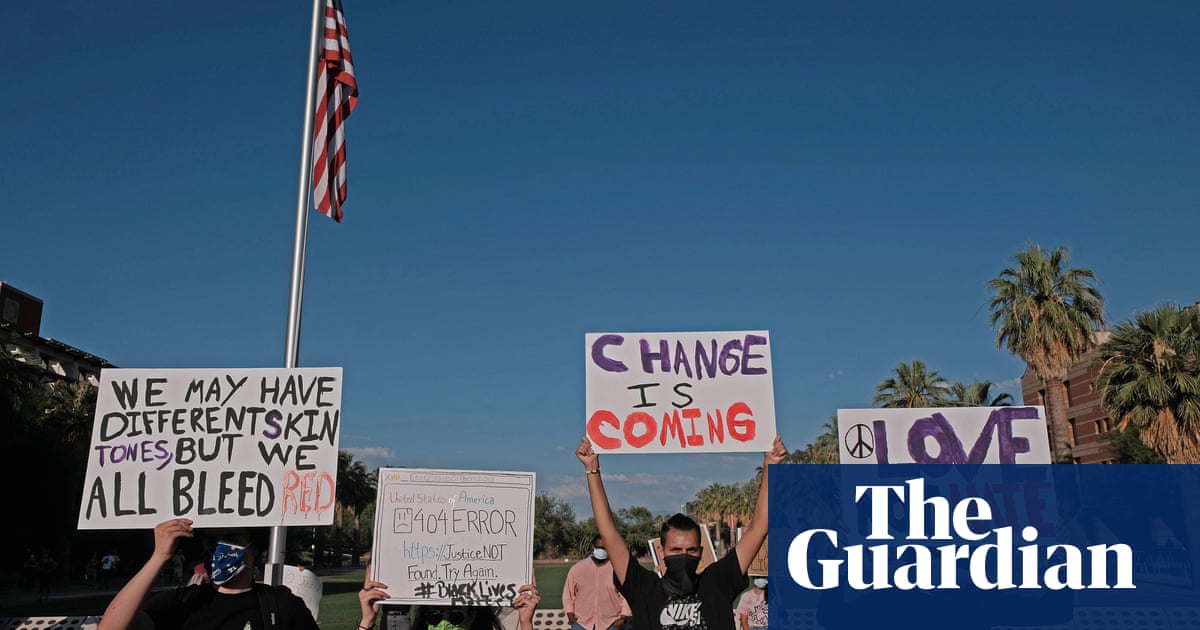
Ten years ago, Arizona enacted one of the strictest and most contentious immigration measures in the nation – the so-called “show me your papers” law – and a generation of young Latinos revolted.
Hundreds of Latino activists and high school students marched through the streets of downtown Phoenix, to protest against a piece of legislation they believed authorized police to discriminate against anybody who looked like them. That was SB 1070.
“We were optimistic that we could stop [then governor] Jan Brewer from signing that bill,” said Raquel Terán, who joined protesters at the state capitol that day. “Obviously we didn’t, but it showed that we had the capacity to mobilize our communities.”
Today Terán works in the copper-domed capitol building where she used to protest. She was elected as a Democrat in 2018 to represent a majority-Hispanic district in the Arizona house of representatives.
The decade-long backlash to the immigration law, accelerated by the election of Donald Trump, demographic change and population growth, is reshaping the state’s political landscape, turning one of the last conservative bastions of the south-west into a battleground that could determine control of the White House and the Senate.
With less than four months until the election, polls show Democratic presidential candidate Joe Biden ahead of the president in Arizona, a state Trump won in 2016 by fewer than four percentage points, a far narrower margin than past Republican nominees. Then, in 2018, in November’s midterm elections, young Latino voters cast votes in record numbers, joining white moderates in the suburbs, to elect Kyrsten Sinema – the first Democrat to win a US senate seat in Arizona in decades.
In this year’s Arizona Senate race, several surveys have found Democrat Mark Kelly, a former astronaut and husband of former congresswoman Gabby Giffords, polling ahead of the Republican incumbent Martha McSally, who was appointed to the seat after the death of John McCain in 2018.
While Trump’s embrace of hardline, anti-immigrant rhetoric seemed to rally his base in the midwest, operatives in both parties believe it has hurt him in Arizona, a border state where many Republicans were trying to move beyond the divisive politics that had tarnished their brand with Latino voters.
When lawmakers in 2010 introduced SB 1070, which included a provision requiring law enforcement to determine the immigration status of anyone officers had “reasonable suspicion” to believe was in the country illegally, the political, economic and cultural backlash was swift. Businesses, sports teams, musicians, even the city of Los Angeles, boycotted the state, and Jon Stewart mocked it as the “meth lab of democracy”. The law remains in effect, though lawsuits and court rulings curtailed its most controversial elements.
“There was political overreach from the right, and SB 1070 was the straw that broke the camel’s back,” said Marisa Franco, the co-founder of the social justice advocacy group Mijente. “It awakened an electorate that’s, I think, more justice-minded.”
After the death of George Floyd in May, Black Lives Matter protests spread from diverse cities like Phoenix and Tucson to largely white, conservative corners of the state such as Fountain Hills and Kingman.
“I think it’s very possible for Arizona to turn not just blue, but even a shade further,” Franco said. “There’s potential for Arizona to support not just the most moderate Democratic agenda, but go beyond that.”
Arizona, home to Barry Goldwater, the senator and 1964 Republican presidential nominee considered the godfather of modern conservatism in America, has long eluded Democrats.
No Democratic presidential candidate has won the state since 1996, and between 2008 and 2018, no Democrat was elected statewide at any level. Now, the Grand Canyon state is a top target for the Biden campaign.
In recent years, an influx of new residents from more liberal states like California, and a growing electoral clout of Latinos, have slowly shifted Arizona’s political landscape, as its population becomes more diverse and less rural. Yet a key factor driving its competitiveness this cycle are the residents living in the Valley’s famous suburban sprawl, who are abandoning the Republican party.
“SB 1070 turned on this radical element in the Republican party that started pushing out moderates and replacing them with very rabid, Anglo anti-immigrant Republicans,” said Arizona congressman Ruben Gallego, who was among the Latino activists swept to elected office in the years after the law went into effect.
“Now you have a generation of young Latinos who are starting to vote aligning with a new coalition of moderate suburban women.”
The trick for Democrats, Gallego added, is how to mobilize the young Latinos demanding systemic change without alienating white moderates craving stability and leadership.
Another reason for Democratic optimism in the state is the boiling frustration over the handling of the coronavirus pandemic by Trump and Arizona’s Republican governor Doug Ducey.
Arizona is facing one of the worst outbreaks in the nation, after the state raced to reopen bars, restaurants and businesses. More than 143,600 people have contracted Covid-19 in Arizona, overwhelming hospitals. Maricopa county, which encompasses Phoenix, has ordered multiple refrigerated trucks as morgues reach capacity.
Ducey initially prevented local governments from setting their own coronavirus-related policies but reversed course in mid-June, as cases and hospitalizations rose sharply. In July, he asked the Trump administration to send hundreds of healthcare workers to the state to help.
As elsewhere, the pandemic has exacted a disproportionate toll on Arizona’s Black, Latino, and Native American residents. In a widely-shared obituary published by the Arizona Republic, a daughter blamed her father’s death from Covid-19 on “the carelessness of the politicians who continue to jeopardize the health of brown bodies through a clear lack of leadership”.
What remains unclear is the extent to which anger will propel Latino voters to cast ballots. In 2016 and 2018, Latinos voted at higher rates than in previous elections but organizers have warned that Democrats must invest more deeply in turning out this critical constituency.
Strategists believe the playbook for Democrats to be successful in the state is moderation and an appeal to bipartisanship. In a post-mortem memo drafted after McSally’s 2018 loss, her campaign noted that Sinema had “hugged McCain tightly, and never once had the word ‘Democrat’ in a TV advertisement”.
Stan Barnes, a conservative consultant and former Arizona state senator, said: “The only way to win statewide as a Democrat in Arizona is to act like you’re not a Democrat.”
Barnes is skeptical that Republicans are headed for a political reckoning in November. He said Democrats have moved too far left for a state that remains largely in Republican control. Particularly on issues like policing, Barnes said Democrats are at risk of alienating white moderate voters who have historically sided with the “law-and-order side of the equation”.
Trump has staked his candidacy on a message of “law and order,” despite dramatic shifts away from his views on issues of race and policing in America. In a naked appeal to white suburban voters this week, the president said that a Biden presidency would “obliterate” their way of life, declaring: “Suburbia will be no longer as we know it.”
But in a sign Trump sees a fight in the desert, he has visited the state twice in two months, once in May to tour a plant producing respiratory masks and again for a rally in June, as coronavirus cases rose sharply in the state.
Because Latino voters in Arizona tend to overwhelmingly support Democratic candidates, whether or not the state will turn blue, “really hinges on turnout,” said Lisa Sanchez, a political scientist at the University of Arizona.
“You’d think during the election of Donald Trump, we would have seen even more mobilization,” Sanchez said. “You’d think all the anti-immigrant anti-Latino rhetoric would have fired people up.”
Activists have been laying the groundwork for years, led by groups like One Arizona, a coalition of organizations focused on Latino civic engagement that was formed in the wake of SB 1070. Tried and tested methods like voter registration and canvassing helped power Democratic gains in 2018 – and, they hope, will dramatically reshape the electorate in 2020.
“Our folks were those people that would potentially not vote – not because they didn’t want to, but because they just simply didn’t know how to or there was a language barrier,” Liz Zamudio, One Arizona’s deputy field director said.
Immigration is a priority for many Latino voters in the state but so too are healthcare and education, Zamudio said, especially as the coronavirus devastates their communities and a debate rages over when to return children to schools.
Yet organizers and strategists have expressed concern that Democrats are not doing enough to mobilize young Latino voters, particularly in swing states like Arizona, where they could determine the outcome.
Josh Ulibarri, a Phoenix-based Democratic pollster, said he has spent the past six weeks surveying voters in Arizona, conducting thousands of interviews from across the state. “I’ve yet to pull a survey out of a field where I felt comfortable with where we are with Latino voters,” he said, adding: “I am really worried about enthusiasm. And I’m really worried about motivation.”
In recent weeks, Biden has scaled up his Latino outreach efforts while building out his operation in the state. Priorities USA, the main pro-Biden Super Pac, announced it is investing $24m in a mobilization and vote-by-mail effort targeting Black and Latino voters in battleground states, including Arizona.
For liberal activists in Arizona, a surge in Latino turnout would be the ultimate repudiation of the nativist politics that defined their youths. The success of candidates like Terán in 2018, they say, is a testament to the years they spent building a grassroots movement.
Born in Douglas, Arizona, Terán was raised on the Mexican side of the border and crossed into the US every day for school. Alarmed by what she saw as rising hostility to immigrants in her state, Terán’s first political act was to register Latino voters. Years later, she asked for their vote.
Days after winning her seat, Terán was served a lawsuit challenging her citizenship in court.
She saw it as a strain of the birther movement, promoted by Trump, that questioned the citizenship of Barack Obama, the nation’s first black president. The case was dismissed but for Terán and her supporters, it was a reminder of the formidable opposition that still exists in Arizona.
“Ten years ago I was standing outside the capitol with a megaphone,” she said. “Now I have a microphone and a seat at the table.”







