

Conservation help from genomics
Corals worldwide are under threat from rising sea temperatures and pollution. One response to heat stress is coral bleaching—the loss of photosynthetic endosymbionts that provide energy for the coral. Fuller et al. present a high-resolution genome of the coral Acropora millepora (see the Perspective by Bay and Guerrero). They were able to perform population genetic analyses with samples sequenced at lower coverage and conduct genome-wide association studies. These data were combined to generate a polygenic risk score for bleaching that can be used in coral conservation.
Structured Abstract
INTRODUCTION
Coral reefs worldwide are suffering losses at an alarming rate as a result of anthropogenic climate change. Increased seawater temperatures, even only slightly above long-term maxima, can induce bleaching—the breakdown of the symbiotic relationship between coral hosts and their intracellular photosynthetic dinoflagellates from the family Symbiodiniaceae. Because these symbionts provide the majority of energy required by the coral host, prolonged periods of bleaching can eventually lead to the death of the colony. In the face of rapidly increasing temperatures, new conservation strategies are urgently needed to prevent future mass losses of coral cover, and these benefit from an understanding of the genetic basis of bleaching.
RATIONALE
Bleaching responses vary within and among coral species; in the reef-building coral Acropora millepora, a commonly distributed species across the Indo-Pacific, these differences have been shown to be at least partly heritable. In principle, therefore, interindividual differences in bleaching should be predictable from genomic data. Here, we demonstrate the feasibility of using a genomics-based approach to predict individual bleaching responses and suggest ways in which this can inform new strategies for coral conservation.
RESULTS
We first generated a chromosome-scale genome assembly as well as whole-genome sequences for 237 samples collected at 12 reefs distributed across the central Great Barrier Reef during peak bleaching in 2017. We showed that we can reliably impute genotypes in low-coverage sequencing data with a modestly sized reference haplotype panel, demonstrating a cost-effective approach for future large-scale whole-genome sequencing efforts. Very little population structure was detected across the sampled reefs, which was likely the result of the broadcast spawning mode of reproduction in A. millepora. Against this genomic background, we detected unusually old variation at the heat-shock co-chaperone sacsin, which is consistent with long-term balancing selection acting on this gene. Our genomic sequencing approach simultaneously provides a quantitative measure of bleaching and identifies the composition of symbiont species present within individual coral hosts. Testing more than 6.8 million variants for associations with three different measures of bleaching response, no single site reached genome-wide significance, indicating that variation in bleaching response is not due to common loci of large effect. However, a model that incorporates genetic effects estimated from the genome-wide association data, genomic data on relative symbiont species composition, and environmental variables is predictive of individual bleaching phenotypes.
CONCLUSION
Understanding the genetics of heat and bleaching tolerance will be critical to predict coral adaptation and the future of coral reef ecosystems under climate change. This knowledge also supports both conventional management approaches and the development of new interventions. Our work provides insight into the genetic architecture of bleaching response and serves as a proof of principle for the use of genomic approaches in conservation efforts. We show that a model based on environmental factors, genomic data from the symbiont, and genome-wide association data in the coral host can help distinguish individuals most tolerant to bleaching from those that are most susceptible. These results thus build a foundation toward a genomic predictor of bleaching response in A. millepora and other coral species.

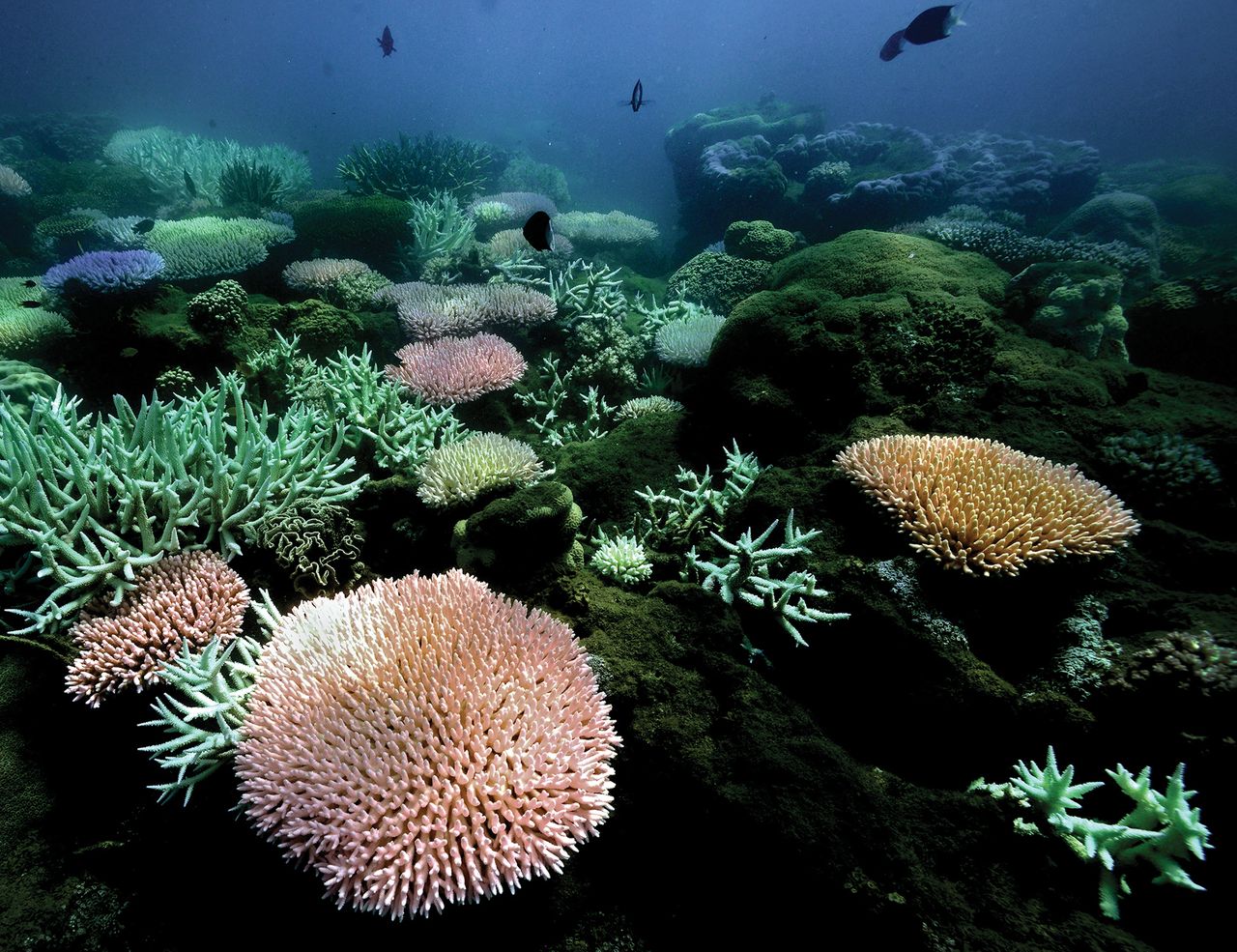
A. millepora colonies presenting various severity of bleaching during March 2017 at Feather Reef on the Great Barrier Reef. Colonies with a greater severity of bleaching are those with the most pale colors. Prolonged periods of bleaching can lead to the eventual death of the coral host.
PHOTO: ERIC MASON/AUSTRALIAN INSTITUTE OF MARINE SCIENCE
Abstract
Although reef-building corals are declining worldwide, responses to bleaching vary within and across species and are partly heritable. Toward predicting bleaching response from genomic data, we generated a chromosome-scale genome assembly for the coral Acropora millepora. We obtained whole-genome sequences for 237 phenotyped samples collected at 12 reefs along the Great Barrier Reef, among which we inferred little population structure. Scanning the genome for evidence of local adaptation, we detected signatures of long-term balancing selection in the heat-shock co-chaperone sacsin. We conducted a genome-wide association study of visual bleaching score for 213 samples, incorporating the polygenic score derived from it into a predictive model for bleaching in the wild. These results set the stage for genomics-based approaches in conservation strategies.







