

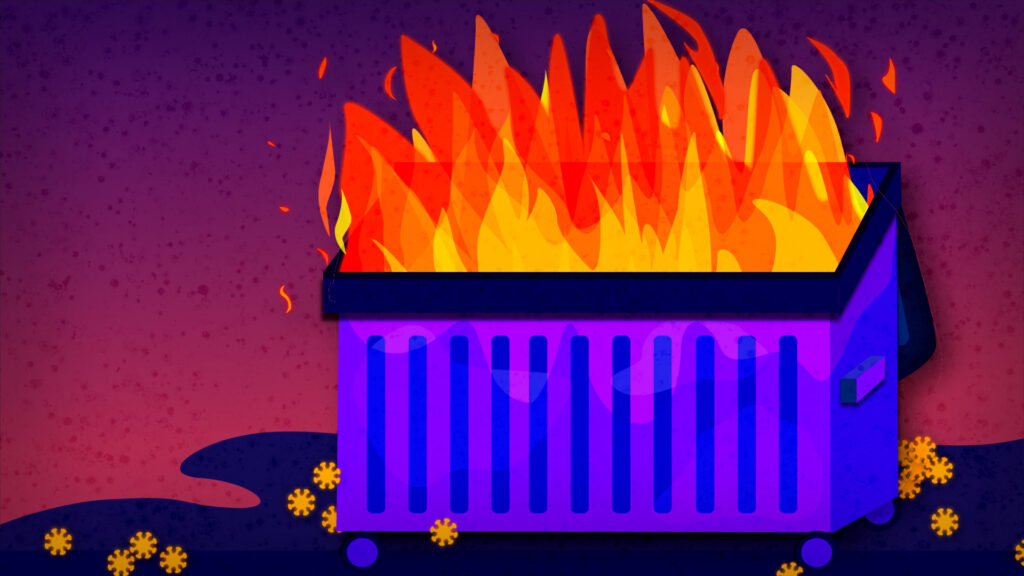
There’s no point in sugar-coating this. The U.S. response to the Covid-19 pandemic is a raging dumpster fire.
Where a number of countries in Asia and Europe have managed to dampen spread of the SARS-CoV-2 virus to the point where they can consider returning to a semblance of normalcy — friends from Paris just emailed me pictures from their Sicilian vacation — many international borders remain closed to Americans.
On Sunday, Florida reported more than 15,000 cases — in a single day. South Korea hasn’t registered 15,000 cases in the entire pandemic to date. One day last week the U.S. recorded more than 68,000 cases.
advertisement
The website Covidexitstrategy.org has updated its previously tri-colored U.S. map, which showed states as either green, signifying they are trending better; yellow, making progress; or red, trending poorly. A fourth designation, called “bruised red,” signals states with uncontrolled spread; criteria for this category includes hospitals nearing capacity both in terms of overall beds and ICU space. Already 17 states are wearing bruised red.
The virus suppression gains earned through the painful societal shutdowns of March, April, and May — the flattened epidemiological curves — have been squandered in many parts of the country, dejected public health experts agree. A vaccine for the masses is still months away. What can be done?
advertisement
One thing is clear, according to public health experts: Widespread returns to lockdown must be a last resort — and may not be doable.
“It would be really a morale breaker,” Anthony Fauci, director of the National Institute for Allergy and Infectious Diseases, told STAT. “The stress and strain that people were under during prolonged lockdown is the genesis of why, when they were given the opportunity to try and open up, they rebounded so abruptly. Because what I think happened is, they overshot.”
But this is not a binary choice between societal lockdowns and the “party like it’s 2019” approach that put the country in the bind it’s in now. With that in mind, STAT asked a number of public health experts for a single suggestion of how we get ourselves out of this mess. We got lots.
None is a magic bullet. This is going to be a painful and slow process. But there are things individuals, public health departments, state and local governments, and the Trump administration can do.
The fire brigade needs us all.
Turn the clock back
Pent-up people embraced newfound freedoms over-exuberantly, Fauci said. He suggests going back to Phase 1 of the reopening process and then working forward with more caution. “Do it the way they should have done it in the beginning,” he said.
“If we do that, particularly closing the bars, avoiding anything that has a congregation of a large number of people, wearing masks outside essentially all the time, keep distancing … I would almost guarantee that we would see a turnaround of the resurgence that we’re seeing now.”
Embrace al fresco living …
Ashish Jha, director of Harvard’s Global Health Institute, favors banning all indoor public activities that bring together groups of people, for now — including church services.
“My best read of the data is that a large chunk of the transmission is happening when people gather indoors. So, cut out the indoors. No restaurants, no bars, no nightclubs, obviously no schools right now,” Jha said.
He’d close stores, except pharmacies and grocery stores, and require those to limit the number of people they admit at any one time. Staff and customers would have to wear face coverings.
… but tailor tools to local settings
Saskia Popescu, an infection prevention epidemiologist at the University of Arizona, thinks advice like this needs to be pragmatic and take into account that conditions vary across the country. Like where she lives, in sweltering Phoenix.
“Everyone likes to say ‘eat outside!’ she notes. “You can’t do that in 115 F heat, so let’s give people the tools to apply infection prevention strategies for these environments.”
“Social responsibility is huge, but if we don’t do effective risk communication and education, you’re failing people,” Popescu said.
Get creative with risk communications
Marm Kilpatrick listens to a lot of NPR. On NPR, he hears a lot of public service announcements from the Centers for Disease Control and Prevention urging people to cover their coughs, wash their hands, practice social distancing. Kilpatrick, an infectious diseases dynamics researcher at the University of California, Santa Cruz, thinks most of that advice is, by now, not useful.
People should be wearing masks, so by definition coughs are covered. (Plus, people who are coughing should be staying home.) Fomites — viruses coughed onto surfaces — are no longer thought to be a major mode of transmission. And people don’t really get how to social distance except “avoid strangers,” he said.
They need better, more useful messages telling them how to do the things they want to do, but safely. Kilpatrick gives it a go: “Wear a mask. Meet outside. Give space.”
Teach people to think in terms of harm reduction
“One thing I notice is that when people ask me a question, they say ‘yet.’ ‘Can I do this yet?’’’ said Amesh Adalja, an expert on emerging infectious disease and pandemic preparedness at Johns Hopkins. “And I say, ‘There is no ‘yet.’”
He suggests borrowing a page from the harm reduction work that has been done to address sexually transmitted diseases and the opioid epidemic — helping people figure out the risks they face and how to navigate them.
“We have to get better at individual risk calculus,” Adalja said. “It’s not something that people are very good at. And I think that’s why when bars opened in certain places it was like the whole town turned 21.”
Accept that for now the virus has the upper hand
We need to learn to live with SARS-CoV-2, said Michael Osterholm, director of the University of Minnesota’s Center for Infectious Diseases Research and Policy.
Pretending the virus is not a threat or trying to will it away is a recipe for disaster. “You have less chance of winning a policy debate against this virus than you do of … winning a debate against 2,000 angry 2-year-olds,” Osterholm said.
“People have to understand that. It’s like trying to defy gravity. Just because you want to doesn’t mean you can.”
Mine the data more efficiently
Public health is amassing lots of information about who is getting sick and where they’re getting infected. That data should be put to better use, said Caitlin Rivers, an assistant professor of epidemiology at the Johns Hopkins Center for Health Security.
“We can use that information to better direct resources and interventions, for example by closing high-risk activities rather than broad shutdowns,” Rivers said. These kinds of analyses will need to be ongoing, because conditions will change, and should be made public to help people assess their personal risks and guide their decision-making.
Cloudy with a chance of Covid
Data mining could be used to develop local forecasting services, said William Hanage, an epidemiologist at Harvard’s T.H. Chan School of Public Health.
He envisages something like: “Covid activity in your area is currently low. While the risk is not zero, all you need to do is wear a mask while indoors in a public space,” or “Covid activity is expected to be very high and you are advised to shelter in place. Please avoid contact with at-risk persons.”
Consistent consistency
Enough with the “but the flu” and “it’s getting better” and “it’s going to go away on its own” talk. There needs to be consistent communications from all levels of government about the risk the virus poses, said Alessandro Vespignani, director of the Network Science Institute at Northeastern University.
“I know it sounds trivial,” Vespignani said, “but I have the feeling that is impossible to win the fight if a large fraction of the population is not believing there is something to fight.”
Cut out the politics
With more than six months’ worth of experience with Covid-19, the world has good evidence about what works to suppress spread of the virus. All levels of government should be urging people to take those steps, said Tom Inglesby, director of the Center for Health Security at Johns Hopkins.
“If leaders from this point forward spoke with the same messages, consistently, clearly, without division, they likely have the power to change the views of many who have been less convinced of the right things to do because of conflicting, confusing messages they have been hearing,” he said.
Leaders should also practice what they preach — masks in public, avoiding large gatherings — and be guided by science, Inglesby said.
Provide more help for the hardest hit
Black, Latinx, and Native American communities have been disproportionately hard hit by this pandemic, said Richard Besser, president and CEO of the Robert Wood Johnson Foundation. And too little has been done to ensure that essential workers, many in low-paying jobs, have the tools to protect their health and the health of their families and communities.
Fixing this means providing income support so people who are sick or exposed can stay home, and ensuring they have sick leave and family medical leave. It also means funding unemployment insurance for the millions of people who have lost their jobs in the pandemic, and extending rent forgiveness and moratoriums on evictions and foreclosures, Besser said, as well as providing safe places for people who need to isolate or quarantine but don’t have the space to do it at home.
Pop-up testing sites
Natalie Dean said more geographically focused testing would turn up cases that are being missed. And bringing the tests to where the people are would result in a lot more people being tested. Dean, an assistant professor of biostatistics at the University of Florida, said more mobile testing vans could help identify where transmission is happening. That’s a different approach than the efforts to find and quarantine people who have been contacts of confirmed cases.
“So, it is less about using tracing to reconstruct a chain, and more about identifying a hot spot and trying to flood the area with tests,” she said.
Daily home testing, on Uncle Sam
Low-cost — $1 a day or less — home testing for Covid-19 is doable, said Michael Mina, a Harvard epidemiologist and associate medical director of clinical microbiology at Boston’s Brigham and Women’s Hospital.
“The tests exist. The technology exists. They could be manufactured tomorrow and they would detect people on the days that they are most likely to be transmitting,” Mina said.
These tests aren’t as sensitive as laboratory tests — they miss some cases — but they have the advantage of giving an instant answer. The turnaround for lab testing can be a week. If everyone in a high transmission zone could test themselves daily and stay home while they test positive, it would dramatically lower transmission, he said, arguing the government should pay for these tests.
Contact tracing, with national support
Too few states have the capacity to do effective contact tracing, says Crystal Watson, an epidemiologist at the Johns Hopkins Bloomberg School of Public Health.
“We need this capacity now and we will need it in the fall,” said Watson, alluding to the fact that Covid-19 and influenza will be co-circulating as we get into the autumn and winter. “The White House should embrace a national initiative for contact tracing, and Congress should provide additional funding for state and local public health authorities to expand contact tracing capacity.”







