

Researchers in the United States say that measuring antibody titers against severe acute respiratory syndrome coronavirus 2 (SARS-CoV-2) may help to distinguish between multisystem inflammatory syndrome in children (MIS-C) and other clinically similar syndromes.
This would help to stratify hospitalized children by risk for adverse outcomes, say Preeti Jaggi (Emory University School of Medicine, Atlanta) and colleagues.
The team’s study of 29 hospitalized children found that those with MIS-C had significantly higher levels of immunoglobulin G (IgG) antibodies against SARS-CoV-2 than children with coronavirus disease 19 (COVID-19) or Kawasaki disease.
The IgG antibodies target the receptor-binding domain (RBD) of the viral Spike protein, the main surface structure that SARS-CoV-2 uses to bind the angiotensin-converting enzyme 2 (ACE2) receptor and gain host cell entry.
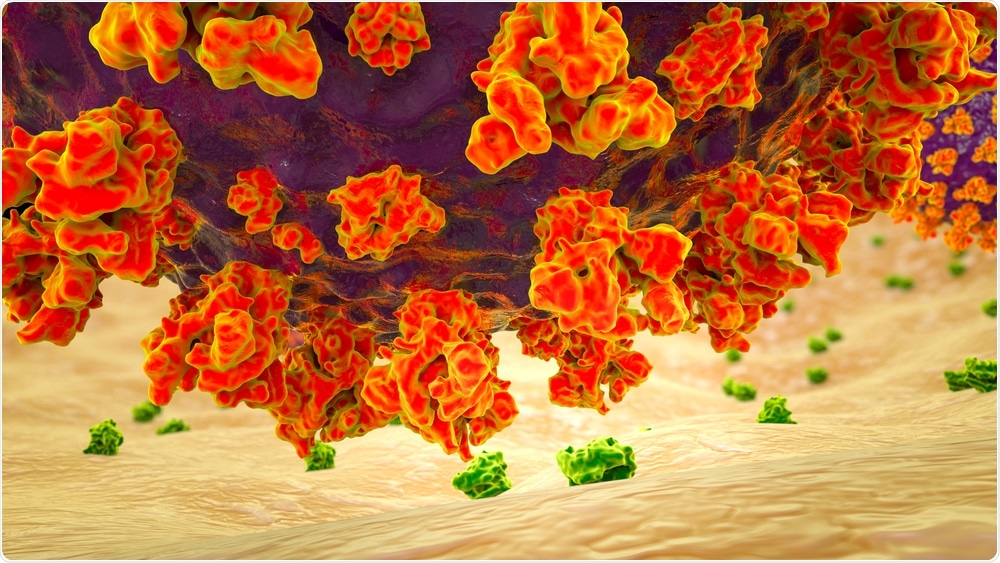
SARS-CoV-2 virus binding to ACE2 receptors on a human cell. Image Credit: Kateryna Kon / Shutterstock
The increased IgG antibody titer against Spike RBD also correlated with virus neutralization, systemic inflammation, and clinical outcomes, thereby suggesting quantitative serology made be of strong diagnostic and prognostic value.
A pre-print version of the paper is available on the server medRxiv*, while the article undergoes peer review.
A small subgroup of infected children develops MIS-C
In most cases, children infected with SARS-CoV-2 are either asymptomatic or mildly symptomatic, and only a small proportion require hospitalization.
However, recent reports describe a subset of children who develop a severe multisystem inflammatory response, with clinical features that resemble Kawasaki Disease. These children often develop hemodynamic instability, cardiac problems, and respiratory failure that requires intensive care in hospital.
On May 14th, 2020, the U.S. Centers for Disease Control and Prevention released a preliminary definition of the syndrome, which they called Multisystem Inflammatory Syndrome in Children (MIS-C) associated with COVID19.
The pathogenesis of the syndrome is not well understood, but it has been proposed that immune dysregulation and inflammation following SARS-CoV-2 infection are involved.
“Although the clinical features of MIS-C have been described, the SARS-CoV-2 serologic responses in these children and children hospitalized with COVID-19 are unknown,” writes Jaggi and colleagues.
What did the researchers do?
Between March 17th and May 26th, 2020, the researchers identified children hospitalized at Children’s Healthcare of Atlanta with MIS-C (n=10), symptomatic COVID-19 (n=10), Kawasaki Disease (n=5) and four hospitalized SARS-CoV-2-negative pediatric controls.
The researchers obtained prospective and residual blood samples from the children and compared serologic responses to SARS-CoV-2 among the different groups.
They used quantitative ELISA to measure IgG and IgM antibody titers against SARS-C0V-2 Spike RBD and a live-virus focus reduction neutralization assay to measure neutralizing antibodies. A linear regression model was used to perform correlation analyses.
Children with MIS-C had the highest IgG antibody titers against SARS-CoV-2
All children with MIS-C had high titers of IgG antibodies against SARS-CoV-2 Spike RBD that strongly correlated with titers of live-virus neutralizing antibodies.
Compared with the COVID-19, Kawasaki Disease, and control subjects, all children with MIS-C had significantly higher IgG antibody titers.
While all children with MIS-C had detectable neutralization titers, only 30% of the COVID-19 children had neutralizing antibodies.
Children in the MIS-C group had significantly higher neutralizing antibody titers than children in any of the other groups.
All children with MIS-C also had detectable IgM antibodies against SARS-CoV-2, suggesting that infections had been recent.
The RBD IgG antibody titers also strongly correlated with laboratory features and clinical outcomes of MIS-C, namely the erythrocyte sedimentation rate (ESR) and the length of stay (LOS) in hospital and in the intensive care unit, respectively.
What are the study implications?
“These results suggest that quantitative SARS-CoV-2 RBD IgG serology may be helpful in establishing the diagnosis of MIS-C and distinguishing it from other syndromes with similar clinical appearances,” write Jaggi and colleagues.
“Quantitative serology may also have prognostic value, as SARS-CoV-2 RBD IgG strongly correlated with metrics of systemic inflammation (ESR) and clinical outcomes (hospital and ICU LOS),” they add.
The team says that to date, the pathogenesis of MIS-C is not well understood, and researchers do not yet know why some children develop the disease, while others do not.
Jaggi and colleagues think that quantitative serology could provide clues about MIS-C pathogenesis and about the timing of disease once SARS-CoV-2 infection has occurred.
“In conclusion, we found that all children with MIS-C had high titers of SARS-CoV-2 RBD IgG antibodies, which correlated with neutralization. RBD IgG antibodies also correlated with metrics of systemic inflammation and with clinical outcomes,” say the researchers.
“Thus, measuring quantitative SARS-CoV-2 RBD antibody titers may have a role in establishing the diagnosis of MIS-C, distinguishing it from other similar clinical entities, and stratifying risk for adverse outcomes,” concludes the team.
*Important Notice
medRxiv publishes preliminary scientific reports that are not peer-reviewed and, therefore, should not be regarded as conclusive, guide clinical practice/health-related behavior, or treated as established information.






