

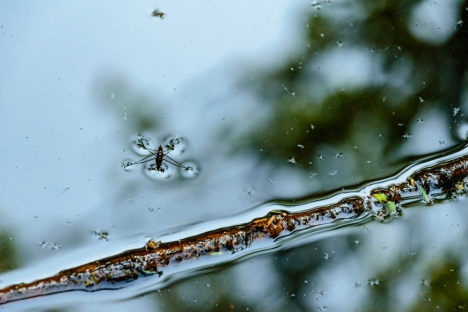
The property of water that enables a bug to skim the surface of a pond or keeps a carefully placed paperclip floating on the top of a cup of water is known as surface tension. Understanding the surface tension of water is important in a wide range of applications including heat transfer, desalination, and oceanography. Although much is known about the surface tension of fresh water, very little has been known about the surface tension of seawater — until recently.
In 2012, John Lienhard, the Abdul Latif Jameel Professor of Water and Mechanical Engineering, and then-graduate student Kishor Nayar SM ’14, PhD ’19 embarked on a research project to understand how the surface tension of seawater changes with temperature and salinity. Two years later, they published their findings in the Journal of Physical and Chemical Reference Data. This spring, the International Association for the Properties of Water and Steam (IAPWS) announced that they had deemed Lienhard and Nayar’s work an international guideline.
According to the IAPWS, Lienhard and Nayar’s research “presents a correlation for the surface tension of seawater as a function of temperature and salinity.” The announcement of the guideline marked the completion of eight years of work with dozens of collaborators from MIT and across the globe.
“This project grew out of my work in desalination. In desalination, you need to know about the surface tension of water because that affects how water travels through pores in a membrane,” explains Lienhard, a world leading expert in desalination — the process by which salt water is treated to become potable freshwater.
Lienhard suggested Nayar take measurements of seawater’s surface tension and compare the results to the surface tension of pure water. As they would soon find out, getting reliable data from salt water would prove to be incredibly difficult.
“We had thought originally that these experiments would be pretty simple to do, that we’d be done in a month or two. But as we started looking into it, we realized it was a much harder problem to tackle,” says Lienhard.
From the outset, Nayar hoped to get enough accurate data to inform a property standard. Doing so would require the uncertainty in the measurements to be less than 1 percent.
“When you talk about property measurements, you need to be as accurate as possible,” explains Nayar. The first hurdle he had to surmount to achieve this level of accuracy was finding the appropriate instrumentation to make reliable measurements — something that turned out to be no easy feat.
Measuring surface tension
To measure the surface tension of water, Lienhard and Nayar teamed up with Gareth McKinley, professor of mechanical engineering, and then-graduate student Divya Panchanathan SM ’15, PhD ’18. They began with a device known as a Wilhelmy plate, which finds the surface tension by lowering a small platinum plate into a beaker of water then measuring the force the water exerts as the plate is raised.
Nayar and Panchanathan struggled to measure the surface tension of salt water at higher temperatures. “The issue we kept finding was once the temperature was above 50 degrees Celsius, the water on the beaker evaporated faster than we could take the measurements,” Nayar says.
No instrument would allow them to get the data they needed — so Nayar turned to the MIT Hobby Shop. Using a lathe, he built a special lid for the beaker to keep vapor in.
“The little lid Kishor built had accurately cut doors that allowed him to put a surface tension probe through the lid without letting water vapor get out,” explains Lienhard.
After making progress on obtaining data, the team suffered a massive setback. They found that barely visible salt scales, which formed on their test beaker over time, had introduced errors to their measurements. To get the most accurate values, they decided to use fresh new beakers for every single test. As a result, Nayar had to repeat nine months of work just prior to his master’s thesis being due. Fortunately, since the main problem was identified and solved, experiments could be repeated much faster.
Nayar was able to redo the experiments on time. The team measured surface tension in seawater ranging from room temperature to 90 degrees Celsius and salinity levels ranging from pure water to four times the salinity of ocean water. They found that surface tension decreases by roughly 20 percent as water goes from room temperature toward boiling. Meanwhile, as salinity increases, surface tension increases as well. The team had unlocked the mystery of seawater surface tension.
“It was literally the most technically challenging thing I had ever done,” Nayar recalls.
Their data had an average deviation of 0.19 percent, with a maximum deviation of just 0.6 percent — well within the 1 percent bound needed for a guideline.
From master’s thesis to international guideline
Three years after completing his master’s thesis, Nayar, by then a PhD student, attended an IAPWS meeting in Kyoto, Japan. The IAPWS is a nonprofit international organization responsible for releasing standards on the properties of water and steam. There, Nayar met with leaders in the field of water surface tension who had been struggling with the same issues Nayar had faced. These contacts introduced him to the long, rigorous process of declaring something an international guideline.
The IAPWS had previously published standards on the properties of steam developed by the late Joseph Henry Keenan, professor and one-time department head of mechanical engineering at MIT. To join Keenan as authors of an IAPWS standard, the team’s data needed to be verified by measurements conducted by other researchers. After three years of working with the IAPWS, the team’s work was finally adopted as an international guideline.
For Nayar, who graduated with his PhD last year and is now a senior industrial water/wastewater engineer at engineering consulting firm GHD, the guideline announcement made the long months collecting data well worth it. “It felt like something getting completed,” he recalls.
The findings that Nayar, Panchanathan, McKinley, and Lienhard reported back in 2014 are broadly applicable to a number of industries, according to Lienhard. “It’s certainly relevant for desalination work, but also for oceanographic problems such as capillary wave dynamics,” he explains.
It also helps explain how small things — like a bug or a paperclip — can float on seawater.







