

MOBILE, Ala. (WALA) – FOX10 News is committed to getting the facts about how the government’s response to the coronavirus affects regular people.
Investigative reporter Brendan Kirby offered more answers on Monday:
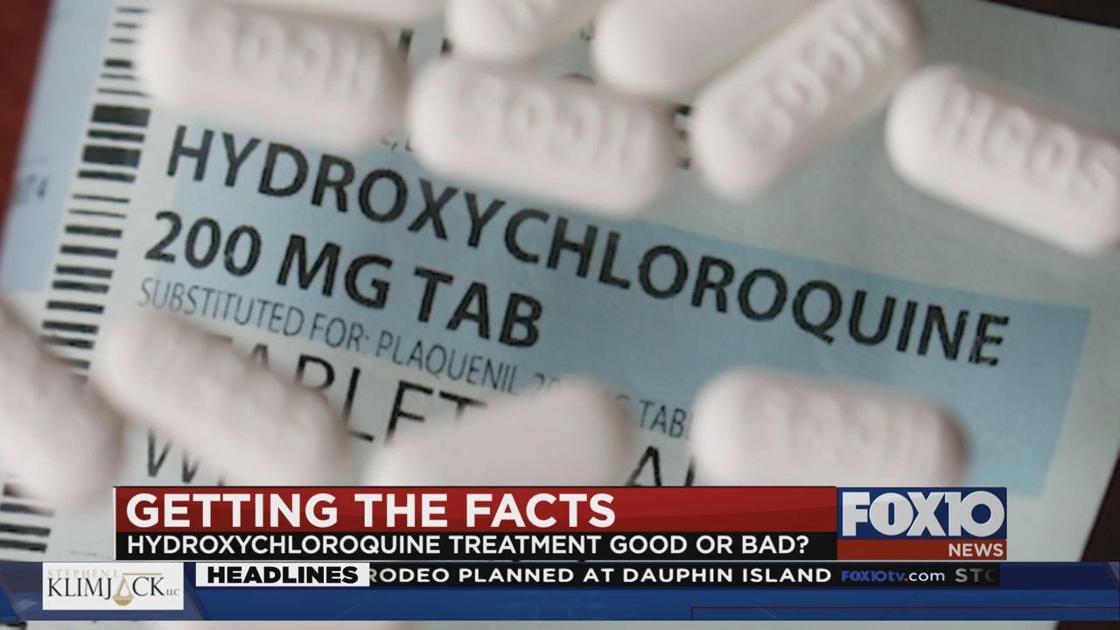
QUESTION: One drug that’s fallen in and out of favor is hydroxychloroquine. And now there’s a new study that shows some promise. Tell us about that.
BRENDAN: This has been something of a political football, largely because President Donald Trump offered his opinion early on that he thought it could be a game-changer.
Studies in the New England Journal of Medicine and The Lancet suggested that not only was it not a good treatment for COVID-19 but it might actually be harmful. But the publications had to retract them after questions arose about the data.
The latest study comes from the Henry Ford Health System in Detroit and involves an examination of 2,541 patients from March 10 to May 2. The death rate was significantly lower for people treated with hydroxychloroquine:
- 13.5 percent of patients treated with just that drug died.
- 22.4 percent died after getting treated with azithromycin.
- 20.1 percent who were treated with both drugs.
- 26.4 percent of patients who got neither drug died.
But there’s still a fair amount of skepticism about this drug, and the World Health Organization over the weekend formally discontinued studies involving it.
QUESTION: Speaking of the WHO, the agency has held off on declaring that the virus is airborne. Tell us about pressure from scientists to change that.
BRENDAN: The New York Times reports that 239 scientists in 32 countries have written an open letter to the WHO asking the organization to revise its recommendations based on research that smaller particles floating in the air can infect people.
The WHO last updated its coronavirus guidelines on June 29, and it says airborne transmission is possible only in rare circumstances involving medical procedures. It continues to focus heavily on the need for people to wash their hands frequently, even though the Centers for Disease Control and Prevention in the United States now says that surface contact with the virus plays only a small part in transmission of the disease.
Many independent experts say the evidence is strong that people can get the virus quite easily by breathing in droplets that linger in the air if people sneeze or cough – or even exhale.
The implications are great, because if airborne transmission plays a large role, it could upend guidelines on everything from air filtration systems to wearing masks even during situations where people are spread more than 6 feet apart.
QUESTION: We know the story by now. You’re unemployed, but no one will answer the phone at the Alabama Department of Labor. But now you can meet face to face, isn’t that right?
BRENDAN: That’s right. But it involves driving to Montgomery. You’ll have to blow the whole day. And there’s no guarantee your issue will be resolved.
Still, for people struggling with an unemployment problem, this might be the best option. The state rolled out the new appointment system at 5 p.m. Friday. And before the weekend was over, availability already had been maxed out.
Your next chance to schedule an appointment will be on Friday. You can find a link on your “Claim Tracker.” The Department of Labor says it can accommodate 300 appointments a day, and you’ll have a window beginning either at 8 a.m., 10 a.m., noon or 2 p.m. at the Crump Community Center in Montgomery.
You will not get to pick your time or day. That will be assigned to you. The state says to arrive 15 minutes early and suggests you bring a chair and snacks – because the wait likely will be long, as long as three to four hours.
If you have a “separation issue,” this won’t help you. And the state says it can’t promise to resolve other issues, either. But if you have a free day, this might be an option.
QUESTION: We got a question from a woman who’s been on unemployment since March and got a notification involving an “Alabama training extension.” She’s likely going to get more money, won’t see?
BRENDAN: She will be eligible for an extension of unemployment benefits after she has exhausted her normal maximum number of weeks.
This comes under a Coronavirus, Aid, Relief and Economic Security (CARES) Act program known as Pandemic Emergency Unemployment Compensation, or PEUC.
Because Alabama’s insured unemployment rate exceeds 5.9 percent, people can get an additional 13 weeks.
If the viewer has been on unemployment and has been filing her recertifications, she does not have to do anything more. It’s automatic.
If you are not currently receiving unemployment or you have not been recertifying for two weeks or more, you will need to file a new claim at www.labor.alabama.gov. If you’re eligible for regular benefits, the state will start a new benefit year. If not, the state will determine if you qualify for the extended benefits.
One more thing: People who filed their claims after Jan. 1 might be eligible for an additional five weeks if they participate in a training program. That will not affected eligibility under the PEUC one way or the other.
(If you have a #COVIDINFO question for investigative reporter Brendan Kirby, email him at [email protected])









