

GLOBAL RESEARCH SYNDICATE
No Result
View All Result
  • Login
  • Latest News
  • Consumer Research
  • Survey Research
  • Marketing Research
  • Industry Research
  • Data Collection
  • More
    • Data Analysis
    • Market Insights
  • Latest News
  • Consumer Research
  • Survey Research
  • Marketing Research
  • Industry Research
  • Data Collection
  • More
    • Data Analysis
    • Market Insights
No Result
View All Result
globalresearchsyndicate
No Result
View All Result
Home Data Collection

New research finds fitness tracker data could predict your marathon performance

globalresearchsyndicate by globalresearchsyndicate
June 30, 2020
in Data Collection
0
New research finds fitness tracker data could predict your marathon performance
0
SHARES
1
VIEWS
Share on FacebookShare on Twitter

Welcome to Riding Nerdy, TNW’s fortnightly dive into bicycle-based tech, where we go into too much detail and geek out on all things related to pedal-powered gadgets.

Eliud Kipchoge last year became the first athlete to run a marathon in under two hours after much training and careful preparation. Regardless of whether you’re aiming for a new world record or you just want to achieve a respectable time for your age, if you’re training for a marathon you might well want to know what you’re on course to accomplish.

There are so many different equations claiming to predict marathon performance. But these are not always very accurate because predicting marathon performance is difficult. However, in our new study, we showed that analyzing the abundance of data produced during training and racing by wearable fitness trackers may be helpful. We found it’s possible to calculate a critical speed value that we can use to predict a runner’s marathon time with a good degree of accuracy.

Many things determine how fast you can run a marathon. First, your physiology plays a huge role in your performance. For example, elite marathon runners tend to be slim with long limbs, which offers them greater running economy and means they will use less energy to move at a given speed. Fast marathon runners also tend to have a higher maximum rate of oxygen use (VO2max) and can operate at a high percentage of this maximum for a long time without developing fatigue.

But there are many other factors involved. The right shoes can make running more economical in terms of how much energy you use. Running with pacers can help runners manage their timing and can reduce air resistance. And of course, choosing a flat course with optimal weather conditions can help too.

Critical speed

Endurance running is essentially determined by the fastest speed you can sustain for a given distance, or how long you can run at a given speed. It’s clear that if you go very fast, then you can only sustain that speed for a short time. And if you want to run for longer times, you need to slow down.

However, small changes can have a large impact on how long we can maintain our speed. This suggests there is a critical speed at which, in theory, we can sustain for quite a long time.

It is quite possible that critical speed is useful for predicting endurance performance. For example, elite athletes appear to run their best marathons at around 96% of their critical speed.
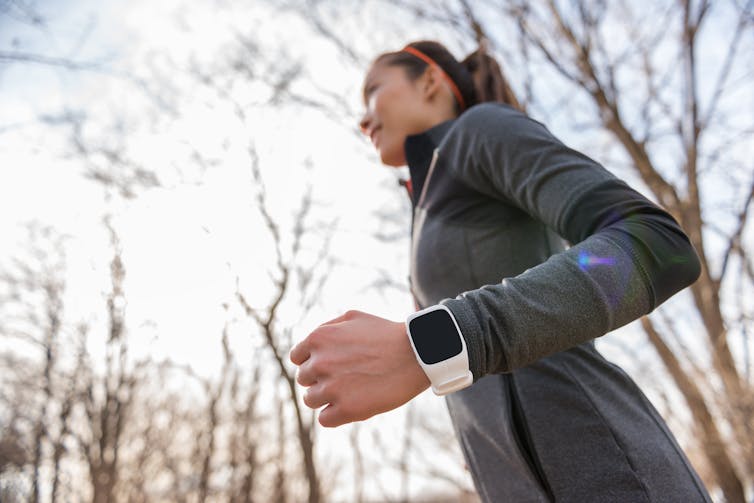
Fitness tracker data enabled highly accurate predictions. Maridav/Shutterstock

This is where activity data collected from fitness trackers (distance, speed, time, heartrate and cadence) can come in. We wanted to know whether all of the data recorded by tracking devices can be used to support runners preparing for a marathon.

By analyzing training data from 25,000 athletes, we found we could estimate their critical speed and predict their marathon performance with 92% accuracy. Considering how many things can impact marathon performance (during training and on race-day) and the different levels of fitness across recreational athletes, this is a high degree of accuracy.

We also found that, on average, runners ran the marathon at speeds around 85% of their critical speed. Faster athletes ran their marathons closer to 93% of their critical speed, but slower runners did so at 79% of their critical speed.

This means that using raw training data to estimate your critical speed, your smart watch or favorite fitness app may soon be able to predict your finish time to an even higher degree of accuracy, as well as providing real-time feedback and advice about how best to pace your race.The Conversation

This article is republished from The Conversation by Daniel Muniz, Senior Lecturer, Exercise Physiology, University of Hertfordshire and Barry Smyth, Professor of Computer Science, University College Dublin under a Creative Commons license. Read the original article.

Read next:

Guns and ammo stocks surge to eclipse ‘stay-at-home’ darlings

Celebrate Pride 2020 with us this month!

Why is queer representation so important? What’s it like being trans in tech? How do I participate virtually? You can find all our Pride 2020 coverage here.


Related Posts

How Machine Learning has impacted Consumer Behaviour and Analysis
Consumer Research

How Machine Learning has impacted Consumer Behaviour and Analysis

January 4, 2024
Market Research The Ultimate Weapon for Business Success
Consumer Research

Market Research: The Ultimate Weapon for Business Success

June 22, 2023
Unveiling the Hidden Power of Market Research A Game Changer
Consumer Research

Unveiling the Hidden Power of Market Research: A Game Changer

June 2, 2023
7 Secrets of Market Research Gurus That Will Blow Your Mind
Consumer Research

7 Secrets of Market Research Gurus That Will Blow Your Mind

May 8, 2023
The Shocking Truth About Market Research Revealed!
Consumer Research

The Shocking Truth About Market Research: Revealed!

April 25, 2023
market research, primary research, secondary research, market research trends, market research news,
Consumer Research

Quantitative vs. Qualitative Research. How to choose the Right Research Method for Your Business Needs

March 14, 2023
Next Post
Idiopathic Thrombocytopenic Purpura (ITP) Therapeutics Market To Reach USD 783 Million By 2026

Cadmium Pigments Market To Reach USD 361.8 Million By 2027

Categories

  • Consumer Research
  • Data Analysis
  • Data Collection
  • Industry Research
  • Latest News
  • Market Insights
  • Marketing Research
  • Survey Research
  • Uncategorized

Recent Posts

  • Ipsos Revolutionizes the Global Market Research Landscape
  • How Machine Learning has impacted Consumer Behaviour and Analysis
  • Market Research: The Ultimate Weapon for Business Success
  • Privacy Policy
  • Terms of Use
  • Antispam
  • DMCA

Copyright © 2024 Globalresearchsyndicate.com

Welcome Back!

Login to your account below

Forgotten Password?

Retrieve your password

Please enter your username or email address to reset your password.

Log In
This website uses cookies to improve your experience. We'll assume you're ok with this, but you can opt-out if you wish. Cookie settingsACCEPT
Privacy & Cookies Policy

Privacy Overview

This website uses cookies to improve your experience while you navigate through the website. Out of these cookies, the cookies that are categorized as necessary are stored on your browser as they are essential for the working of basic functionalities of the website. We also use third-party cookies that help us analyze and understand how you use this website. These cookies will be stored in your browser only with your consent. You also have the option to opt-out of these cookies. But opting out of some of these cookies may have an effect on your browsing experience.
Necessary
Always Enabled
Necessary cookies are absolutely essential for the website to function properly. This category only includes cookies that ensures basic functionalities and security features of the website. These cookies do not store any personal information.
Non-necessary
Any cookies that may not be particularly necessary for the website to function and is used specifically to collect user personal data via analytics, ads, other embedded contents are termed as non-necessary cookies. It is mandatory to procure user consent prior to running these cookies on your website.
SAVE & ACCEPT
No Result
View All Result
  • Latest News
  • Consumer Research
  • Survey Research
  • Marketing Research
  • Industry Research
  • Data Collection
  • More
    • Data Analysis
    • Market Insights

Copyright © 2024 Globalresearchsyndicate.com



