

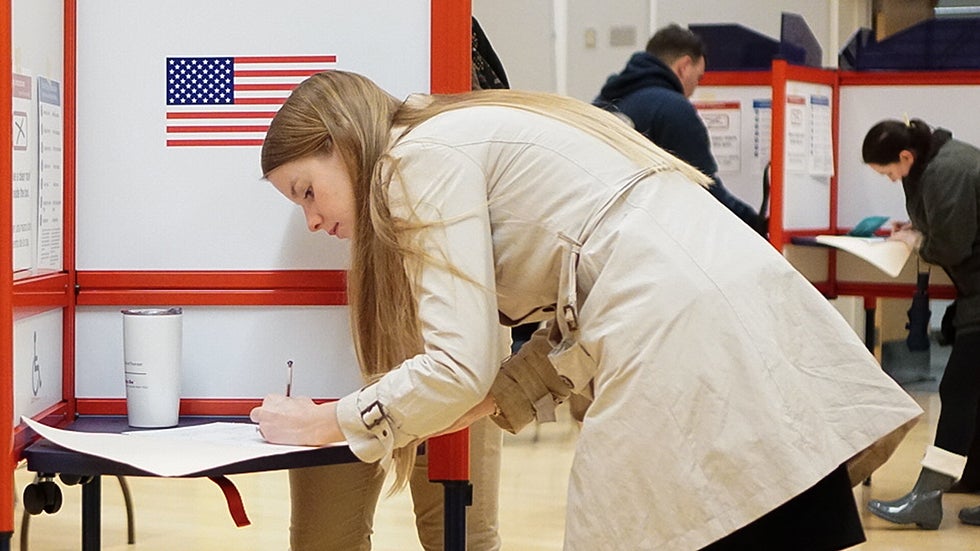
With young Americans forming the backbone of protests against racial injustice and structural inequality in the United States, many people are wondering if this is a pivotal moment where Generation Z (defined as those Americans born after 1996, and often referred to as “Zoomers”) can translate protest into votes.
An awakening at the ballot box among America’s youngest eligible voters would threaten President Trump Donald John TrumpTrump rally sparks self quarantine of dozens of Secret Service agents GOP: Trump needs a new plan Trump faces ObamaCare court deadline as political ground shifts MORE’s re-election chances. By the 2020 election, Generation Z is expected to account for 1 out of every 10 votes, with Trump’s challenger, former Vice President Joe Biden
 Joe BidenGOP: Trump needs a new plan Trump distracts from, fuels right-wing violence Biden to accept nomination in Milwaukee amid scaled-back convention MORE, projected to have a 24-point advantage among 18-29 year-olds.
Despite the visible surge in activism, concerns remain over the degree to which Zoomers will turn out in the 2020 Election. Young people vote at notoriously low levels, and questions raised over the safety and ease of voting during the COVID-19 pandemic continue to cast a shadow over predictions of voter turnout.
To shed light on the question of Gen Z turnout ahead of the election, we conducted a survey of Americans age 18-24. We found a generation that’s eager to shape politics but unsure whether voting is worth the effort. While Zoomers want to make voting easier, they still cite a lack of candidates speaking to their concerns as a primary reason for not voting.
We fielded a survey using the research firm Qualtrics, which recruited more than 1,000 American citizens age 18-24 between May 21-27. While participants were volunteers (i.e. not a random sample), we constructed the sample to be representative of Gen Z on several metrics (gender, race, socioeconomic status).
As part of the questionnaire, we asked respondents two sets of questions. The first presented respondents with a series of proposed election reforms and actions and asked them whether these changes would make them more likely to vote. The second asked individuals to assess whether a number of potential barriers to voting were a reason why people their age might abstain.
On average, Zoomers are deeply invested in voting and reject the notion that they need hand-holding in order to participate. More than 75 percent of survey subjects said that voting was a duty, while only around 35 percent said they needed help registering to vote or finding their polling location.
Yet when we asked them about reforms that would make voting more likely, the top issue was registration. More than 77 percent of respondents said that having more locations to register (e.g., schools, retail locations) would make them more likely to vote. Similarly, 59 percent said same-day registration would also make voting easier. The United States is one of only a few democracies that require citizens to register before voting. This two-step process can create a barrier to participation — one that members of Gen Z believe should be easier.
Strong majorities of Zoomers also said that early voting (69 percent) and voting by mail (68 percent) would make them more likely to vote. Moreover, roughly 2 in 3 members of Gen Z said that reminders to register and vote via text, phone or mail would boost the likelihood of them turning out on Election Day.
Yet removing barriers may not be enough. The second-most cited issue in individual voting choices, selected by 72 percent of Zoomers, is the existence of candidates on the ballot who speak to the issues young people care about. In some cases, seeing more ethnically/racially diverse candidates or more women candidates might help boost turnout. But that approach may hinge on the partisan affiliation of members of Gen Z: 76 percent of Democrats agree that more minority candidates would make them likelier to vote. In contrast, only 36 percent of Republicans said the same. For women candidates, that partisan gap was 70 percent/36 percent, and for younger candidates the gap was 68 percent/43 percent.
When we examine which barriers Zoomers view as hindering other people their age from voting, the top culprits are not structural barriers such as a lack of registration sites or early voting locations. Instead, they point to the cost-benefit analysis of voting. More than 40 percent of survey participants said that a major reason members of Gen Z do not vote is simply because they believe their vote will not change the election outcome.
In place of rational motivations for turning out, scholars often talk about civic duty or voting as an act of expression. While a vast majority of Gen Z views voting as a civic duty, we unfortunately find little evidence that they believe it has great expressive value. Nearly 40 percent of participants said that the lack of appealing candidates was a factor in non-voting decisions, while roughly a third said that politics being unenjoyable was also a major factor.
And while members of Gen Z want more registration sites and access to mail-in ballots, only a small minority of respondents viewed confusion around voter registration (17 percent), the process of obtaining an absentee ballot (20 percent) or lines at polling locations (21 percent) as major reasons not to vote. This is perhaps a testament to the work nonprofit organizations and colleges have done in recent years to teach young people how to vote. Moving forward, advocacy organizations and political parties must work to recruit compelling candidates and convince Gen Z that their vote matters if they want the benefits of this labor.
It is not difficult to predict that Gen Z is poised to become a major force in this fall’s elections, particularly given the energy that young people are harnessing in protests across the nation against policy brutality and racial inequality. Protest politics can pay dividends at the ballot box, resulting in higher voter turnout among not only those Americans who are protesting, but those at home who agree with the message being brought to the streets.
But our data suggest that making it easier to vote and, especially, offering a slate of candidates who give young people a reason to turn out will help solidify increased voter engagement among Gen Z. When a candidate speaks to the issues they care about, members of Gen Z say they will be able to navigate the bureaucracy of election administration and cast a ballot.
Jared McDonald, Ph.D., is a postdoctoral scholar of communication at Stanford University (@jaredmcdonald), Melissa Deckman, Ph.D., is the Louis L. Goldstein Professor of Public Affairs at Washington College (@MelissaDeckman), Mileah Kromer Ph.D., is associate professor and director of the Sarah T. Hughes Field Politics Center at Goucher College (@MileahKromer). Anne Moses Ph.D., is the founder and president of IGNITE, a non-partisan, non-profit organization that trains young women to be political leaders (@annebmoses).
*The survey cited in this opinion piece was generously funded by Washington College, the Sarah T. Hughes Field Politics Center at Goucher College, IGNITE, and the Center for Democracy and Civic Engagement at the University of Maryland. The views and opinions expressed in this article are that of the authors and do not reflect the funding sources. Please contact the authors for a statement on the survey methodology.







