

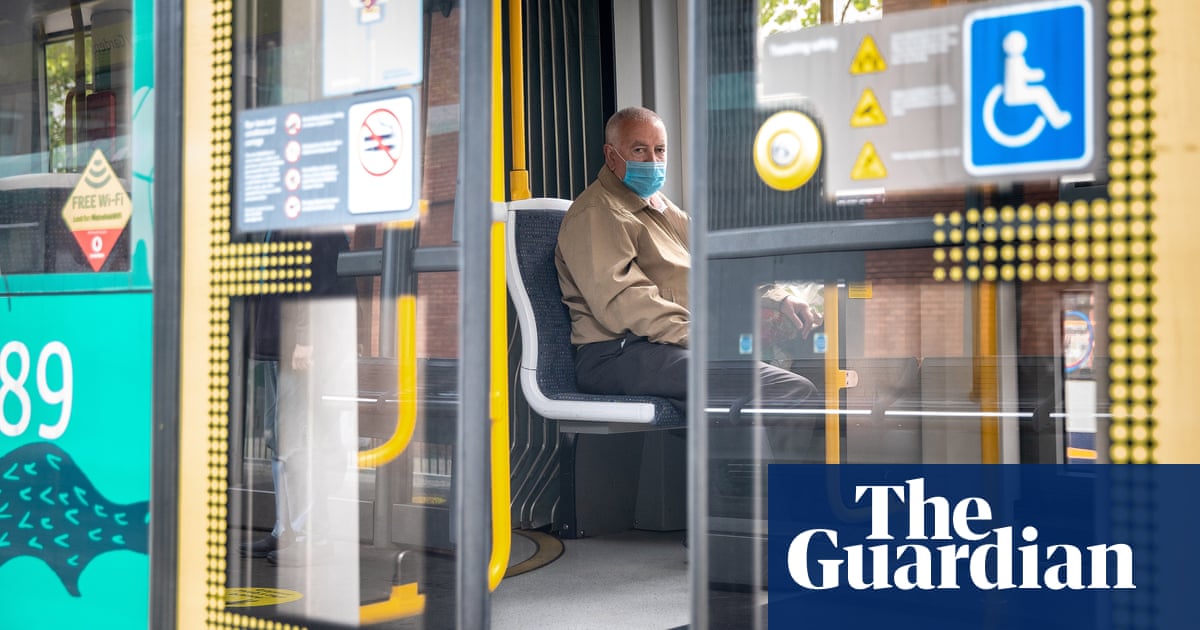
Ensuring that every passenger on public transport wears a face covering will require a significant change to current behaviour – and potentially an uphill battle.
A Guardian survey suggests that fewer than four in 10 people currently wear one, with young and middle-aged men the least likely to use them on trains, buses, trams and the tube.
The survey of almost 800 travellers in Manchester, Glasgow and London carried out this week found that in some areas as few as 10% of passengers wear face coverings.
The World Health Organization (WHO) guidance on face masks has remained consistent during the coronavirus pandemic. It has stuck to the line that masks are for healthcare workers – not the public.
“Wearing a medical mask is one of the prevention measures that can limit the spread of certain respiratory viral diseases, including Covid-19. However, the use of a mask alone is insufficient to provide an adequate level of protection, and other measures should also be adopted,” the WHO has stated.
Nevertheless, as some countries have eased lockdown conditions, they have been making it mandatory to wear face coverings outside, as a way of trying to inhibit spread of the virus. This is in the belief that the face covering will prevent people who cough and sneeze ejecting the virus any great distance.
There is no robust scientific evidence – in the form of trials – that ordinary masks block the virus from infecting people who wear them. There is also concerns the public will not understand how to use a mask properly, and may get infected if they come into contact with the virus when they take it off and then touch their faces.
Also underlying the WHO’s concerns is the shortage of high-quality protective masks for frontline healthcare workers.
Nevertheless, masks do have a role when used by people who are already infected. It is accepted that they can block transmission to other people. Given that many people with Covid-19 do not show any symptoms for the first days after they are infected, masks clearly have a potential role to play, especially on crowded public transport as people return to work.
Sarah Boseley Health editor
It also showed that outside London, the use of face coverings fell dramatically, although most of the public transport used was still quiet, reflecting the current status of lockdown restrictions.
Of 465 passengers on London tube carriages and buses on a variety of routes on Tuesday , less than a third of men and half of women were wearing face coverings. White men in particular were less likely to cover their faces.
In Manchester on Wednesday, only 10% of travellers on trams and buses surveyed – 22 out of 212 – wore face coverings. And on trains and around the subway in Glasgow on Thursday, fewer than one in five – 18 out of 98 – were wearing face coverings.
Phoebe, a 20-year-old Chinese student, said she didn’t understand why more people were not wearing face coverings. “I’m staying in London with my grandma while I’m studying here,” she said. “I don’t want to put her at risk so I always wear a mask when I travel. Wearing a mask is about being considerate towards others. That takes no effort at all. I don’t understand why some people believe it is not a good idea to wear a mask.”
Unlike countries such as France, Vietnam and the Czech Republic, where mask-wearing is compulsory in some or all public spaces, the government’s advice has until now appeared hesitant and uncertain.
Research has shown that young men are more likely to breach lockdown rules than young women – and according to the Guardian’s research, they also seem less likely to wear face coverings than other groups.
Young and middle-aged white men in London were least likely to be wearing a face covering among those we surveyed, with just 18% wearing them.
One mask-wearing hospital consultant interviewed by the Guardian while on the tube to work at the Whittington hospital in north London, expressed alarm at the low numbers of people wearing masks while travelling. “If two people are close to each other on public transport and both are wearing masks the risk of transmitting the virus is reduced by 90% ,” he said.
The consultant, from an Asian background, condemned the government’s handling of the pandemic as chaotic, saying that it had only recently acknowledged the increased risk the virus poses to black and minority ethnic communities. He said that its refusal to learn from other countries in terms of policies like mask wearing in public was “very disappointing”.
Among the 265 men in the London survey 70% – 186 – were not wearing masks. The figure for the 192 women surveyed who chose not to wear masks was 100 out of 192 – 52%.
A minority of passengers on buses and tubes in London who we surveyed were older people; the vast majority were young and middle-aged. We broke down our data into three ethnic groups – black, white and Asian. Only 18% of all the 126 white men we observed travelling – 29 – wore masks, compared with 39% of Asian men – 17 out of 43 and the 29% of black men – 14 out of 48.
Frazer Blackley, 55, travelling on London Underground’s Northern Line, said that he did have a mask but didn’t wear it when the tube was quiet, only if it got crowded. One man, a retired psychologist, said he wasn’t convinced of the efficacy of masks, but carried one in his pocket which he put on sometimes “to provide reassurance” to other members of the public.
Mask-wearing among women from all ethnic groups was higher than for men and more consistent across ethnic groups with 43% – 48 out of 111 white women travelling – wearing masks, along with 43% of Asian women – 17 out of 39 – and 37% of black women – nine out of 24 women travelling.
Of the 212 people surveyed in Manchester, travelling from Whitefield in north Manchester to affluent Didsbury in the south through the city centre and including MediaCity, 190 people from all ages and backgrounds were not wearing face coverings. Of the 22 that did, 13 were men with three appearing to be middle-aged. Of the women surveyed, young white women were the most likely to wear a face covering.
In Glasgow, out of 98 travellers, 18 were wearing face coverings, usually ready-made reusable masks rather than scarves or other cloth items. They were worn by an equal number of men and women, and mainly by middle-aged people. Of the travellers observed, the sexes were evenly split; around half were younger people, and the vast majority were white. Of those not wearing masks, similarly around half were younger people and just over half were men.
While different scientists have reached different conclusions about the efficacy of masks, the consensus is in favour of mask wearing.
Commenting on the findings of the Guardian survey, Prof Trish Greenhalgh from the University of Oxford said: “The evidence on face coverings is contested but my own interpretation is that is stacks up strongly in favour. SARS-CoV-2 is spread by droplet infection, and droplets are stopped by cloth face coverings.
“I think this small survey indicates that this policy [of compulsory face coverings on public transport] is needed. After all, my mask mainly protects you and yours protects me, so to be fair on everyone, all of us should be wearing a face covering.”
Dr Jonathan Fluxman of the campaign group #Masks4All, urged everyone to wear a mask in public. “The findings of the Guardian survey are not at all surprising given the government’s dreadful messaging around face coverings. To describe them as ‘marginally beneficial as a precautionary measure’ totally undermines their importance and effectiveness, as demonstrated in numerous other countries.
“If 80% of people wear them, we can drive down transmission. Please do wear one whenever you encounter other people.”







