

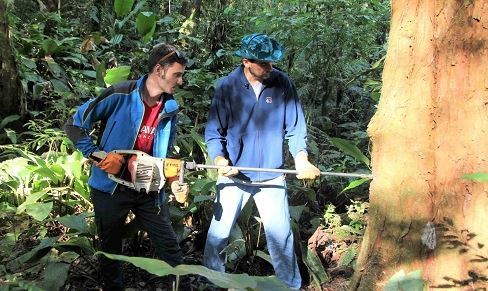
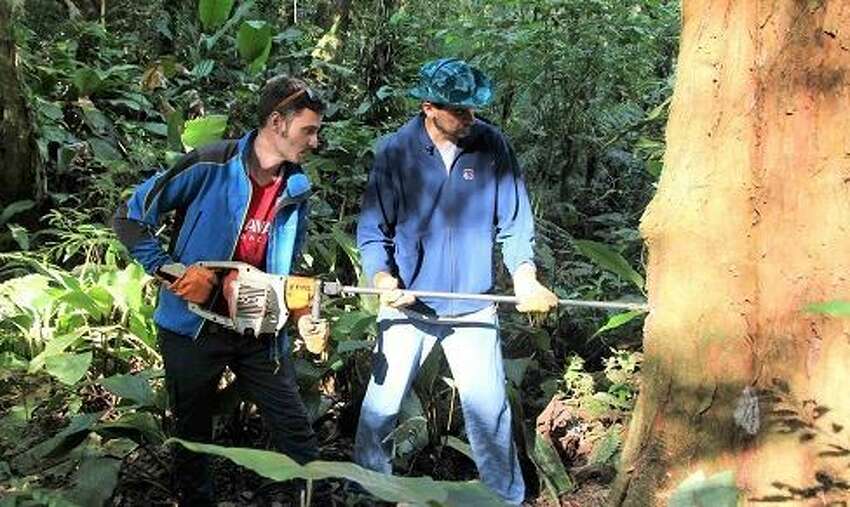
Courtesy University at Albany.University at Albany
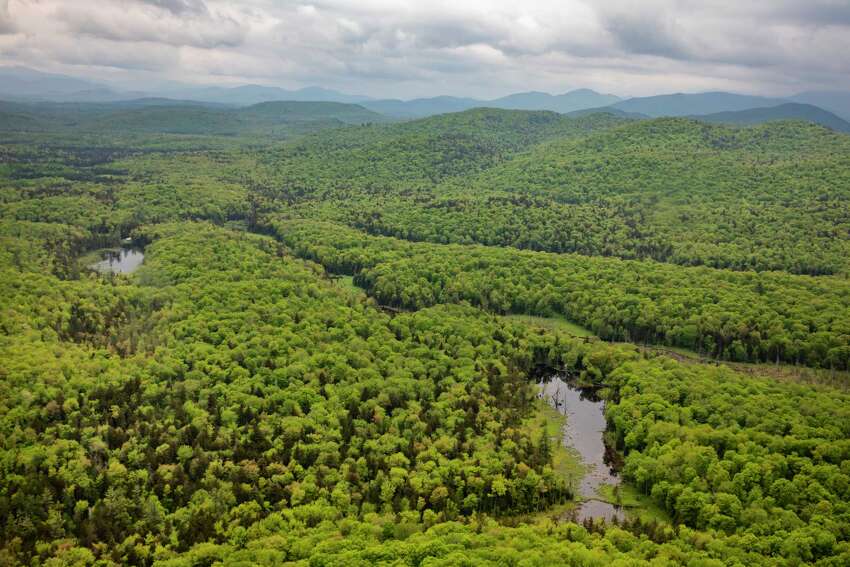
ALBANY — Will the Adirondacks and Catskills start looking like the rain forests of Brazil in a couple of years?
Not exactly, but New York’s forests will likely grow more varied in the size and height of their trees in coming decades, if a historical study of tree rings led by University at Albany researchers is any indication.
And that in turn may mean these temperate forests may play a more important role globally in capturing carbon dioxide greenhouse gases.
That’s because, based on historic trends, forests in temperate climates including those in New York may experience less stress and more vigor due to the warmer and wetter weather that climate change is bringing.
At the same time, tropical rain forests in places like Brazil and Africa may undergo more climate stress due to increased heat. Those forests may become more uniform in size and shape, based on their tree ring data.
These predictions, based on a study of thousands of tree rings around the planet going back more than a century, are based on the idea that synchrony in tree rings — growth among a given population of trees at the same rate– can provide clues to its vigor or lack thereof.
Forests that are under stress, from too much heat, for example, will exhibit more synchrony, since limited resources put a ceiling on growth.
“They grow what they need to survive,” said Ernesto Tejedor, a post-doctoral researcher at UAlbany’s Department of Atmospheric and Environmental Sciences.
Tejedor was the lead author, working with Professor Mathias Vuille, of the study in the journal, Global Ecology and Biogeography, that outlines the findings.
It’s an important study since it provides a new tool for scientists to help predict which areas of the planet may play a greater or lesser role in carbon capture.
The world’s dense rain forests have long been viewed as major carbon reservoirs, but in the future that job may fall to more temperate forests.
While the study makes projections into 2045, it looks to data from the past, combined with new technologies to reach its conclusions.
To get their tree ring data, researchers looked to the National Oceanic and Atmospheric Administration which maintains a bank of tree ring samples from 3,579 forests worldwide. These samples, taken by drilling out core samples, provide a gauge into which years were difficult or easier for trees, as the rings were bigger in years with plenty of water and beneficial temperatures and less so for years that didn’t have those advantages.
The looked at samples from 1901 to 2012 and compared them to climate records in those years.
Then using a computer model, they projected them forward.
There were complications and some extrapolations. Visual inspection of tree rings have long given a clear read on the vibrancy of trees in temperate climates.
But that’s been less so in tropical climates. Without the freezing winters and hot summers of places like Russia, Europe or North America, tropical rings have been much harder to read.
But advances in examining the isotopes of the samples is changing that.
Isotopes are variations in an element, such as carbon, nitrogen or oxygen differentiated by the number of neutrons in each atom.
By looking at the various isotopes in the samples researchers can get a picture of the tree rings over the years.
The samples were truly global, coming from Europe, Asia, Africa, Russia and other places as well as North America. In New York there are 52 sites including some from the Adirondacks, near Keene and southern New York’s Orange County.
Larch, oak, spruce and other varieties are in the data base.
The rings, though, aren’t from the Brazilian rain forest. That area’s historic inaccessibility made getting samples unrealistic, but they do have rings from the subtropical forests in northern Argentina.
Rain forests in Brazil and the Congo Basin in Africa are of particular interest since temperatures are expected to rise significantly there in coming years.
There were COVID-19-related complications in finishing the study, including delays in getting the newest samples from remote areas. The pandemic is also holding up plans to gather new tree ring samples, said Tejedor.
Will the study put more emphasis on saving temperate forests for the sake of carbon sequestration?
That’s hard to say, said Tejedor, who remarked that other factors such as insects, fires and other factors can influence forest health.
Looking at the synchrony is one of several tools to try and predict how forests in various locations will be doing in future years.
“If temperate forests in the future are less synchronized… they will have more capacity to act as carbon pools,” Tejedor said. “On the other hand, they will face other challenges, such as competition, insect outbreaks, fires, etc. That is why it is so important to first, have the capacity and the means to manage the forests according to their potential situation.”
Vuille also worked on the paper and is overseeing much of the larger research.
In 2017 he received a $5 million National Science Foundation grant for research into historical climate change patterns. In addition to tree rings, researchers are also looking at cave sediment. It runs through 2022.
Vuille and Tejedor also worked with atmospheric and climate scientists from Spain, Germany, the United Kingdom and other parts of the U.S.
And they are developing new tree ring networks in Peru, Bolivia, Brazil and Argentina.
“This new network will provide invaluable information, not only on the ecological impacts of climate change in these forests, but also the greater significance of this current climatic period,” said Vuille.
For more information go to https://www.pirecreate.com.
[email protected] 518 454 5758 @RickKarlinTU







