

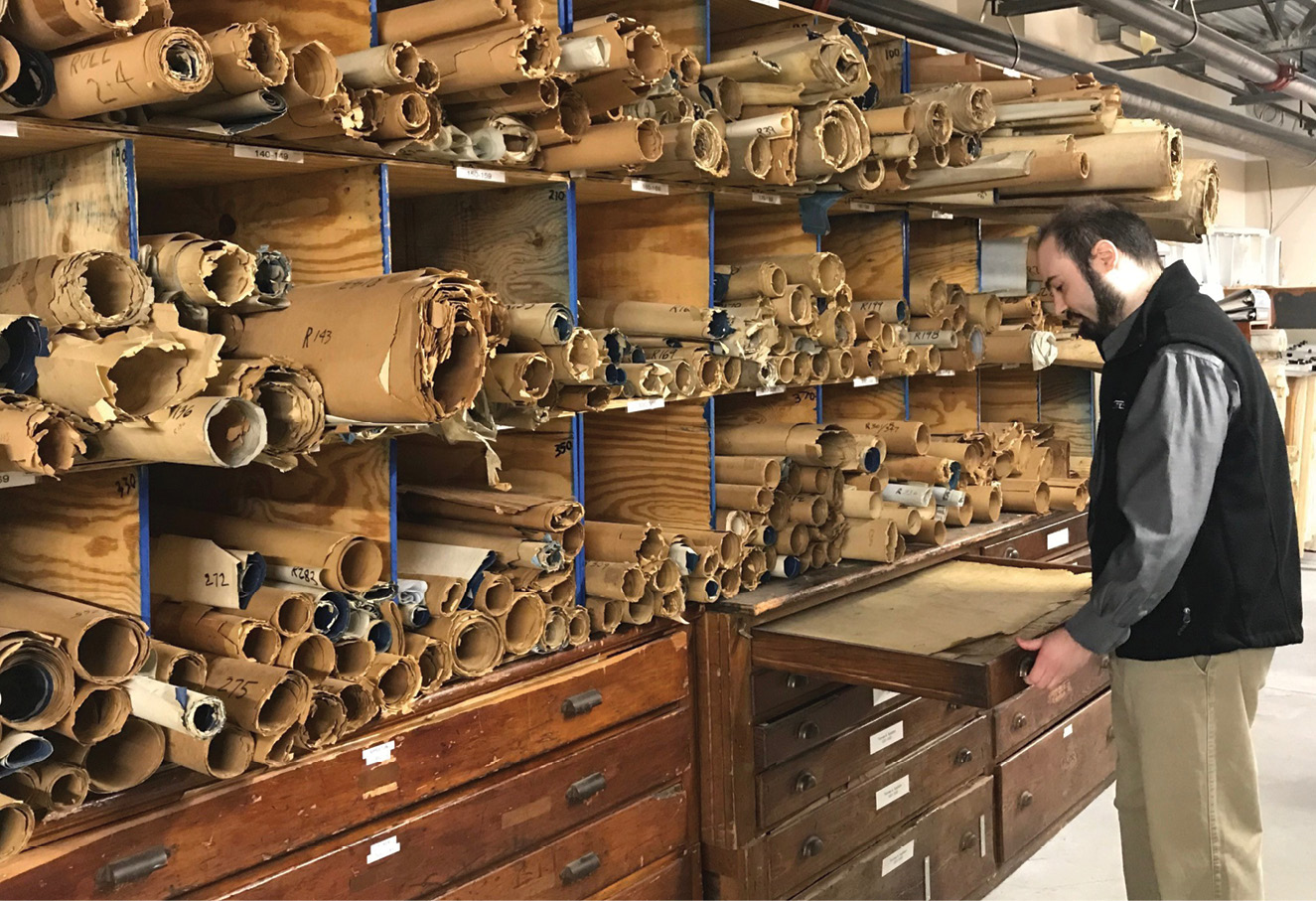
 Hancock Associates, a Danvers, Massachusetts-based land surveying, civil engineering and wetland science firm was founded in 1978. Over the years, it has amassed thousands of its own records as well as those from 24 other firms dating as far back as 1852. These records assist Hancock’s staff in performing tasks quickly and efficiently and also help preserve local history.
As you can imagine, the volume of folders, flat plans, rolled plans and field books from 168 years of work requires a substantial amount of physical space; and if not stored correctly, those historical documents could become damaged and even lost forever. Proper cataloging also is paramount for retrieval and use of the documents. The solution was to bring on Travis Yacovitch as a full-time Archivist to digitize and catalog the thousands of historical records as well as the new ones that are continually being created by the firm.
Travis’ journey to Hancock Associates and his work there is an interesting story.
 I graduated from North Shore Community College in Massachusetts with an associate degree in Liberal Arts but was unsure of what I wanted for a career. Eventually, my fondness for local history from the Salem Witch Trials to the role that Boston played in the American Revolution along with my desire to be immersed in history led me to Philadelphia, the home of the Liberty Bell and Independence Hall, to study history at Temple University. While there, I worked part-time at the Paley Library in the Special Collections Department which handled all of the university’s archives and records. It was there that my interest and admiration for archiving began to take root as I learned the ins and outs of the trade thanks to plenty of hands-on work. I then graduated from Temple University with a Bachelor of Arts in American History and a minor in English and was a member of Phi Alpha Theta, a history-based honors society. With recommendations from my supervisor at the library and two other teachers, I applied to Simmons University in Boston, Massachusetts for their Master’s program in Library and Information Science.
 While I was waiting for classes to start, I interned at the Peabody Essex Museum in Salem, Massachusetts in their Registration Department. I archived exhibition records, assisted with object conditioning, processed loan renewals and updated entries in the museum database. While at Simmons, I worked at Thoreau Institute Library with the Walden Woods Project in Concord, Massachusetts sorting and organizing a collection of materials related to Henry David Thoreau who was a land surveyor for much of his life. Little did I know that land surveying would soon become a key part of my professional career.
While pursuing my Master’s degree, a longtime friend of mine who was a land surveyor at Hancock Associates told me that the firm was looking for an Archivist. I left the Thoreau Institute Library to take the position and continued my studies at Simmons University through their online program. I graduated from Simmons with a Master of Science Degree in Library and Information Science with a concentration in Archival Management. All of my education and experience is put to work at Hancock.
 You might think that creating a digital copy of a document is relatively simple, but there are many factors to consider before scanning or photographing one. What is the size and format? What is the material and condition of the paper? What kind of equipment are you using? What is the brightness and contrast of the light source? Once you have answered these questions, you can properly light the piece, line up your shot and take the digital copy. From there, file size is assessed. What format will the document be saved and how much computer file space will it need? Can it be compressed to save on the megabytes of file size? These questions also need to be answered on a piece-by-piece basis.
When looking at a large volume of materials, it can be tempting to work as quickly as possible. However, when it comes to archiving, quality and accuracy is far more important than speed. I will scan a piece as many times as I think is needed because I want to be sure that I save the best result possible. It takes time to handle each piece correctly but it’s time well spent. An original document will deteriorate over time and is at risk of being damaged or lost starting from the day it was created. With a digital file, the information is captured forever.
Creating the digital file is only part of the archiving process. The organization and storage of files is just as important. The information serves no useful purpose if it is not easily found. This is true for the physical archives and the digital ones. Over the years at Hancock, I have learned a great deal about land surveying which allows me to properly assess and organize materials.
Our files in our physical archive are organized by the name of the company in which they originated, the content and the document format, then stamped with a reference number. The digital archive, which is stored within our in-house computer network and backed up daily, is similarly structured and is easily searchable through a proprietary database. The database uses geotagging whereby common street addresses are converted to longitude and latitude coordinates for maximum accuracy. I also created a searchable satellite map of sites which allows Hancock project managers to easily look up previous surveys to get information. It can easily save hours of field and research work.
I’ve been Hancock’s full-time Archivist for over three years now and have digitized thousands of land surveying and civil engineering records…and counting. If you have questions about preserving history through archiving, feel free to reach out.
Travis Yacovitch is a full-time Archivist at Hancock Associates. You can connect with him at linkedin.com/in/travisyacovitch/







