

The running back position can be the most frustrating when it comes to fantasy points and assessing value. With injuries and inconsistency plaguing the position it can be tough to work out who performed well and who struggled when it comes to the end of the season. One way of assessing performance is to compare a running back’s finish at the position compared to their ADP. While that is a simple assessment to do, it does not necessarily help us to project what the previous season’s fantasy point return means for the future of a running back.
Therefore, what we need is to be able to analyze a running back’s performance on a deeper level. Sure we have numbers such as yards per carry and yards per reception to help us do that, but fantasy points include those yards and combine touchdowns into the numbers as well. Here at Pro Football Network, we have the Offensive Share Metric, which tells us how a running back performs when it comes to factors within their control, but what if we could combine that information with something directly looking at fantasy production.
That is where calculating Expected Fantasy Points (xFP) for running backs and Fantasy Point Differential (FPD) comes in. In this article, I will discuss how the metrics came about, what they tell us, and how we can use them to help value players in dynasty leagues.
Although the 2021 draft season is almost a year away, it is never too early to start building your favorite team with future draft prospects. The PFN Mock Draft Simulator has been updated to include over 350 prospects in the 2021 NFL Draft Class. Choose your speed, trade all you want (for free), and put together a winning draft class for your favorite team! Click here to enter the simulator!
Expected Fantasy Points (xFP)
Correlating running back carries and touches to fantasy points
With running backs, the natural place to start looking for a correlation between opportunity and fantasy points is with carries and/or touches. To do this, a reasonable set of data is required, which initially was two years. When that demonstrated a reasonable correlation, the next step was to go to five years. When the correlation remained steady then, ten years’ worth of data presented the perfect combination of a large data set while keeping the numbers comparable to the current day.
The first step was to look at carries, and as you might expect, there was a reasonably good agreement (R2 = 0.88) between carries and fantasy points when it came to non-PPR scoring. The agreement was slightly lower but still good (R2 = 0.82) when it came to PPR scoring.

Therefore, in an attempt to increase the correlation, why not look at touches instead of carries? Given that the role of a running back is evolving further and further into the receiving game, looking at touches immediately seems a better way to assess the value of running backs when comparing to fantasy points. As expected, the agreement and correlations were slightly higher when it came to touches compared to both non-PPR (R2 =0.92) and PPR (R2 = 0.90) scoring.

Further investigation demonstrated good agreement and correlation of fantasy points with both touchdowns and scrimmage yards. However, as both of those variables are largely dependent on touches in the first place, they would be harder metrics to use to project performance forward. They also both directly contribute to the fantasy points, making the relationship more obvious in the first place. Therefore, using touches, as it has a better agreement than carries with fantasy points, and is an indirect factor in fantasy points is the way forward.
Comparing the effect of carries and receptions
The problem now is that by using touches as an overall metric, we are giving the same amount of weight to both carries and receptions. Therefore, before continuing with touches to calculate xFP, an investigation into the contribution of both carries and receptions into a running back’s fantasy points is the next step.
In order to do this, it is crucial to break down a running back’s fantasy points into their contribution from carries and receptions separately. Using these broken down values, we can then look at the correlation between carries and fantasy points earned from those carries, as well as the correlation for receptions. When it comes to receptions, we need to do this for both non-PPR and PPR scoring.

As you can see from the graphs above, there is superb agreement and correlation, as you might expect, between carries and rushing fantasy points as well as between receptions and receiving fantasy points in PPR scoring. There is still a good agreement between receptions and receiving fantasy points in non-PPR scoring, and it is still something we can use going forward.
The next step is to find out how much a carry and a reception are worth in comparison to each other. Using the equation of the linear regression lines from the graphs above, it is possible to calculate how many fantasy points a carry and a reception are worth in the two different scoring settings. Ultimately, a carry is worth 58% of a reception in a standard league and just 30% of a reception in PPR leagues.
Therefore, using touches as an overall standard to calculate expected fantasy points would result in backs that primarily carry the ball being undervalued compared to pass-catching backs. That difference would be especially pronounced in PPR leagues. In order to address this, the next stage will calculate a running back’s xFP using carries and receptions separately.
Calculating xFP
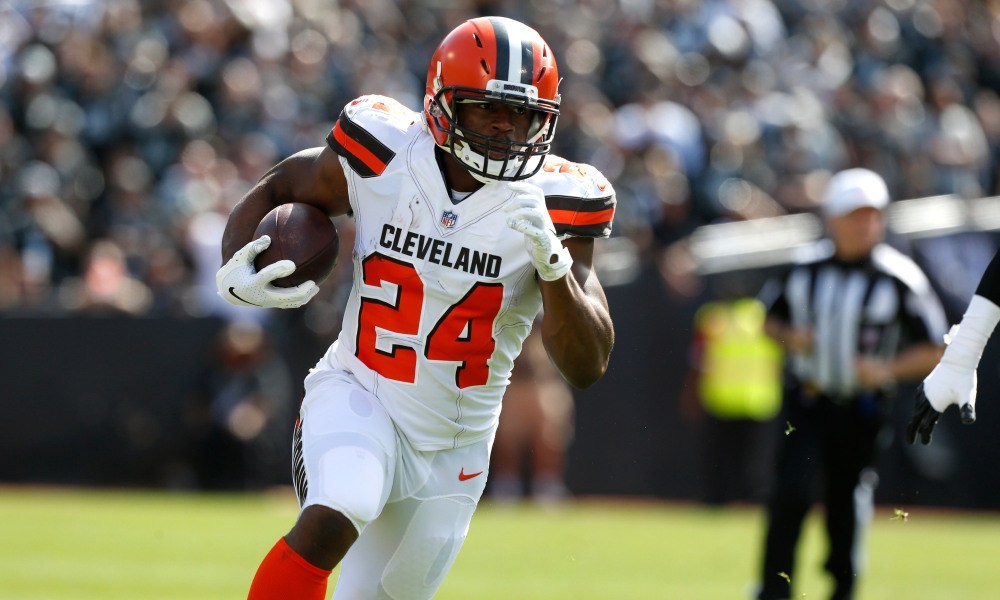
Now that the method for calculating the value of both carries and receptions is established, projecting expected fantasy points for a running back is somewhat of a simple task. Using the number of carries and receptions an RB had/or is projected to have, will tell us the xFP of that player for any given season. For example, in 2019, Nick Chubb had 298 carries and 38 receptions, giving him an xFP value of 219.8 in non-PPR scoring and 255.8 in PPR scoring.
Fantasy Point Differential (FPD)
What is FPD and how is it calculated?
FPD is somewhat self-explanatory, in that it is looking at the difference between expected and actual fantasy points. Now that the method for calculating xFP is established, it is a simple step to apply that number retrospectively to any running back to see how their fantasy point output compares. That number can then be turned into a percentage of the expected value, by dividing the difference between the two numbers by the xFP for that running back.
Going back to the example of Nick Chubb in 2019, where his xFP was 219.8 and 255.8 in non-PPR and PPR, respectively. Chubb scored 219 and 255.2 fantasy points in those two formats respectively in 2019, giving him an FPD of -0.4% and -0.2%, respectively. That means that in 2019 Chubb performed almost exactly how he should have based on ten years of running back performance.
To give some context, in 2019, Raheem Mostert had an FPD of 56% and 49% in non-PPR and PPR leagues, respectively. In contrast, Frank Gore had an FPD of -28% and -35% in non-PPR and PPR, respectively. So while Mostert greatly outperformed his xFP in 2019, Gore struggled to make the most of his opportunities.
What does this tell us?
The first element is simply to review performance in a year. Fantasy points tie together so many elements of a running back’s results that by using xFP and FPD we can immediately assess whether a back over or underperformed the opportunities afforded to him.
The test for fantasy football owners, especially in dynasty leagues, is determining how to use this information. On the one hand, you may be able to take a back who scored highly but still underperformed compared to his xFP and sell them high, knowing the risk of a big drop off if the opportunities are not there in the future. However, the same goes for selling high or buying low on players. FPD can help to identify players whose success may not be sustainable, or whose tough season was not due to a lack of opportunities, but maybe some bad luck.
Translating this into a winning formula is key. At the basic level, the xFP metric can give fantasy owners an idea of how optimistic or pessimistic a running back’s fantasy point projections are for that season. However, with just a touch more research, the FPD metric can tell a story. Maybe the rookie back that struggles last season is really yet another back struggling in the same system as others have failed previously? Did the back that succeeded wildly last year lose some key pieces to his offensive line? The FPD metric simply offers insight into how a player performed relative to their xFP. The key is to then translate that data into a projection for the future.







