


Artificial intelligence, machine learning and deep learning are popular terms in enterprise IT, and sometimes used interchangeably, particularly when companies are trying to market their products. The terms, however, are not synonymous — there are important distinctions. Here is a primer on artificial intelligence vs. machine learning vs. deep learning.
What is artificial intelligence?
The term AI has been around since the 1950s. In short, it depicts our struggle to build machines that can challenge what made humans the dominant lifeform on the planet: our intelligence. However, defining “intelligence” has turned out to be rather tricky, because what we perceive as intelligent changes over time.
Early AIs were rule-based computer programs that could solve somewhat complex problems. Instead of hardcoding every decision the software was supposed to make, the program was divided into a knowledge base and an inference engine. Developers would fill out the knowledge base with facts, and the inference engine would then query those facts to arrive at results.
But this type of AI was limited, particularly as it leaned heavily on human input. Rule-based systems lack the flexibility to learn and evolve and are hardly considered intelligent anymore.
Modern AI algorithms are capable of learning from historical data, which makes them usable for an array of solutions such as robotics, self-driving cars, power grid optimization and natural language understanding.
While AI sometimes yields superhuman performance in these fields, we still have a long way to go before AI can actually compete with human intelligence.
For now, there is no AI that can learn the way humans do, that is, with just a few examples. AI needs to be trained on mountains of data to understand any topic. We still don’t have algorithms that are capable of transferring their understanding of one domain to another. For instance, if we learn a game such as StarCraft, we can play StarCraft II just as quickly. But for AI, it’s a whole new world and it must learn each game from scratch.
Human intelligence also possesses the ability to link meanings. For instance, consider the word “human.” We can identify humans in pictures and videos, and AI has also gained that capability. But we also know what we should anticipate from humans: We never expect a human to have four wheels and emit carbon like a car. Yet, there is no AI that can even tell what was wrong with the sentence I just wrote.
So, AI’s definition is a moving target. We were amazed when AI algorithms got so sophisticated that they outperformed expert human radiologists but later learned about their limitations. That’s why we now distinguish between the current “narrow” AI and the human-level version of AI that we are pursuing: artificial general intelligence.
What is machine learning?
Machine learning is a subset of AI — it’s one of the AI algorithms we’ve developed to mimic human intelligence. The other type of AI would be symbolic AI or good old-fashioned AI (GOFAI), i.e. rule-based systems using if-then conditions.
Machine learning marks a turning point in AI development. Before machine learning, we tried to teach computers all the ins and outs of every decision they had to make. This made the process fully visible, and the algorithm could take care of a number of complex scenarios too.
In its most complex form, the AI would traverse a number of decision branches and find the one with the best results. That is how IBM’s Deep Blue was designed to beat Garry Kasparov at chess.
But there are many things we simply cannot define via rule-based algorithms: for instance, face recognition. A rule-based system would need to detect different shapes such as circles, then determine how they are positioned and within what other objects, so that it would constitute an eye. And don’t ask programmers how to code for detecting a nose!
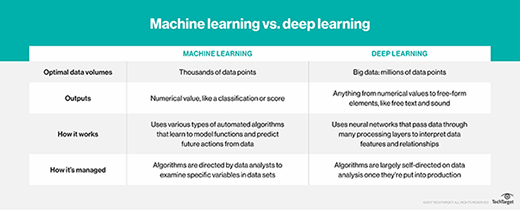
Machine learning takes an entirely different approach and lets the machines learn by themselves, by ingesting vast amounts of data and detecting patterns. Many machine learning algorithms use statistics formulas and big data to function, and it is arguable that our advancements in big data and the vast data we collected enabled machine learning in the first place.
Some of the machine learning algorithms used for classification and regression include linear regression, logistic regression, decision trees, support vector machines, naive Bayes, k-nearest neighbors, k-means, random forest and dimensionality reduction algorithms.
What is deep learning?
Deep learning is a subset of machine learning. It still involves letting the machine learn from data, but it marks an important milestone in AI’s evolution.
Deep learning was developed based on our understanding of neural networks. The idea of building AI based on neural nets has been around since the 1980s, but it wasn’t until 2012 that deep learning got real traction. Just like machine learning owes its bloom to the vast amount of data we produced, deep learning owes its adoption to the much cheaper computing powers that became available (as well as advancements in its algorithm).
Deep learning enabled much smarter results than were originally possible with machine learning. Consider the face recognition example from earlier: In order to detect a face, what kind of data should we give to the AI and how should it learn what to look for, given that the only information we can provide is pixel colors?
Deep learning makes use of layers of information processing, each gradually learning more and more complex representations of data. The early layers may learn about colors, the next ones learn about shapes, the following about combinations of those shapes and finally actual objects. Deep learning demonstrated a breakthrough in object recognition, and its invention made AI quickly advance on several fronts, including natural language understanding.
Deep learning is currently the most sophisticated AI architecture we have developed. There are several deep learning algorithms, including convolutional neural networks, recurrent neural networks, long short-term memory networks, generative adversarial networks and deep belief networks.
Wrapping up: AI vs. machine learning vs. deep learning
Contrary to AI, machine learning and deep learning have very clear definitions. What we considered AI changes over time. For instance, object character recognition, or OCR, used to be considered AI, but no longer is. However, a deep learning algorithm trained on thousands of handwritings and able to learn to convert those to text, by today’s definition, would be considered AI.
Machine learning and deep learning both represent great milestones in AI’s evolution, and there will probably be many others as we head for what we today call artificial general intelligence.







