

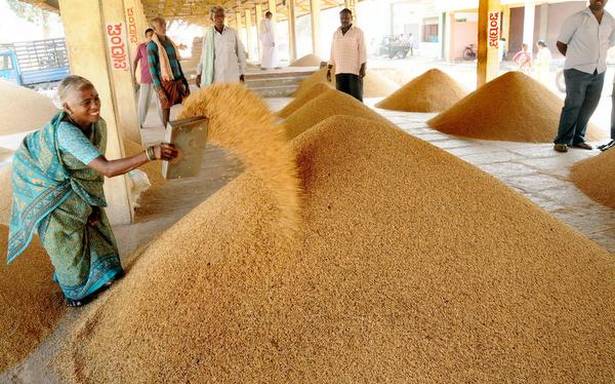
Wheat-producing States have already chalked out their plan of action at the onset of wheat procurement amid the Covid-19 pandemic. The procurement agencies are contemplating on how to enhance farmer coverage by rendering the benefit of price support scheme or minimum support price.
Is MSP-based procurement effective in times of coronavirus? Research shows that the MSP implementation can be effective for food-grains surplus-producing States, as the market clearing price often falls below the MSP. However, a reality check considering farmers’ awareness of and access to MSP, their perception about MSP, selling medium, turnaround time for transaction/payment, grievance redressal, etc are needed for improving the procurement efficacy.
Procurment evaluation
It is interesting to note that the Ministry of Consumer Affairs, Food and Public Distribution in association with Food Corporation of India (FCI) and Indian Institutes of Management carried out a State-specific concurrent evaluation of paddy procurement for the kharif marketing season (KMS) in 2019-20. As part of the monitoring institution, we conducted a formative evaluation of paddy procurement in Uttar Pradesh, which is a major food grains-producing and contributing State in procurement and offtake.
During the KMS 2019-20, the FCI and nine State agencies were involved in procurement, covering more than 50 revenue districts of UP. The agencies together procured a whopping 56.55 MMT against a target of 50 MMT. About 7,08,485 farmers (that is only 5.8 per cent of the State’s farmer population) have benefited from this open-ended centralised procurement.
Following an extensive field survey conducted in the western and eastern parts of Uttar Pradesh, we find that about 92 per cent beneficiaries (out of 304 surveyed) perceive the role of MSP as a remunerative price, about 66 per cent report MSP being a price instrument that prevents distress sales, and about 42 per cent believe its role is setting a floor price for open market. The majority of non-beneficiaries (out of 298 interviewed) perceive the importance of MSP in floor-price setting and preventing distress sales. However, merely 8 per cent non-beneficiaries perceive the MSP as a source of remunerative price.
On the access to MSP, most farmers receive the information about paddy procurement operation from fellow farmers, actual visit to markets/mandis, local newspapers and SMS alerts. While co-operative societies also disseminate MSP information to some extent, the role of TV, radio, commission agents or traders and the local panchayat is almost negligible.
Findings also reveal that farmers have sold their grains through the government procurement centre at the APMC mandis (about 45 per cent), retail/rice mills (about 22 per cent), and government procurement by cooperatives/self help groups (about 17 per cent). About 11 per cent farmers marketed their paddy to private traders either at or outside APMCs. The average volumes of paddy sold by farmers is highest at APMC-private and -government procurement that varies between 16-17 tonnes per farmer, followed by retail/rice mill (about 13 tonnes) and government procurement by cooperatives/SHGs (about 9 tonnes). These figures support the role of government in procurement (either at APMCs or through cooperatives/SHGs) and APMCs by government or private trader procurement.
Realisation of prices
Price realisation is observed to be at the maximum (MSP of common/Grade A paddy, ₹18,150-18,350 per tonne plus ₹200 as incidental expenses) when farmers sell paddy at the government procurement centre of APMCs or through cooperatives/SHGs outside APMCs. Lower price realisation from aggregators and private traders (average price being ₹13,500) with a higher dispersion from the average price suggests that some farmers realised extremely non-remunerative price due to low bargaining power or immediate requirement of cash.
The average price realised from private traders within APMCs (₹14,642) is significantly higher than that of from private traders outside APMCs (₹13,166). This implies that beneficiary farmers can have better access to information of price and market arrival and several options at APMCs as compared to the outside market.
We also observe that about 50 per cent of surveyed farmers sold their paddy to government procurement centres in the APMC premises, which are located on an average distance of about 6-8 km from their farm gate or houses. About 15 per cent farmers disposed grains directly to rice mill, even though they are located at an average distance of about 13 km from the farm gate. There are no stringent quality checks here, as is done at government procurement centres, nor is there requirement of land records-based pre-registration criteria while selling at rice mills. Farmers sell relatively a low quantity of paddy within villages or nearby village/town.
Transaction waiting-time or payment realisation time, however, varies. For a majority of farmers (about 94 per cent non-beneficiaries and 52 per cent beneficiaries), the average transaction time in selling their produce is between 2-8 hours. Since non-beneficiaries often sell their produce to private traders at APMC premises, about 43 per cent of them complete their transaction within just 2-4 hours. On the other hand, for about 26 per cent beneficiaries, the average transaction time is between 1-2 days, especially in peak procurement season. About 35 per cent beneficiaries realised full payment within a week, and 49 per cent of them reported a longer turnaround time of about 30 days or more. In contrast, 55 per cent non- beneficiaries received their payment on the spot, and 25 per cent realised in two days.
So, payment immediacy compels many farmers sell grains outside the MSP system. However, payment transparency at MSP-based procurement has been observed as beneficiaries realised their MSP dues via DBT. About 75 per cent of non-beneficiaries received payment in cash and only 17 per cent non-beneficiaries received it through transfer.
Systematic improvement
There is potential to improve the procurement efficacy. First, the awareness level of farmer should increase; local social media can play an important role in this. Though the android-based cell phone is a dominant medium of price and market arrival information, community radio can also make an impact on MSP information dissemination for farm communities.
Second, as most procurement centres/APMCs run an online procurement system (83.3 per cent) and online onsite registration system by State food marketing department (91.7 per cent), we propose a 100 per cent adoption of online procurement system to improve governance of procurement system.
Third, availability of moisture measurement kit and assaying facilities, high speed dryers, and DBT of MSP dues to farmer accounts can make an effective MSP-based procurement. Also, to bring transparency, procurement centres need to display specification and price in vernacular language and grievance redressal mechanism should be in place to address farmer complaints related to delay in payment or transaction time.
Fourth, since the mobility of farmers and procurement agencies has been restricted, further deliberations on the effective implementation of MSP and its dovetailing with the electronic negotiable warehouse receipt financing and farmer-producer organisation trading modules, added to the eNAM portal and Aadhaar-enabled registration and payment system, should take place at policy level.
Finally, the price deficiency payment system, as piloted in Madhya Pradesh and staggered procurement in Punjab, can have implications for the farm sector amid the lockdown.
The writers are faculty for Centre for Food & Agribusiness Management at IIM-Lucknow. Views are personal.







