

Joe Flatman explores half a century of reports from the past.
A selection of articles mentioned by Joe Flatman in this month’s column below can be accessed for free for one month via Exact Editions, from 2 April. Use the links within the text to jump to the individual articles, or click on the covers below. Print subscribers can add digital access to their account for just £12 a year – this includes everything from the last 50 years, right back to Issue 1! Call our dedicated subscriptions team on 020 8819 5580, quoting DIGI362, to add digital access to your account, or click here for more information.
In my last two columns I explored the history of CA’s visits to two neighbouring counties, Hampshire and the Isle of Wight. Examining the archaeological history of those locations got me thinking of other counties known and unknown to me, alike. In this latest column, therefore, I explore CA’s reporting on the archaeology of Cornwall over the past 50-plus years, a county – some would strongly urge, a country – that I have begun to visit of late due to family connections. Subsequent columns will (in no particular order) follow this geographic theme, so if you have a favoured county that you’d like me to focus on in the future, then do please let me know.
ROUNDS AND CLIFF CASTLES
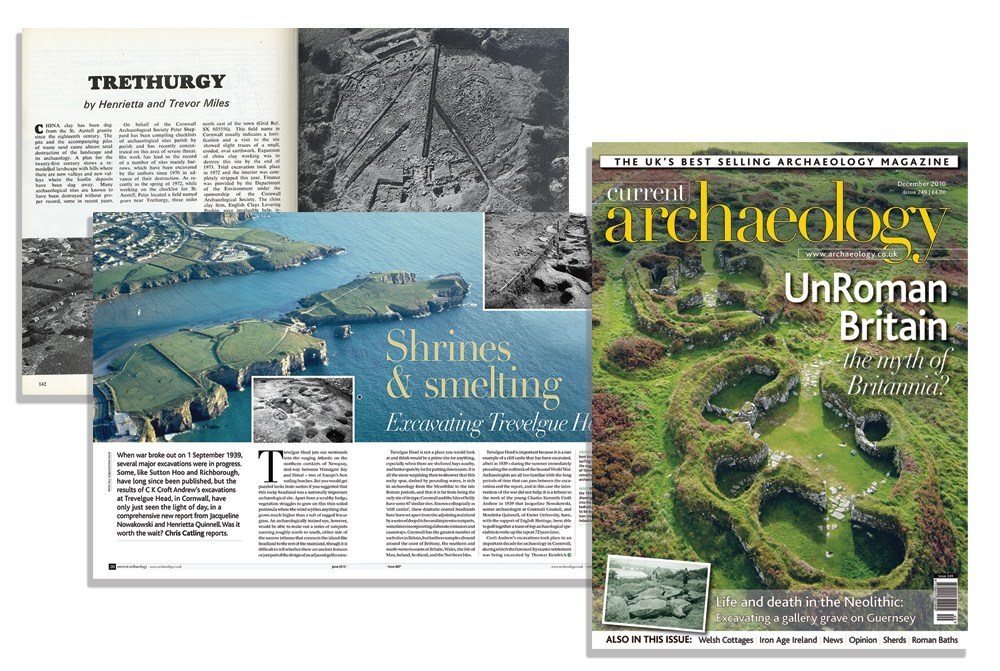
Cornwall first featured in issue 40 (September 1973), when CA visited excavations led by the Cornwall Archaeological Society at Trethurgy, near St Austell. Survey of an area of sites threatened by industry had identified a ‘round’ (otherwise known as a ringfort or rath), and even truncated, as it had been by later land-use, the Trethurgy round was impressive. With an interior spanning 48m by 55m, the ramparts survived to about 1.50m high within the Cornish hedge banks on two sides of the site, which sits 170m above sea level on a hill slope with a good view of St Austell Bay. Excavation of the site over subsequent years demonstrated that occupation started in the late 2nd century AD, with three oval houses situated within the perimeter. A possible four-post granary structure (alternative hypotheses for the structure are that it was a watchtower or even a platform for exposing the dead) was identified, as well as areas for animal husbandry and storage, in use throughout the occupation, which continued until the late 4th century before declining.

CA 47 (November 1974) visited another ‘defended’ hilltop site, that of Carn Brea, to the immediate south-west of Redruth. Excavations led by Roger Mercer between 1970 and 1972 examined the Neolithic occupation of this site between around 3700 and 3400 BC: the fieldwork identified a two-acre (0.8ha) inner enclosure surrounded by one of 11 acres (4.5ha), enclosing 14 platforms on which would have stood Neolithic longhouses. In similar vein, CA 267 (June 2012) visited Trevelgue Head near Newquay, one of the most dramatic clifftop ‘defended’ sites in Cornwall, rich in archaeology from the Mesolithic to the late Roman periods. Known colloquially as ‘cliff castles’, these coastal locations were set apart from the adjoining mainland by ditches and ramparts, often incorporating elaborate entrances and causeways. Cornwall has the greatest number of such sites in Britain – 67 in total – but further examples abound around the coast of Brittany, the southern and southwestern coasts of England, Wales, the Isle of Man, Ireland, Scotland, and the Northern Isles.

THE FARM AND THE FOGOU
In contrast to these defended sites, CA 44 (May 1974) explored the archaeology of another distinctively Cornish site-type: a fogou (or fougou), a Cornish-language word meaning ‘cave’. These are akin to the underground passages known as souterrains in other parts of the western seaways in Brittany, Ireland, and Scotland. CA 44 visited the fogou at Carn Euny, just to the west of Penzance. It is situated in the centre of a larger settlement, occupied from the Iron Age until the late 4th century AD, with walls that survive up to a metre high in places, making it among the best-preserved ancient villages in south-west England.

CA 249 (December 2010) then visited perhaps the most famous of all settlement sites in Cornwall: that of Chysauster, near Penzance. As they explained in Current Archaeology (and explored in depth in their book UnRoman Britain), the archaeologists Miles Russell and Stuart Laycock proposed through their analyses of such sites a different view than that traditionally accepted of life in ‘Roman’ Britain. They suggested that beyond the lifestyles of the wealthy and prominent few, Roman culture never fully embedded itself in Britain, having a comparatively minor impact on the people and period that immediately followed. Chysauster is, in this context, a prominent location regionally where the inhabitants traded with Rome but did not become ‘Roman’ themselves. Putting a more modern spin on the situation, Russell and Laycock propose that:
As with the white-washed colonial houses built by British émigrés in India, or the brick-built Georgian houses of America, many of the palatial villas of Roman Britain may not have been created by (or indeed for) the indigenous population, but for incoming officials, entrepreneurs, and pioneers… Ultimately, such cultural ‘bubbles’ probably had comparatively little impact on the wider native lands beyond.
A further exploration of Cornwall’s Iron Age settlements came in CA 309 (December 2015), with visits to the Iron Age settlements at Middle Amble Farm and Carruan Farm near Polzeath. Geophysical survey on Cornwall’s north coast at this time had revealed two substantial settlements – perhaps even ‘proto-towns’ like ‘Duropolis’, where around 150 roundhouses were recently excavated near Winterborne Kingston, Dorset (see CA 306) – but unlike the examples discussed above, these sites had none of the monumental defences traditionally associated with settlements of this size.
INDUSTRIAL LEGACIES
While many visitors to Cornwall (at least those of an archaeological mindset) come to explore its prehistoric sites, the most visible elements of its history are those of its industrial, especially mining, legacy. CA 216 (March 2008) – and, more recently, CA 352 (July 2019) – focused on industrial sites up and down the country in an in-depth review by the then-just-retired chairman of English Heritage, Sir Neil Cossons. Cornish mining sites rightly feature prominently in this review, including Levant Mine near Penzance, which has the oldest working steam-powered beam engine in Cornwall, and comprises part of the Cornish Mining Landscape that was declared a World Heritage Site in 2007.
A final site that mustbe mentioned in anysurvey of Cornish archaeology is Gwithian, a parish inwest Cornwall that was explored in CA 220 (July 2008). The site became the focus of an extensive project from the late 1940s onwards that was, until the 1960s, led by that doyen of Cornish archaeology, Charles Thomas. Over 70 sites were investigated in the course of the survey, dating from the Mesolithic to the post-medieval periods, through excavations large and small, field surveys, and field-walking. CA revisited the site, metaphorically speaking, in 2008 to learn of steps being undertaken to fully publish the results of this remarkable project, which was in many ways far ahead of its time as an integrated, multi-period, multi-site assessment of a location. Although there had been interim publications of results, full details of the three set-piece excavations – the Bronze Age sites, the post-Roman site, and the medieval manor of Crane Godrevy – had remained unpublished until, in 2003-2004, an appraisal of the entire archive led to further detailed study by the Historic Environment Service of Cornwall County Council. Thanks to this painstaking archival work, the full story of the area, and of the communities of archaeologists who surveyed and excavated it, can now be told.
Further information
Trevelgue Head is freely accessible from the South West Coast Path.
Carn Euny is in the care of the Cornwall Heritage Trust and is also free to visit – see www.english-heritage.org.uk/visit/places/carn-euny-ancient-village/.
Chysauster (English Heritage) and Levant Mine (National Trust) are both regularly open to the public. For details about Chysauster, see www.english-heritage.org.uk/visit/places/chysauster-ancient-village/, and for Levant Mine, see www.nationaltrust.org.uk/levant-mine-and-beam-engine.
The Gwithian archive can be accessed for free online via the Archaeology Data Service at https://archaeologydataservice.ac.uk/archives/view/ gwithian_eh_2007/overview.cfm.

About the author
Joe Flatman completed a PhD in medieval archaeology at the University of Southampton in 2003, and since then has held positions in universities, and local and most recently – central government. Since March 2019, he has been a Consultancy Manager in the National Trust’s London and South-East Region, leading a team working on Trust sites across Hampshire and the Isle of Wight. You can follow him on Twitter @joeflatman.







