

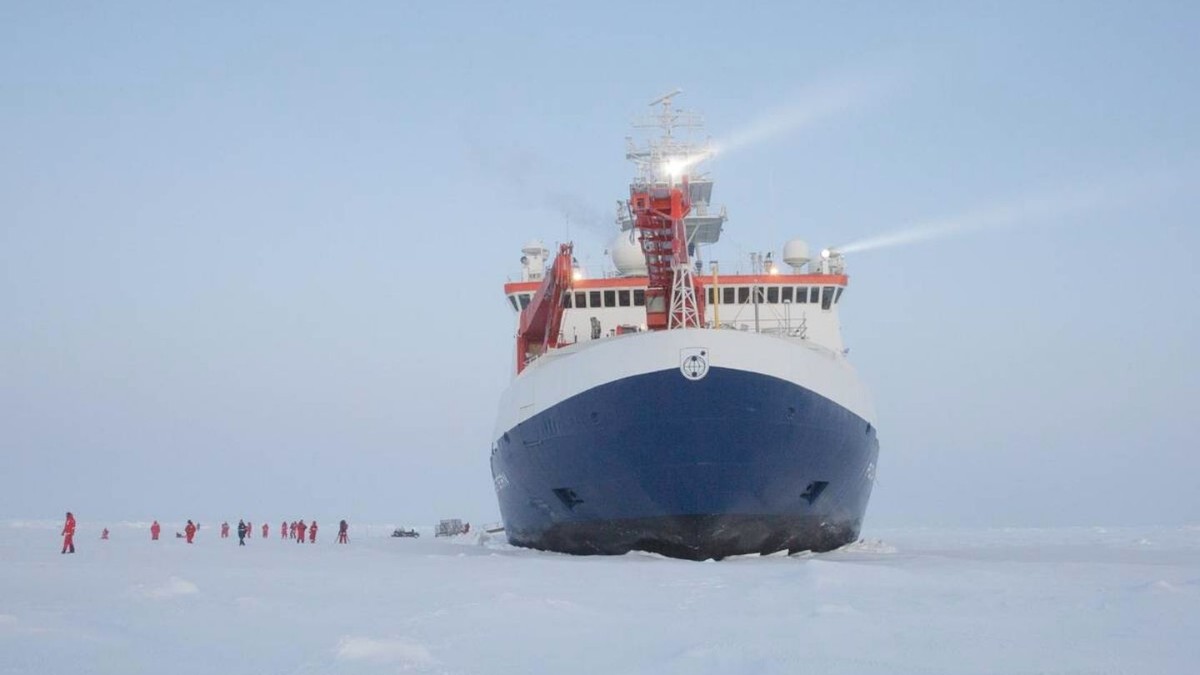
For the past six months, the German icebreaker Polarstern has been drifting through the central Arctic Ocean, intentionally frozen into the ice. A rotating cast of hundreds of scientists from all over the world have been traveling to and from the vessel for months at a time to assist with the MOSAiC expedition, an enormous polar science effort aimed at improving our understanding of the Arctic environment in a time of rapid, human-caused climate change.
The year-long expedition’s next crew rotation was set to fly to the Polarstern from Svalbard, Norway, in mid-April. But thanks to a global pandemic, that plan has been dashed. Now, the scientists currently aboard the Polarstern are preparing to stay put for approximately six weeks longer than they had planned in order to keep the ship’s myriad research projects alive.
Earlier this month, the government of Svalbard – a remote island archipelago in the Arctic Ocean – closed its borders to outsiders amid growing concerns over COVID-19. As a result, roughly 100 scientists and support staff who had planned to relieve the crew that’s been aboard the Polarstern since February no longer have a flight. MOSAiC’s organisers are now scrambling to pull together a contingency plan, which will likely involve ferrying the next group of scientists north with a resupply shipment aboard a giant icebreaker vessel.
“There’s no way to carry out these flights for the crew rotation,” said Markus Rex, an atmospheric scientist at the Alfred Wegener Institute Helmholtz Centre for Polar and Marine Research and expedition leader for MOSAiC. “That has a major impact on how we plan the expedition.”
As the coronavirus pandemic ripples around the globe, travel by air, land, and sea has been brought to a standstill. This is upending countless scientific field expeditions, including planned trips to Greenland this spring, NASA-led Earth science airborne campaigns, and dozens of oceanographic research cruises using ships that are part of the U.S. Academic Research Fleet, which was ordered to stand down earlier this month.
MOSAiC scientists face the challenge of continuing a massive international research endeavour that can’t easily be stopped. As organisers navigate travel restrictions in order to keep crews of scientists and support staff rotating on and off the Polarstern and ensure a steady influx of new supplies, they’re also doing everything in their power to prevent a deadly virus from spreading to the vessel, which is difficult to reach by air and takes weeks to reach by sea.
The first signs of trouble came earlier this month, when a researcher who had planned to participate in survey flights out of Svalbard to support MOSAiC tested positive for the virus. That caused MOSAiC to delay its spring airborne campaign, and subsequently, the campaign was canceled as the Norwegian government and local authorities on Svalbard began restricting international travel.The MOSAiC team is exploring the possibility of extending a series of planned summertime flights to compensate, although Rex warned that it’s “too early to say what will happen to the summer phase.”
The cancellation of these survey flights, which were going to study Arctic ice, cloud, and aerosol properties, are a disappointment, but they don’t compromise the campaign’s core scientific mission.
The bigger concern now is what to do about the crew that was supposed to link up with the Polarstern in April, relieving the roughly 100 scientists and support staff currently aboard. Fortunately, the Polarstern is in no danger of running out of supplies anytime soon, and the scientists currently on board are continuing to go about their day-to-day activities.
“People on Polarstern are safe, they are in a virus free environment, they have all the provisions they need,” Rex said. “They are focusing on science.”
The contingency plan now taking shape involves chartering an icebreaker vessel to ferry the relief crew north after everyone’s undergone a 14-day quarantine and tested negative for the coronavirus. Organizers are currently in talks with “a number of icebreakers,” Rex said, as well as authorities in various partner countries to determine where their vessel can ship off from.
Or, instead of chartering an entirely new ship, the team could potentially accelerate the expedition’s next resupply cruise. MOSAiC had already chartered the Swedish icebreaker Oden to ship north and rendezvous with the Polarstern in June. Organizers are now looking into the possibility of bumping that resupply shipment forward to approximately mid-May, and sending the relief crew along with it. In that scenario, the team currently aboard Polarstern would spend about six extra weeks on the ship, and instead of three more crew changes between now and September, there would be two.
While this would mean leaving behind some scientists who had planned to participate in MOSAiC, Rex says it’s likely that a number of researchers will not be able to go anyway due to travel restrictions from their institutions or countries.
Another challenge MOSAiC’s organizers have been wrestling with is disembarking an outgoing expedition of scientists who left the Polarstern in early March bound for Tromso, Norway. Until very recently, it looked as if these researchers – traveling aboard the Russian icebreaker Kapitan Dranitsyn – would need to find a new port due to Norway’s coronavirus travel restrictions. But recently, the team got some good news: The Norwegian authorities are granting the Kapitan Dranitsyn an exception so that its crew can disembark and head to a nearby airport.
“We will bring them from a bus transport from the port to a shuttle flight back to Germany,” Rex said. “And we have support from the German authorities to travel to Bremen and back to their home countries from Bremen. Obviously that was quite a bit of work to make that happen.”
As the MOSAiC mission soldiers on, other scientists are coming to terms with the fact that their own expeditions, some of which have been in the works for years, are going to have to wait as well.
These include a University of Rhode Island-led campaign to study symbiotic relationships between deep sea animals and bacteria at hydrothermal vents in the southwest Pacific in April, and EXPORTS, a NASA-led effort to study ocean carbon cycling that includes over a dozen research projects and was set to kick off next month in the North Atlantic.
Both cruises were called off earlier this month amidst the U.S. Academic Research Fleet’s 30-day suspension, and both are now anticipating significant delays.
“We don’t know when this cruise will be rescheduled,” said Roxanne Beinart, an assistant professor at the University of Rhode Island leading the deep sea campaign, noting that it took several years for her team to secure both the vessel and underwater robots needed to carry out their planned field work. “Even if the pandemic miraculously resolves very quickly, it could be easily a year before we get back on the schedule.”
As for EXPORTS, it’s currently unclear whether it can be resuscitated in the exact manner as was planned for this year, partly because one of the participating research vessels, the R/V Atlantis, wasn’t scheduled to be in the Atlantic in 2021. Science lead Dave Siegel of the University of California, Santa Barbara said the team has reached out to various European partners to see if a different ship can be secured. But ultimately, some science might have to be sacrificed for the sake of expediency, since a key goal of the campaign was to provide data in support of an $800-million NASA ocean satellite slated to launch in 2022.
“Science is going to go forward,” Siegel said, noting that an initial 2018 campaign in the North Pacific was quite successful. “But having the opportunity to get all the resources in the same place at the same time? I don’t know if we’ll be able to do that again.”
This article originally appeared on VICE US.







