

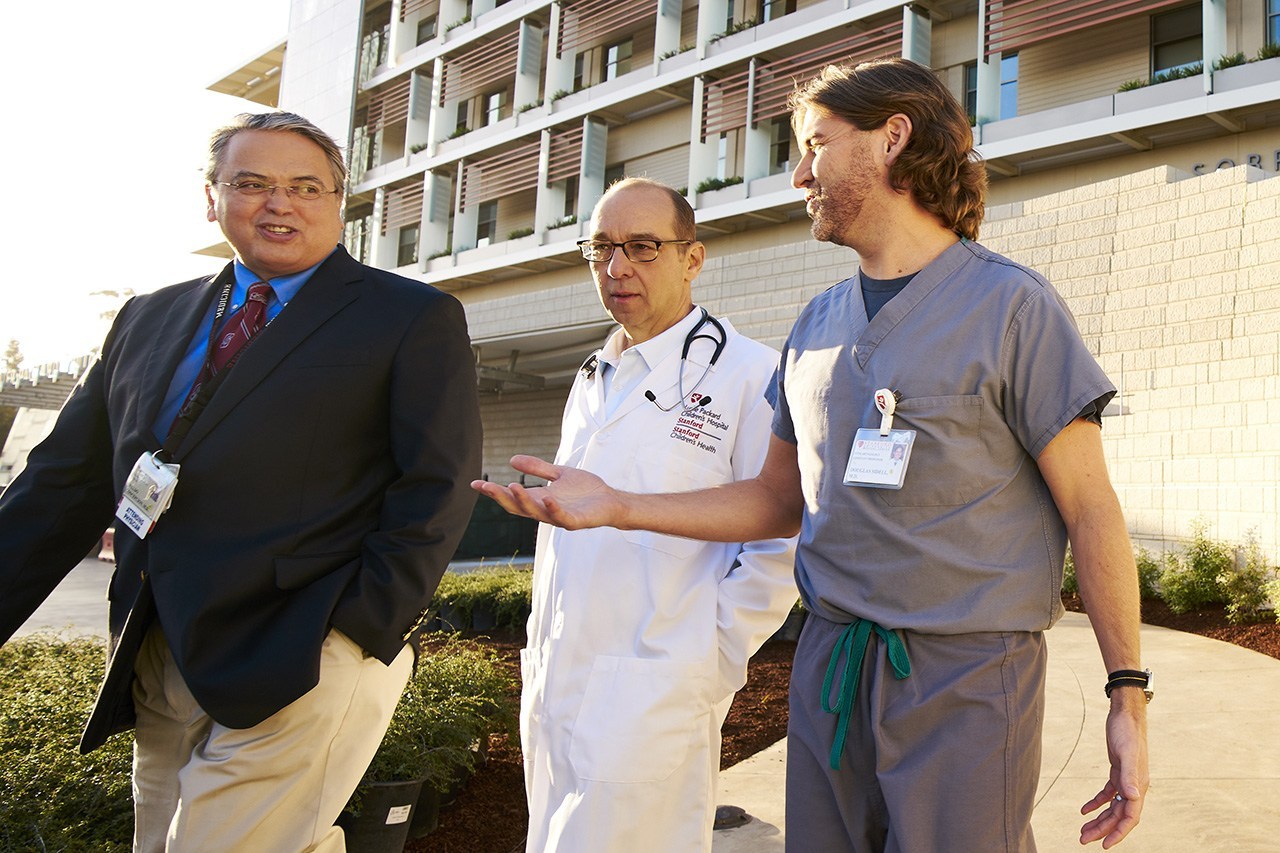
As a pediatric pulmonary physician, Dr. David Cornfield treats children and teenagers, generally the population least susceptible to Covid-19. But because his clinical practice is through the Lucile Packard Children’s Hospital in Stanford, most of the patients he sees also have underlying medical conditions.
“We serve a pretty vulnerable population,” he said. “Children born prematurely, children with asthma, cystic fibrosis, chronic lung diseases, pulmonary hypertension. Little babies that have gone through the gauntlet, born very, very tiny and are now just beginning to walk. There is tremendous anxiety among the children, and their families.”
Cornfield works both in inpatient and outpatient at the Children’s Hospital, and in a related clinic across the street. There are about 25 clinicians in the practice, he says, and so far they have not seen many infected cases at the hospital. But there have been some positive cases, one of whom was hospitalized for a non-respiratory issue.
“Covid-19 may not be so problematic for otherwise healthy children, but we have every reason to believe it might be for these kinds of patients,” he said in an interview. “There is tremendous fear and uncertainty, which is wholly understandable.”
In addition to his clinical practice, Cornfield is a highly regarded physician scientist, engaged in multiple research projects in the field of pulmonary medicine (conditions affecting lungs and breathing), and is a professor of pulmonary pediatric medicine at Stanford and medical director of respiratory therapy at the Children’s Hospital.
He is engaged in several studies right now to develop more usable data about Covid-19, because, he says, there’s very little out there, and some of what’s been published is leading to misinformation and unnecessary fears.
For example, he points to a recent article in the New England Journal of Medicine that described how long the coronavirus can live on cardboard, steel and other hard surfaces. That information went viral, but was widely misinterpreted. “That was a very controlled laboratory study,” he cautions. “It didn’t really focus on transmissibility. Yes, the virus can live on packages and bags, but not always in the amount that can be transmissible.
“There’s a tremendous amount of anxiety, because there’s just no data.”
To provide much-needed normative data, Cornfield is leading a Stanford study that will examine 400 schoolchildren on the Peninsula to determine the prevalence of Covid-19 in those ages 10-18. The study, conducted together with the the Chan Zuckerberg Biohub, could start as early as next week.
There’s a tremendous amount of anxiety, because there’s just no data.
He is also working with a team of engineers, bioengineers and physicists to develop a remote-controlled ventilator that would reduce the risks in caring for infected patients by mitigating staff exposure. That study is bringing together experts from UC Berkeley, UCSF and Stanford, among others.
“We’re trying really hard,” he said.
One of the things he’s most concerned about is the shortage of medical professionals in areas of the country hardest hit by Covid-19, including New York City. A colleague of his who runs a major health care organization there put out an emergency appeal for physicians to come work in the city, where they are currently caring for 1,000 patients with Covid-19, more than a quarter of whom are on ventilators.
“They’re running out of doctors,” Cornfield said. “The governor has said he will accredit them within 24 hours. That usually takes 24 months. It’s unprecedented.”
Still, Cornfield cautions, the coronavirus situation can be and will be handled. By following the prudent guidelines sent out by the CDC, notably social distancing and regular, careful hand-washing, people can protect themselves and their families.
At his clinic, Cornfield and his staff follow an eight-point strategy they developed to mitigate exposure to possibly infected people. Anything elective has been canceled and almost all patient visits are conducted virtually. Person-to-person contact is limited to direct medicine, he says. They even have to delay or cancel routine appointments for chronically ill patients.
“We are concerned not just about the children themselves, but about their families and all the extended family members that accompany patients to these appointments,” he said. “We are doing our very best to mitigate exposures.”
And yes, staying 6 feet away from other people is important, and not a made-up number. Asked whether 3 feet was enough, he said no. “It does matter. Six feet is the way to go.”
So when will the much-vaunted flattening of the curve take place? Cornfield predicts we will know a lot more by the end of the weekend, when we will begin to see whether the shelter-in-place and other proactive steps people are taking have any effect.
“As of yesterday, the numbers in the Bay Area appear to be flattening,” he said Friday.
“People need to know this is a real danger, and it will be with us for some time. But it’s not a magical danger. You can take prudent steps to keep yourself and your family safe.”
He was in line at a CVS store recently, he said, and a woman fully 10 feet away recoiled from him. He saw that as an overreaction.
“You can still be kind, you can still find each other’s humanity. This is not the Bubonic Plague.”







