


By Dusty Sonnenberg, CCA, Ohio Field Leader: a project of the Ohio Soybean Council and soybean checkoff
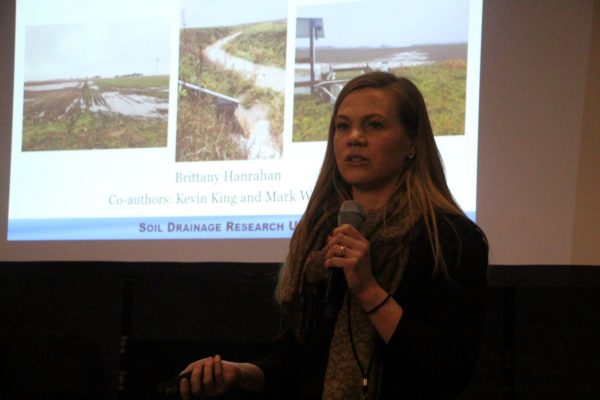
Identifying factors that influence flow and nutrient loss was the topic of a presentation by Brittany Hanrahan, research biologist with the ARS Soil Drainage Research Unit in Ohio at the Conservation Tillage Conference.
“We know that storms can contribute disproportionately to cumulative annual phosphorus (P) and nitrogen (N) losses during the year,” Hanrahan said. “The big picture is that excess P and N fuel algal blooms and have negative impacts. Excess P and N fertilize the algal blooms which eventually die and decompose stripping oxygen from the water causing hypoxic zones. There are over 400 different hypoxic zones found in the world today.”
Data collected in the edge of field studies show that peaks in water discharge coincide with peaks in precipitation events. Surface runoff levels of P and N differ from tile discharge levels.
“Flow and nutrient loss vary and are consistent with seasonal patterns that we would expect,” Hanrahan said. “Flow and nutrient loss are not strongly predicted by precipitation alone. Rainfall total explains only 9% of tile N loss and 13% of tile dissolved reactive phosphorus (DRP) loss.”
There is large variability in flow and nutrient response for any given precipitation event.
“Over 80% of the variability in DRP and N load remains unexplained,” Hanrahan said. “We need to look at other variables rather than just precipitation alone to further explain this.”
Water quality is controlled by various factors.
“Water quality is influenced by source, mobilization, and delivery,” she said. “Source is the amount of P or N that is in the soil profile; mobilization are the processes that control the release of nutrients, or make P and N available; and delivery includes the transportation pathways, such as surface or subsurface flow.”
Each of these factors (source, mobilization and delivery) are controlled by number of sub-factors.
“Land cover, land use and management, atmospheric deposition, geology and soil properties, climate, topography and catchment hydrology all factor into those things that influence water quality in a number of different ways,” Hanrahan said.
In research, a simple linear regression model shows how one explanatory variable influences one response variable, and you can predict how that influence is happening and if it is a positive or negative effect. To tackle this multifaceted problem, a multiple linear regression model was created.
“This model included all the weather variables that we could think of, including the event precipitation, duration, intensity, previous 7-day precipitation, daily maximum temperature, and day of the hydrologic year,” Hanrahan said. “We also included field properties such as drainage area and average field slope. The model considered management practices that might affect event discharge, such as the number of tillage events in a given year, and the management system, such as no-till, or conventional, and also tile spacing. Soil properties including sand, silt, and clay content, soil organic matter levels, the soil C:N ratio, soil levels of Al, Fe, S, as well as soil test P and NO3-; and finally hydrologic variables such as event discharge, time to peak flow, and time to receding.”
The primary goal of the model was to help predict if each variable had a positive (increasing effect) on the response variable, or if it had a negative (or decreasing effect) influencing the response variable.
The magnitude of effect on tile drainage discharge is the response variable first being measured. Significant controls that had the strongest positive (increasing) effect were the previous 7-day precipitation, and event precipitation. The controls that had the strongest negative (decreasing) effect were daily temperature and tile spacing.
“Basically, as the amount of rainfall received in the previous 7 days increased and the amount of rain in the event increased, it had the greatest impact on tile drainage discharge increasing. As daily temperature increased and tile spacing increased, tile drainage discharge decreased,” Hanrahan said.
The effect on tile drainage nitrate load was the next response variable measured. The strongest positive (increasing) effects were: tile discharge and soil S level, followed closely by the total amount of N applied. The strongest negative (decreasing) effects: were days since fertilizer application and the day of the hydrologic year.
“As tile drainage discharge increased and the soil Sulfur level increased, the tile drain Nitrate load increased. As the days since fertilizer application increased and the date of the hydrologic year increased, the tile drain Nitrate load decreased,” Hanrahan said.
The effect on tile drainage DRP load was measured. The strongest positive effects were: tile discharge and soil test P levels. The strongest negative effects were: soil Al levels and days since fertilizer application.
“As tile discharge increased and soil test P levels increased, the DRP level increased in the drainage. As the days since fertilizer application increased and the date of the hydrologic year increased, the DRP load in the drainage decreased,” Hanrahan said.
The effect on surface discharge was measured. The strongest positive effects were: the percent clay content of the soil, and the average field slope. The strongest negative effects were: date of the hydrologic year, and soil organic matter.
“As the percent of clay content in the soil and the slope increased, the surface discharge increased. As day of hydrologic year increased and organic matter increased, surface discharge decreased,” Hanrahan said.
The effect on surface nitrate load was measured. The strongest positives effects measured were: surface discharge and soil iron (Fe) levels. The strongest negative effects measured were: days since fertilizer application and the percent sand content of the soil.
“As surface discharge and the level of soil iron increased, the nitrate load increased, and as the days since fertilizer application increased and as the percent sand content of the soil increased, the nitrate load decreased in surface runoff,” Hanrahan said.
The effect on surface DRP load was measured. The strongest positives effects measured were: surface discharge and tile spacing. The strongest negative effects measured were: reduced vs. no-till and soil test Al levels.
“This is a little different. It is a category variable, not a continuous variable. This just means that as a field changes from reduce tillage to no-till, the surface DRP load decreased, and also as soil Al increased, the surface DRP load decreased. As the surface discharge increased and as tile spacing increased, the surface DRP load increased,” Hanrahan said.
All of the positive and negative effects can point to targeted management opportunities for the farmer. Factors that influenced nitrate and DRP load at the surface were very similar.
“A farmer can manage flow, they can manage fertilizer application in terms of the amount of fertilizer applied, and the timing of application. A farmer needs to consider the soil test P levels in the field,” Hanrahan said. “Soil Aluminum level was one thing that showed up notably more than once in the study, and will need to be researched further as to possible impacts.”
The multiple linear regression model, is very involved, but necessary in projects such as this with multiple influencing factors.
“The important part of this analysis is that we are considering all the factors together rather than individually, which is a systems approach. That confirms what we knew. Trying to figure out which factors interact with each other to know what is causing the responses is the next step. Once these are put into a model, we can figure out what we can manage to get reductions in the responses to the interactions,” Hanrahan said.







