

GLOBAL RESEARCH SYNDICATE
No Result
View All Result
  • Login
  • Latest News
  • Consumer Research
  • Survey Research
  • Marketing Research
  • Industry Research
  • Data Collection
  • More
    • Data Analysis
    • Market Insights
  • Latest News
  • Consumer Research
  • Survey Research
  • Marketing Research
  • Industry Research
  • Data Collection
  • More
    • Data Analysis
    • Market Insights
No Result
View All Result
globalresearchsyndicate
No Result
View All Result
Home Data Collection

US Government Sites Give Bad Security Advice — Krebs on Security

globalresearchsyndicate by globalresearchsyndicate
March 26, 2020
in Data Collection
0
US Government Sites Give Bad Security Advice — Krebs on Security
0
SHARES
3
VIEWS
Share on FacebookShare on Twitter

Many U.S. government Web sites now carry a message prominently at the top of their home pages meant to help visitors better distinguish between official U.S. government properties and phishing pages. Unfortunately, part of that message is misleading and may help perpetuate a popular misunderstanding about Web site security and trust that phishers have been exploiting for years now.

For example, the official U.S. Census Bureau website https://my2020census.gov carries a message that reads, “An official Web site of the United States government. Here’s how you know.” Clicking the last part of that statement brings up a panel with the following information:
A message displayed at the top of many U.S. .gov Web sites.

The text I have a beef with is the bit on the right, beneath the “This site is secure” statement. Specifically, it says, “The https:// ensures that you are connecting to the official website….”

Here’s the deal: The https:// part of an address (also called “Secure Sockets Layer” or SSL) merely signifies the data being transmitted back and forth between your browser and the site is encrypted and cannot be read by third parties.

However, the presence of “https://” or a padlock in the browser address bar does not mean the site is legitimate, nor is it any proof the site has been security-hardened against intrusion from hackers.

In other words, while readers should never transmit sensitive information to a site that does not use https://, the presence of this security feature tells you nothing about the trustworthiness of the site in question.

Here’s a sobering statistic: According to PhishLabs, by the end of 2019 roughly three-quarters (74 percent) of all phishing sites were using SSL certificates. PhishLabs found this percentage increased from 68% in Q3 and 54% in Q2 of 2019.

“Attackers are using free certificates on phishing sites that they create, and are abusing the encryption already installed on hacked web sites,” PhishLabs founder and CTO John LaCour said.
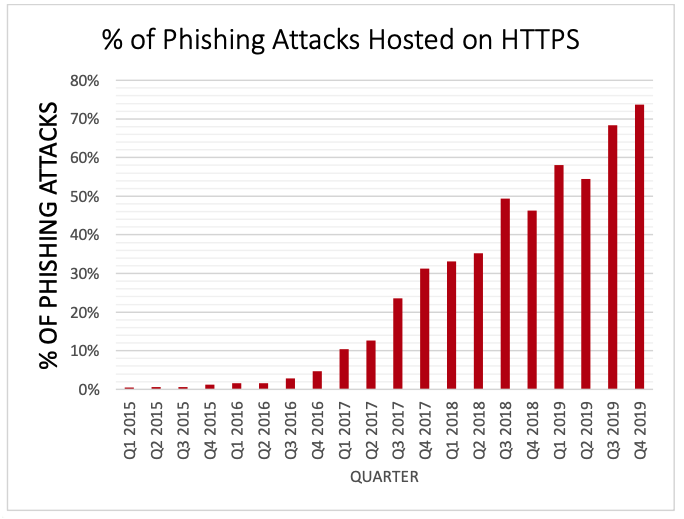
Image: PhishLabs.com

The truth is anyone can get an SSL certificate for free, and that’s a big reason why most phishing sites now have them. The other reason is that they help phishers better disguise their sites as legitimate, since many Web browsers now throw up security warnings on non-https:// sites.

KrebsOnSecurity couldn’t find any reliable information on how difficult it may be to obtain an SSL certificate for a .gov site once one has a .gov domain, but it is apparently not difficult for just about anyone to get their very own .gov domain name.

The U.S. General Services Administration (GSA), which oversees the issuance of .gov domains, recently made it a tiny bit more difficult to do so — by requiring all applications be notarized — but this seems a small hurdle for scam artists to clear.

Regardless, it seems the federal government is doing consumers a disservice with this messaging, by perpetuating the myth that the presence of “https://” in a link denotes any kind of legitimacy.

“‘Https’ does not mean that you are at the correct website or that the site is secure,” LaCour said. “It only indicates that the connection is encrypted. The server could still be misconfigured or have software vulnerabilities. It is good that they mention to look for ‘.gov’. There’s no guarantee that a .gov website is secure, but it should help ensure that visitors are on the right website.”

I should note that this misleading message seems to be present only on some federal government Web sites. For instance, while the sites for the GSA, the Department of Labor, Department of Transportation, and Department of Veterans Affairs all include the same wording, those for the Commerce Department and Justice Department are devoid of the misleading text, stating:

“This site is also protected by an SSL (Secure Sockets Layer) certificate that’s been signed by the U.S. government. The https:// means all transmitted data is encrypted — in other words, any information or browsing history that you provide is transmitted securely.”

Other federal sites — like dhs.gov, irs.gov and epa.gov — simply have the “An official website of the United States government” declaration at the top, without offering any tips about how to feel better about that statement.



Tags: John LaCour, OMB, phishing, PhishLabs, U.S. General Services Administration, White House Office of Management and Budget




This entry was posted on Wednesday, March 25th, 2020 at 3:30 pm and is filed under A Little Sunshine.
You can follow any comments to this entry through the RSS 2.0 feed.

You can skip to the end and leave a comment. Pinging is currently not allowed.


Related Posts

How Machine Learning has impacted Consumer Behaviour and Analysis
Consumer Research

How Machine Learning has impacted Consumer Behaviour and Analysis

January 4, 2024
Market Research The Ultimate Weapon for Business Success
Consumer Research

Market Research: The Ultimate Weapon for Business Success

June 22, 2023
Unveiling the Hidden Power of Market Research A Game Changer
Consumer Research

Unveiling the Hidden Power of Market Research: A Game Changer

June 2, 2023
7 Secrets of Market Research Gurus That Will Blow Your Mind
Consumer Research

7 Secrets of Market Research Gurus That Will Blow Your Mind

May 8, 2023
The Shocking Truth About Market Research Revealed!
Consumer Research

The Shocking Truth About Market Research: Revealed!

April 25, 2023
market research, primary research, secondary research, market research trends, market research news,
Consumer Research

Quantitative vs. Qualitative Research. How to choose the Right Research Method for Your Business Needs

March 14, 2023
Next Post
Global Asphalt Market 2018-2022 | Emergence of New Bitumen Refinery Plants to Boost Market Growth | Technavio | Business

Global Infrared Aerial Camera Market 2020-2024 | Increasing Use of Infrared Aerial Cameras in UAVs to Boost Market Growth | Technavio | Business

Categories

  • Consumer Research
  • Data Analysis
  • Data Collection
  • Industry Research
  • Latest News
  • Market Insights
  • Marketing Research
  • Survey Research
  • Uncategorized

Recent Posts

  • Ipsos Revolutionizes the Global Market Research Landscape
  • How Machine Learning has impacted Consumer Behaviour and Analysis
  • Market Research: The Ultimate Weapon for Business Success
  • Privacy Policy
  • Terms of Use
  • Antispam
  • DMCA

Copyright © 2024 Globalresearchsyndicate.com

Welcome Back!

Login to your account below

Forgotten Password?

Retrieve your password

Please enter your username or email address to reset your password.

Log In
This website uses cookies to improve your experience. We'll assume you're ok with this, but you can opt-out if you wish. Cookie settingsACCEPT
Privacy & Cookies Policy

Privacy Overview

This website uses cookies to improve your experience while you navigate through the website. Out of these cookies, the cookies that are categorized as necessary are stored on your browser as they are essential for the working of basic functionalities of the website. We also use third-party cookies that help us analyze and understand how you use this website. These cookies will be stored in your browser only with your consent. You also have the option to opt-out of these cookies. But opting out of some of these cookies may have an effect on your browsing experience.
Necessary
Always Enabled
Necessary cookies are absolutely essential for the website to function properly. This category only includes cookies that ensures basic functionalities and security features of the website. These cookies do not store any personal information.
Non-necessary
Any cookies that may not be particularly necessary for the website to function and is used specifically to collect user personal data via analytics, ads, other embedded contents are termed as non-necessary cookies. It is mandatory to procure user consent prior to running these cookies on your website.
SAVE & ACCEPT
No Result
View All Result
  • Latest News
  • Consumer Research
  • Survey Research
  • Marketing Research
  • Industry Research
  • Data Collection
  • More
    • Data Analysis
    • Market Insights

Copyright © 2024 Globalresearchsyndicate.com

