
GLOBAL RESEARCH SYNDICATE
No Result
View All Result
  • Login
  • Latest News
  • Consumer Research
  • Survey Research
  • Marketing Research
  • Industry Research
  • Data Collection
  • More
    • Data Analysis
    • Market Insights
  • Latest News
  • Consumer Research
  • Survey Research
  • Marketing Research
  • Industry Research
  • Data Collection
  • More
    • Data Analysis
    • Market Insights
No Result
View All Result
globalresearchsyndicate
No Result
View All Result
Home Data Collection

Keeping gorillas safe amid COVID-19 concerns

globalresearchsyndicate by globalresearchsyndicate
March 24, 2020
in Data Collection
0
Keeping gorillas safe amid COVID-19 concerns
0
SHARES
15
VIEWS
Share on FacebookShare on Twitter

  • Gorillas are vulnerable to human diseases, including respiratory illnesses, and may be susceptible to infection by COVID-19.
  • Researchers and trackers working for the Dian Fossey Gorilla Fund, a conservation nonprofit in Rwanda, are taking special precautions to prevent the spread of COVID-19 to the roughly 500 gorillas they study and protect in the wild.
  • Economic turmoil from COVID-19, including loss of tourism revenue, could spell trouble for gorilla conservation.

As the COVID-19 pandemic unfolds, gorilla conservation teams are working to ensure that Africa’s endangered mountain gorillas (Gorilla beringei beringei), and the people who protect them, remain safe.

Gorillas are vulnerable to human diseases, and can experience these diseases in more severe forms. Mountain gorillas have died from the common cold. So with the first human cases of COVID-19 confirmed in Rwanda (19 as of March 22), gorilla research and conservation nonprofit the Dian Fossey Gorilla Fund (Fossey Fund) and the Rwandan government are ramping up precautionary measures to protect the great apes.

Handwashing is among the best ways to prevent human-to-human transmission of COVID-19. Gorillas are vulnerable to human diseases, so staff at the Dian Fossey Gorilla Fund take the same precautions to protect the gorillas they work with. Image courtesy of the Dian Fossey Gorilla Fund.

“At this time, it is not known if gorillas are susceptible to COVID-19,” Tara Stoinski, president and chief scientific officer of the Fossey Fund, told Mongabay. “However, given that gorillas share such a high percentage of our DNA and are susceptible to other human respiratory viruses, the most appropriate approach is to assume that they would be affected by COVID-19 and put in place appropriate measures.”

Researchers and trackers working for the Fossey Fund study and protect half of the roughly 1,000 mountain gorillas in living in Rwanda. Each morning, the field teams track the gorillas by finding their nests and then following the path of crushed vegetation left by the gorillas’ daily bustle. Once the gorillas are located, the field teams perform general health checks on each animal and take note of any changes in the group.
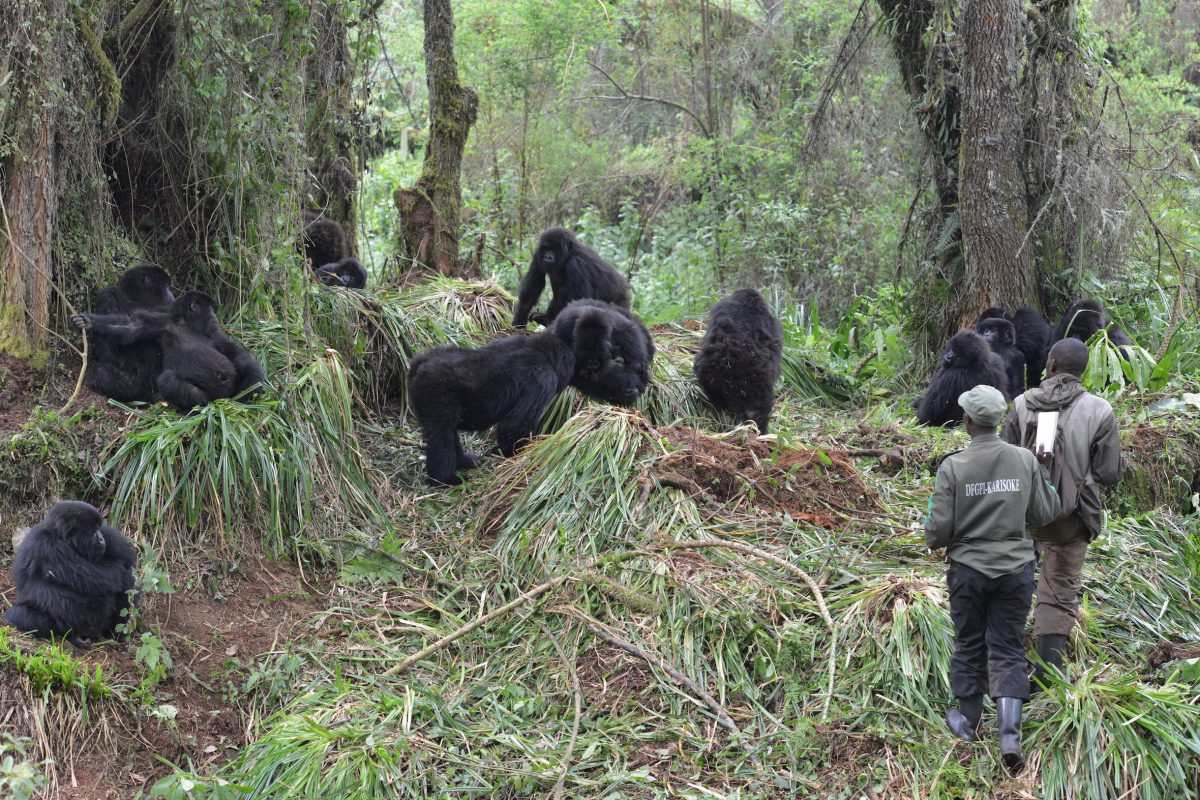
Rangers in Rwanda survey a wild population of mountain gorillas. Image courtesy of the Dian Fossey Gorilla Fund.

Now, in addition to wearing masks and having daily health checks themselves, these field teams are limiting time with the gorillas outside of necessary monitoring of the gorillas’ health. After evaluating the gorillas, the team members stay 100 meters (330 feet) away to protect them from infection. The Fossey Fund has suspended all other ongoing research activities, as well as tourism, in order to minimize the time that humans spend with the gorillas.

“We do not know if SARS CoV-2 [CODIV-19] infections have occurred in human-habituated eastern gorillas (mountain and Grauer’s) or other great apes in the region,” Kirsten Gilardi, executive director and chief veterinary officer of Gorilla Doctors, a nonprofit veterinary organization, said in a statement.

“We do know that great apes, including gorillas, are susceptible to human respiratory pathogens and that respiratory illnesses regularly occur in mountain gorillas,” Gilardi said. “When a gorilla is sick, our veterinarians collect diagnostic samples (fresh feces) to be screened for multiple pathogens, including the new SARS CoV-2 [COVID-19] virus.”

Staff at the Dian Fossey Gorilla Fund’s Karisoke Research Center in Rwanda undergo health checks before working in the field with gorillas. Image courtesy of the Dian Fossey Gorilla Fund.

Mountain gorillas, listed as endangered on the IUCN Red List, live in protected areas in Rwanda, the Democratic Republic of Congo, and Uganda. Rwanda is closing three national parks to visitors. In the DRC, Virunga National Park, home to roughly a third of the global mountain gorilla population, has barred visitors until June 1. Uganda has not officially barred tourism, but, according to the Uganda Wildlife Authority, tourism has all but halted.

“Gorilla tourism is one of the primary sources of foreign revenue for Rwanda,” Stoinski said. “With gorilla tourism suspended and travel greatly reduced for an unknown period of time, there will be a significant impact on the country’s economy.”
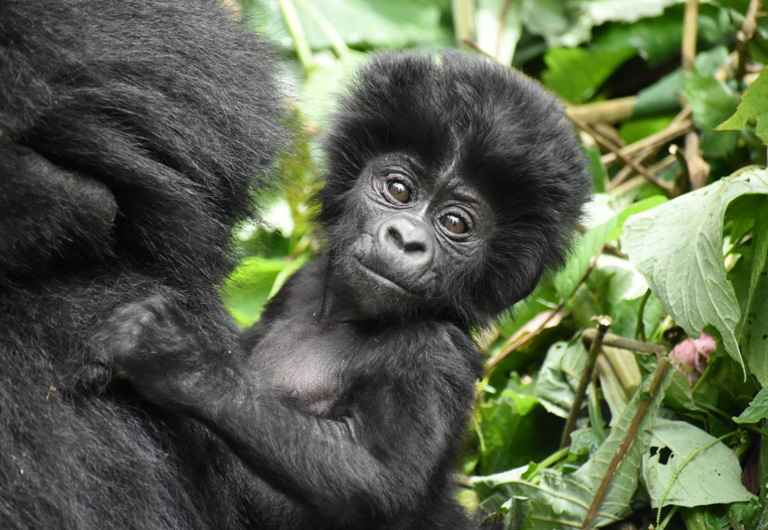
An infant mountain gorilla in Bwindi Impenetrable National Park, Uganda. Image courtesy of Gorilla Doctors.

Beyond its immediate health threats, COVID-19 is also causing concern for conservation at large. Economic instability could lead to a rise in illegal wildlife trafficking and poaching and decrease capacity for community-based conservation efforts. Globally, many organizations working to protect wildlife are nonprofits run on donations, which could dwindle in uncertain economic times.

“Conservation is not something we can step away from,” Stoinski said. “We are at an unprecedented time in our planet’s history in terms of human-caused mass extinctions and climate change. Extinction is preventable but not reversible, so it is essential that on-the-ground activities continue.”

Banner image of an infant mountain gorilla courtesy of the Dian Fossey Gorilla Fund.

Find all of Mongabay’s coverage of gorilla conservation here.

Liz Kimbrough is a staff writer for Mongabay. Find her on Twitter @lizkimbrough_

FEEDBACK: Use this form to send a message to the author of this post. If you want to post a public comment, you can do that at the bottom of the page.


Animals, Biodiversity, Community-based Conservation, Conservation, Coronavirus, COVID-19, Diseases, Economy, Endangered Species, Environment, Environmental Economics, Gorillas, Great Apes, Mammals, Poaching, Protected Areas, Wildlife, Wildlife Trafficking, Zoonotic Diseases

Related Posts

How Machine Learning has impacted Consumer Behaviour and Analysis
Consumer Research

How Machine Learning has impacted Consumer Behaviour and Analysis

January 4, 2024
Market Research The Ultimate Weapon for Business Success
Consumer Research

Market Research: The Ultimate Weapon for Business Success

June 22, 2023
Unveiling the Hidden Power of Market Research A Game Changer
Consumer Research

Unveiling the Hidden Power of Market Research: A Game Changer

June 2, 2023
7 Secrets of Market Research Gurus That Will Blow Your Mind
Consumer Research

7 Secrets of Market Research Gurus That Will Blow Your Mind

May 8, 2023
The Shocking Truth About Market Research Revealed!
Consumer Research

The Shocking Truth About Market Research: Revealed!

April 25, 2023
market research, primary research, secondary research, market research trends, market research news,
Consumer Research

Quantitative vs. Qualitative Research. How to choose the Right Research Method for Your Business Needs

March 14, 2023
Next Post
Cloud Security Software Market Research Study including Growth Factors, Types and Application by regions from 2020 to 2024

Recessed Floor Light Fixtures Market Research Reports by Size, Market Driver, Trend and Segmentation Analysis to 2026

Categories

  • Consumer Research
  • Data Analysis
  • Data Collection
  • Industry Research
  • Latest News
  • Market Insights
  • Marketing Research
  • Survey Research
  • Uncategorized

Recent Posts

  • Ipsos Revolutionizes the Global Market Research Landscape
  • How Machine Learning has impacted Consumer Behaviour and Analysis
  • Market Research: The Ultimate Weapon for Business Success
  • Privacy Policy
  • Terms of Use
  • Antispam
  • DMCA

Copyright © 2024 Globalresearchsyndicate.com

Welcome Back!

Login to your account below

Forgotten Password?

Retrieve your password

Please enter your username or email address to reset your password.

Log In
This website uses cookies to improve your experience. We'll assume you're ok with this, but you can opt-out if you wish. Cookie settingsACCEPT
Privacy & Cookies Policy

Privacy Overview

This website uses cookies to improve your experience while you navigate through the website. Out of these cookies, the cookies that are categorized as necessary are stored on your browser as they are essential for the working of basic functionalities of the website. We also use third-party cookies that help us analyze and understand how you use this website. These cookies will be stored in your browser only with your consent. You also have the option to opt-out of these cookies. But opting out of some of these cookies may have an effect on your browsing experience.
Necessary
Always Enabled
Necessary cookies are absolutely essential for the website to function properly. This category only includes cookies that ensures basic functionalities and security features of the website. These cookies do not store any personal information.
Non-necessary
Any cookies that may not be particularly necessary for the website to function and is used specifically to collect user personal data via analytics, ads, other embedded contents are termed as non-necessary cookies. It is mandatory to procure user consent prior to running these cookies on your website.
SAVE & ACCEPT
No Result
View All Result
  • Latest News
  • Consumer Research
  • Survey Research
  • Marketing Research
  • Industry Research
  • Data Collection
  • More
    • Data Analysis
    • Market Insights

Copyright © 2024 Globalresearchsyndicate.com



