

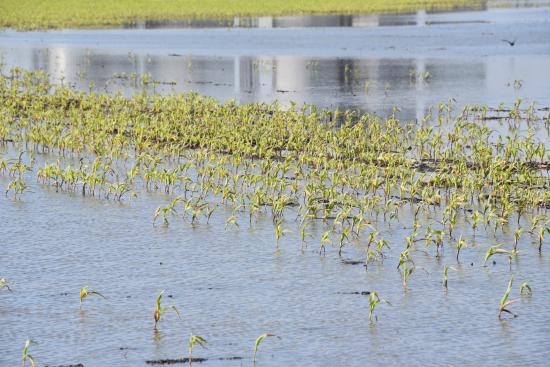
Recent trends in agriculture have put the focus on a few specific topics in the industry. Among other things, the weather, data, and research have been prominent and hotly debated across the agricultural landscape.
Iowa State University maintains a strong presence among colleges for agriculture and agriculture-related majors and research.
One of the researchers contributing to the university’s studies is Sotirios Archontoulis, an associate professor of integrated cropping systems for the agronomy program.
“Basically, my research is to understand the complex interaction between crops, soils, and environment,” Archontoulis says. “[My] interest is [in] the yield, and of course, the sustainability. We do research in this area to figure out which practices increase the yield and minimize the nitrogen leaching and N2O emissions into the atmosphere. We do both field-to-research, and we do simulation modeling.
“We use modeling because it’s impossible to measure everything in the field, so we measure a few things, and then we use the model to get the big picture. Another reason is that with modeling we can go backwards and forwards in time; understand historical trends and predict future trajectories”
Archontoulis and farmers around the Midwest watched and felt the effects of a mostly damp 2019 across the Corn Belt.
Read more: Increased risk of spring flooding in central and southeastern states
2019 Weather and Yields
Last year marked the wettest year on record for the U.S. since 1973, according to the National Oceanic and Atmospheric Administration.
That wetness started early and often in the Midwest, creating issues with planting for farmers, but many farmers were able to salvage the 2019 season.
“2019, it was a very challenging weather year, but I’m very glad that Iowa was able to buffer all this extreme weather,” Archontoulis says. “We had better corn yields than 2018.. One percent higher yield and three percent more production of corn.”
While Iowa managed a productive year, Archontoulis points out that Illinois and Indiana didn’t fare as well, losing 10-15% of their production – mostly due to the weather and delayed planting.
Despite the delayed planting and poor weather stretches, Illinois and Indiana still exceeded some people’s expectations even after the late start.
“Somehow, the Corn Belt was able to buffer all this variability,” Archontoulis says. “I’m a bit skeptical about the future because what happened in 2019 in May, we will probably see that more often in the coming years.
“We really need to do something about this [spring] period. Yeah, one year, perhaps we were a little light, but if this continues year by year by year, we need to make changes, and we need to figure out ways in order to protect production.”
Archontoulis notes that in the past farmers have had around 64 days suitable for fieldwork, and now that’s dwindled to around 45. Archontoulis says with the current trends the days will continue to fall.
With limited days in the field and no ability to guarantee future weather events, Archontoulis lays out short-term activities to help minimize the damage of chaotic rain events.
Archontoulis says investing in technology to speed up the planting season and get out of the field quicker is one option. Archontoulis also says a bigger emphasis could be put on drainage.
“There’re fields without tile drainage, and then after a big rainfall, it may take a week for the soils to dry out,” Archontoulis says. “Fields with tile drainage may take two days, and then the farmer can go and do operations.”
Along with those ideas, Archontoulis and other Iowa State researchers attempt to combine the in-field efforts with knowledge to apply for the best benefit of Midwest farms. With data gathered from the unusual weather year, Archontoulis and Iowa State add another year of available information.
Read more: Expect to see more floods and droughts this spring and summer
Research
Entering the 2020 season, Archontoulis awaits spring where he’ll evaluate different factors in the agricultural system.
With those variables, Archontoulis will search for historical trends to improve accuracy.
“As the months progress and we start to make predictions, I’m going to look at different aspects,” Archontoulis says. “I’m going to look at the projections for the weather and how those projections are going to affect the dynamics of soil nitrogen, soil water, and soil temperature. In other words, how the soil nitrogen supply in 2020 [January to April] compares with the previous year. That can provide some insight to inform decision making.
“The nitrates in the soil is very critical because in the next three months – April, May, and June – farmers apply fertilizers, so it’ll be helpful to have a sense of how much is in the soil or how does the trend between the spring compares with the last five years – 20 years.”
With that analysis, farmers can tweak the amounts of fertilizer they put on.
With that information, it gets added to the pool of data available. The data gets put toward improving models and adding accuracy to different alternatives that can be used for farms.
While the analysis and researchers’ roles are important, it still needs to be supplied with farmers’ experiences and knowledge.
“Every farmer knows their particular field better than anyone else,” Archontoulis says. “It’s hard to advise someone who is already an expert on a discipline. We are good at giving general recommendations, but to go and provide advice for a particular field, we need to have more data from the farmer in order to do a site-specific model analysis and come up with management options.”
Aside from having that background on the land, Archontoulis also says it’s important to have farmers involved in asking questions with the research processes and findings.
Working together, farmers and researchers add multiple perspectives and ideas, while getting feedback from the group who uses the tools the most.
“We try to give something that benefits the farmer, and the farmer is the person who can value how good or bad our prediction tool is,” Archontoulis says. “The way that I see things, to make faster progress, we need to invest more time, and we need to figure out ways to work closer and closer with farmers. That’s the only way.
“Farmers, in my experience, have brilliant ideas. They bring valid questions to research, and they have many years of experience, which is sometimes worth more than having 20 years of data.”
Read more: Key innovations and products from the 2020 Commodity Classic
According to Archontoulis, the value of data analytics to farmers can be measured in three stages on the research side of the operation.
The first level is just data and creation of empirical relationships. The second stage is using that data to generate predictions, which is the current stage that we’re in. The third stage is improving those predictions to create optimum solutions or prescription-based forecasting.
The final stage will take a good amount of time, says Archontoulis. While predictions aren’t accurate enough to attain the prescription level with high confidence, Archontoulis expects us to reach the third stage sooner than people may think.
To help move toward that third level, Archontoulis and other researchers at Iowa State have developed Forecast and Assessment of Cropping sysTemS (FACTS). Since FACTS launched, Archontoulis has helped adjust the system to improve its quality and accuracy.
FACTS aims to provide farmers with information over the weather, soil, and crops to assist with decision making during the growing season. Out of season, the system measures different performances of previous years to provide future scenarios and different alternatives that help guide decisions for upcoming seasons.
“Basically, what we did was to expand the predictions from a couple of fields in Iowa to the entire Corn Belt, so that was a major breakthrough for us,” Archontoulis says. “We were able to run simulations and release real-time results for 30 to 40 fields within a county – and then we had Iowa, Illinois, and Indiana – so this makes approximately 280 counties, we are talking about thousands of fields.”
Along with running the 2019 season, the system also ran historical seasons for the counties, too, creating a benchmark for each area. By generating a benchmark, the system can compare 2020 in regards to the previous years as 2020 progresses. Archontoulis expects the system to extend to more Midwest states in the future.
To view the FACTS system, click here.







