
GLOBAL RESEARCH SYNDICATE
No Result
View All Result
  • Login
  • Latest News
  • Consumer Research
  • Survey Research
  • Marketing Research
  • Industry Research
  • Data Collection
  • More
    • Data Analysis
    • Market Insights
  • Latest News
  • Consumer Research
  • Survey Research
  • Marketing Research
  • Industry Research
  • Data Collection
  • More
    • Data Analysis
    • Market Insights
No Result
View All Result
globalresearchsyndicate
No Result
View All Result
Home Survey Research

Device Uses AI, Thermal Imaging to Survey Public Areas for Flu-Like Illness | Research & Technology

globalresearchsyndicate by globalresearchsyndicate
March 20, 2020
in Survey Research
0
Device Uses AI, Thermal Imaging to Survey Public Areas for Flu-Like Illness | Research & Technology
0
SHARES
2
VIEWS
Share on FacebookShare on Twitter

A contactless, portable surveillance device, developed by a team at the University of Massachusetts Amherst (UMass), can capture crowd-level bioclinical signals directly related to physical symptoms of influenza-like illnesses from public waiting areas in an unobtrusive manner in real time, then analyze the data to directly monitor flu-like illnesses and influenza trends. The health surveillance device, called FluSense, is powered by artificial intelligence (AI). It could be used in hospitals, waiting rooms, and larger public spaces to forecast seasonal flu and other viral respiratory outbreaks, such as the COVID-19 pandemic or SARS.

FluSense uses a microphone array and a thermal camera along with a neural computing engine to passively and continuously characterize speech and coughing sounds along with changes in crowd density on the edge. It stores no personally identifiable information, such as speech data or distinguishing images.
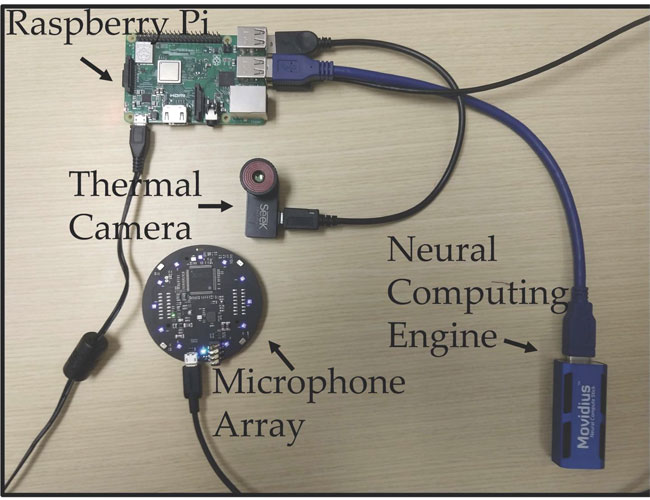
FluSense portable surveillance device for detecting flu-like illness in public spaces, UMass Amherst.


The FluSense device houses these components. Courtesy of UMass Amherst.


To build the device, the researchers first developed a lab-based cough model. They then trained a deep neural network classifier to draw bounding boxes on thermal images representing people and to count them. “Our main goal was to build predictive models at the population level, not the individual level,” professor Tauhidur Rahman said.

The researchers placed FluSense, which is about size of a large dictionary, in four health care waiting rooms at the UMass University Health Services clinic. From December 2018 to July 2019, the FluSense platform collected and analyzed more than 350,000 thermal images and 21 million nonspeech audio samples from the public waiting areas.

FluSense was able to accurately predict daily patient counts with a Pearson correlation coefficient of 0.95. The researchers compared signals from FluSense with laboratory-confirmed influenza case data obtained in the same facility and found that the FluSense sensor-based features were strongly correlated with laboratory-confirmed influenza trends.

The early symptom-related information captured by FluSense could support current influenza prediction efforts, such as the FluSight Network, a multidisciplinary consortium of flu forecasting teams.
“I thought if we could capture coughing or sneezing sounds from public spaces where a lot of people naturally congregate, we could utilize this information as a new source of data for predicting epidemiologic trends,” Rahman said.
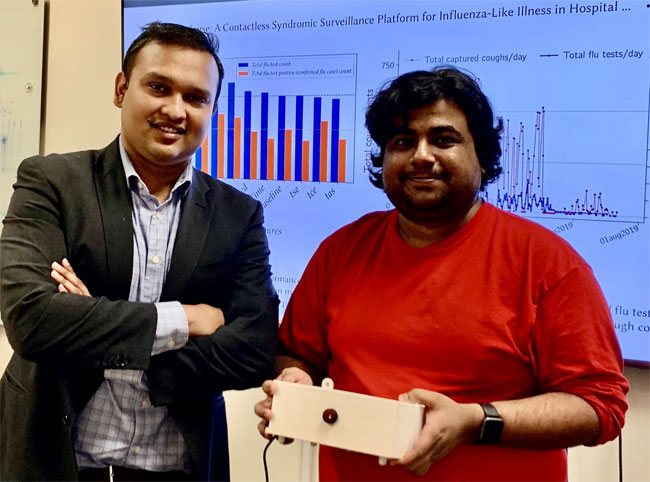
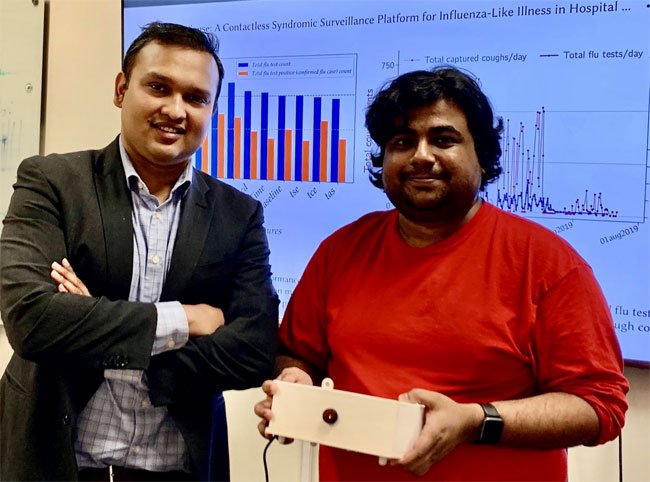
Tauhidur Rahman, (l), and Forsad Al Hossain display their FluSense device. Courtesy of UMass Amherst.


Tauhidur Rahman (left) and Forsad Al Hossain display their FluSense device. Courtesy of UMass Amherst.


Researcher Forsad Al Hossain said that FluSense, which consists of an edge-computing sensor system, models, and data processing pipelines, demonstrates the value of combining AI with edge computing to enable data to be gathered and analyzed right at the data’s source. “We are trying to bring machine-learning systems to the edge,” he said. “All of the processing happens right here [in the FluSense device]. These systems are becoming cheaper and more powerful.”

The next step is to test FluSense in other public areas and geographic locations. “We have the initial validation that the coughing indeed has a correlation with influenza-related illness,” professor Andrew Lover said. “Now we want to validate it beyond this specific hospital setting and show that we can generalize across locations.”

The research was published in Proceedings of the ACM on Interactive, Mobile, Wearable and Ubiquitous Tech (www.doi.org/10.1145/3381014). 

Related Posts

How Machine Learning has impacted Consumer Behaviour and Analysis
Consumer Research

How Machine Learning has impacted Consumer Behaviour and Analysis

January 4, 2024
Market Research The Ultimate Weapon for Business Success
Consumer Research

Market Research: The Ultimate Weapon for Business Success

June 22, 2023
Unveiling the Hidden Power of Market Research A Game Changer
Consumer Research

Unveiling the Hidden Power of Market Research: A Game Changer

June 2, 2023
7 Secrets of Market Research Gurus That Will Blow Your Mind
Consumer Research

7 Secrets of Market Research Gurus That Will Blow Your Mind

May 8, 2023
The Shocking Truth About Market Research Revealed!
Consumer Research

The Shocking Truth About Market Research: Revealed!

April 25, 2023
market research, primary research, secondary research, market research trends, market research news,
Consumer Research

Quantitative vs. Qualitative Research. How to choose the Right Research Method for Your Business Needs

March 14, 2023
Next Post
Consumer Robotics Market Expected to Witness a Sustainable

Consumer Robotics Market Expected to Witness a Sustainable

Categories

  • Consumer Research
  • Data Analysis
  • Data Collection
  • Industry Research
  • Latest News
  • Market Insights
  • Marketing Research
  • Survey Research
  • Uncategorized

Recent Posts

  • Ipsos Revolutionizes the Global Market Research Landscape
  • How Machine Learning has impacted Consumer Behaviour and Analysis
  • Market Research: The Ultimate Weapon for Business Success
  • Privacy Policy
  • Terms of Use
  • Antispam
  • DMCA

Copyright © 2024 Globalresearchsyndicate.com

Welcome Back!

Login to your account below

Forgotten Password?

Retrieve your password

Please enter your username or email address to reset your password.

Log In
This website uses cookies to improve your experience. We'll assume you're ok with this, but you can opt-out if you wish. Cookie settingsACCEPT
Privacy & Cookies Policy

Privacy Overview

This website uses cookies to improve your experience while you navigate through the website. Out of these cookies, the cookies that are categorized as necessary are stored on your browser as they are essential for the working of basic functionalities of the website. We also use third-party cookies that help us analyze and understand how you use this website. These cookies will be stored in your browser only with your consent. You also have the option to opt-out of these cookies. But opting out of some of these cookies may have an effect on your browsing experience.
Necessary
Always Enabled
Necessary cookies are absolutely essential for the website to function properly. This category only includes cookies that ensures basic functionalities and security features of the website. These cookies do not store any personal information.
Non-necessary
Any cookies that may not be particularly necessary for the website to function and is used specifically to collect user personal data via analytics, ads, other embedded contents are termed as non-necessary cookies. It is mandatory to procure user consent prior to running these cookies on your website.
SAVE & ACCEPT
No Result
View All Result
  • Latest News
  • Consumer Research
  • Survey Research
  • Marketing Research
  • Industry Research
  • Data Collection
  • More
    • Data Analysis
    • Market Insights

Copyright © 2024 Globalresearchsyndicate.com




