

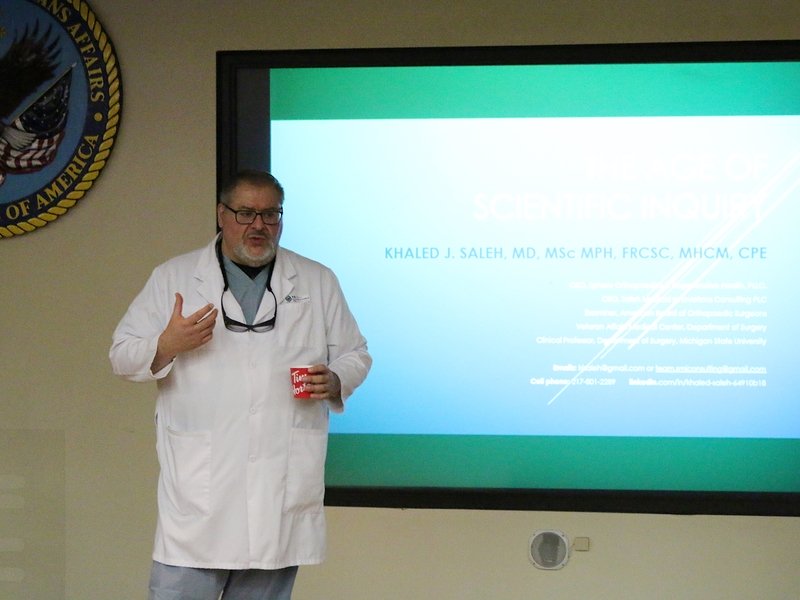
Faced with that “what’s next” feeling, Saleh quickly decided metro Detroit was his new home and he would make the best of it. His two daughters and son had already moved to Southeast Michigan.
First, Saleh took a part-time job as attending orthopedic surgeon in February 2018 to continue his 22-year career in hip and knee transplants at the John D. Dingell VA Medical Center, next to DMC. He is a member of the Detroit VA’s five-surgeon orthopedic department.
Saleh also sees patients two days a week at his office, four-surgeon Sphere Orthopedics and Regenerative Health in Ferndale, trains medical students, residents and fellows for Michigan State University and conducts orthopedic research at the Detroit VA.
But to accomplish a longtime goal of starting a research organization and foundation, Saleh worked out a business plan with Greg Sobczyk, chief administrator for surgical services at the Detroit VA, and anesthesiologist Vinay Pallekonda, regional medical director of NorthStar Anesthesia, which holds the anesthesia services contract with DMC.
Saleh worked with Sobczyk, Detroit VA leadership and other like-minded doctors to create the Surgical Institute of Excellence for Health Services Research. SIEHSR is a joint venture between Saleh and the VA intended to improve surgical and health outcomes in veterans treated nationwide over the last three decades years.
The VA has one of the largest and most comprehensive databases in the nation. Its VA Informatics and Computing Infrastructure, or VINCI, database is helping Saleh investigate ways to improve surgical outcomes such as postoperative pain, postoperative infection and opioid reduction, said Sobczyk.
“We have our own research department in surgery, and we work with some of the different” VA departments, Sobczyk said. “But no other service in this hospital is doing what we are doing. This is new and frankly very exciting because this has not been done anywhere that I know of” within the national VA system.
“I’ve spoken with my counterparts and nobody’s doing anything like this, which is surprising because we have all these resources, and we’re able to build these partnerships,” Sobczyk said.
George McKelvey, a research associate with NorthStar Anesthesia in DMC’s anesthesiology department, said one SIEHSR project is to identify methods to prevent trauma and suffering in U.S. veterans with post-traumatic stress disorder. The current veteran suicide rate is 17 deaths per day, or 6,000 annually.
“Our veterans have protected our country and our freedoms, it is the very least of our duty to try and do the same for them,” Saleh said.
Because of the continuing high suicide rate, Saleh said he wants to develop ways to identify at-risk veterans who have been diagnosed with post-traumatic stress disorder and may potentially attempt self-harm or suicide.
Kamela Devole, Sphere’s clinic operations manager and project manager with SIEHSR and other Saleh businesses, said data for research projects will be drawn from the VA’s extensive database. “It’s data (on veterans) that’s been collected since 1991 and no one else has this,” Devole said.
SIEHSR is currently collaborating with several organizations in Michigan and the U.S. They include the Detroit VA, Drexel University, Michigan State University, MSU High-Performance Computing Center, DMC department of anesthesiology, Wayne State University/Mike Ilitch School of Business and Oakland University, McKelvey said.
Financial support for SIEHSR has been provided by Irving, Texas-based NorthStar and the Veterans Administration.
Mohanad Baldawi, M.D., a Detroit VA clinical research assistant, said the multi-specialty team of researchers has been analyzing the VA’s big data set for orthopedic patients.
For example, one project is looking at orthopedic patients with hip and knee replacement surgery to see whether general or regional anesthesia is associated with better outcomes, he said.
“We (also) are investigating whether laparoscopic (minimally invasive) or open surgery is associated with better outcomes,” Baldawi said. “This VA data set includes hundreds of thousands of patients who are veterans and admitted to VA hospitals all over the United States.”
Besides Baldawi, other researchers include Arik Ragowsky, associate professor of information systems management at WSU’s Mike Ilitch School of Business; and David Gefen, research professor and director of the doctorate in business administration program at Drexel University.
Ragowsky said he and Gefen are studying how medical treatment types and health care policy such as the Affordable Care Act of 2010 can help to postpone or reduce the potency of the progression from post-traumatic stress disorder to depression to narcotics to self-harm, including suicide, among veterans.
“This is a topic of much interest considering both the opioid epidemic and the prevalence of PTSD among veterans,” Ragowsky said.
Using IT systems and patient records, Ragowsky said, cases can be tracked to see how patients were readmitted and what was common with the cases that were readmitted. He said the data will help to show what treatment showed successful outcomes.







