
GLOBAL RESEARCH SYNDICATE
No Result
View All Result
  • Login
  • Latest News
  • Consumer Research
  • Survey Research
  • Marketing Research
  • Industry Research
  • Data Collection
  • More
    • Data Analysis
    • Market Insights
  • Latest News
  • Consumer Research
  • Survey Research
  • Marketing Research
  • Industry Research
  • Data Collection
  • More
    • Data Analysis
    • Market Insights
No Result
View All Result
globalresearchsyndicate
No Result
View All Result
Home Data Collection

Surprise! There’s more water on Jupiter than anyone thought

globalresearchsyndicate by globalresearchsyndicate
February 22, 2020
in Data Collection
0
Surprise! There’s more water on Jupiter than anyone thought
0
SHARES
7
VIEWS
Share on FacebookShare on Twitter

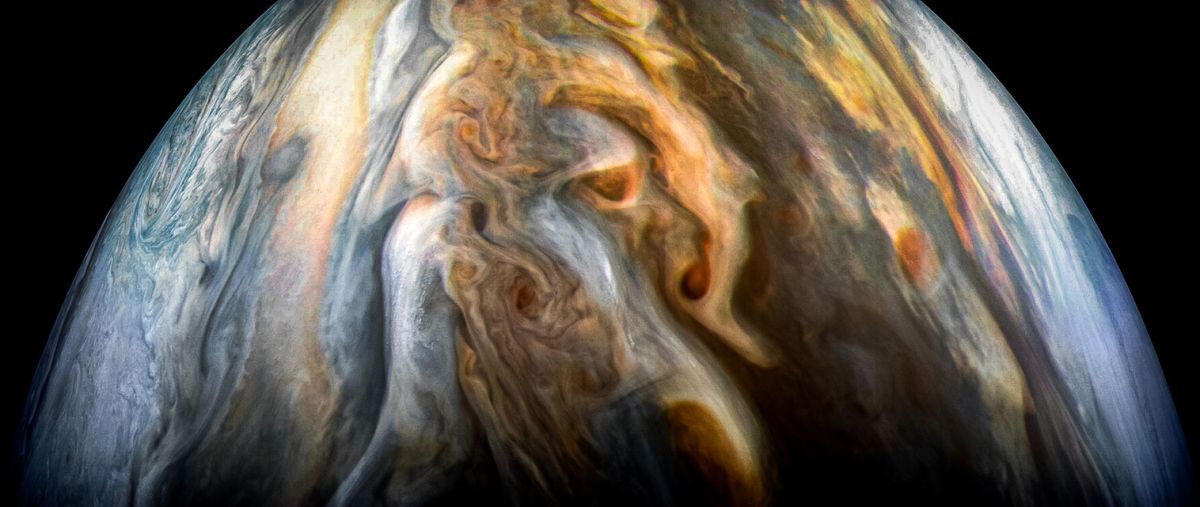
Jupiter appears to have more water than anyone expected.

Newly released data from NASA’s Juno probe shows that water may make up about 0.25% of the molecules in the atmosphere over Jupiter’s equator. While that doesn’t sound like much, the calculation is based on a prevalence of water’s components, hydrogen and oxygen, three times more than at the sun. The new measurements Juno obtained are much higher than a previous mission suggested.

The surprise result has scientists delving deep again into results from NASA’s Galileo mission to Jupiter, which obtained drier results in 1995 when engineers deliberately threw the spacecraft into Jupiter’s atmosphere. (Galileo was low on fuel and NASA didn’t want to take the chance, even if it was a slight one, of the spacecraft accidentally crashing on a potentially habitable icy moon.)

Related: NASA’s Juno mission checks out epic Io eclipse on Jupiter

Reconciling the results from Galileo and Juno is key for scientists to better understand how our solar system came together, NASA said in a statement. Since Jupiter was probably the first planet to form, it could have sucked up most of the gas and dust that the sun’s formation left behind. How much water Jupiter soaked up, then, should help scientists identify the most plausible theories to explain its formation.

And understanding Jupiter’s birth would in turn help scientists understand how the planet’s wind currents move and what its insides are made of. Scientists should be able to generalize findings at Jupiter to certain kinds of large exoplanets to learn how other solar systems formed.

Galileo’s results were a puzzle even back in the 1990s. The spacecraft sent back data showing 10 times less water than scientists predicted, and more weirdly, the amount of water appeared to increase the deeper Galileo went into Jupiter’s atmosphere, according to the NASA statement. Scientists had expected that by the time it stopped transmitting data, at a depth of about 75 miles (120 kilometers), the atmosphere around it should have been well-mixed with an unchanging composition. 

A ground-based infrared telescope was able to measure water concentrations at Jupiter at the same time as Galileo’s plunge and showed that Galileo may have accidentally hit a dry spot, meaning water is not well-mixed deep in Jupiter’s atmosphere. 

Juno’s first eight flybys also showed a lack of atmospheric mixing. The spacecraft’s radiometer obtained data even deeper than Galileo’s measurements, at 93 miles (150 km) down, and found more water at the equator than Galileo did. 

Scientists are now waiting to compare Juno’s equatorial measurements with observations at the north of the planet; Juno’s 53-day orbit is gradually moving northward to examine more of that hemisphere with each flyby. The spacecraft’s next science flyby will be on April 10.

“Just when we think we have things figured out, Jupiter reminds us how much we still have to learn,” Scott Bolton, Juno principal investigator at the Southwest Research Institute, said in the NASA statement. “Juno’s surprise discovery that the atmosphere was not well mixed even well below the cloud tops is a puzzle that we are still trying to figure out. No one would have guessed that water might be so variable across the planet.”

The new research is described in a paper published Feb. 10 in the journal Nature Astronomy.

Follow Elizabeth Howell on Twitter @howellspace. Follow us on Twitter @Spacedotcom and on Facebook.


Related Posts

How Machine Learning has impacted Consumer Behaviour and Analysis
Consumer Research

How Machine Learning has impacted Consumer Behaviour and Analysis

January 4, 2024
Market Research The Ultimate Weapon for Business Success
Consumer Research

Market Research: The Ultimate Weapon for Business Success

June 22, 2023
Unveiling the Hidden Power of Market Research A Game Changer
Consumer Research

Unveiling the Hidden Power of Market Research: A Game Changer

June 2, 2023
7 Secrets of Market Research Gurus That Will Blow Your Mind
Consumer Research

7 Secrets of Market Research Gurus That Will Blow Your Mind

May 8, 2023
The Shocking Truth About Market Research Revealed!
Consumer Research

The Shocking Truth About Market Research: Revealed!

April 25, 2023
market research, primary research, secondary research, market research trends, market research news,
Consumer Research

Quantitative vs. Qualitative Research. How to choose the Right Research Method for Your Business Needs

March 14, 2023
Next Post
Survey Unveils Profile of Bitcoin (BTC) and Ethereum (ETH) Holders in Malaysia, Vietnam and the Philippines

Survey Unveils Profile of Bitcoin (BTC) and Ethereum (ETH) Holders in Malaysia, Vietnam and the Philippines

Categories

  • Consumer Research
  • Data Analysis
  • Data Collection
  • Industry Research
  • Latest News
  • Market Insights
  • Marketing Research
  • Survey Research
  • Uncategorized

Recent Posts

  • Ipsos Revolutionizes the Global Market Research Landscape
  • How Machine Learning has impacted Consumer Behaviour and Analysis
  • Market Research: The Ultimate Weapon for Business Success
  • Privacy Policy
  • Terms of Use
  • Antispam
  • DMCA

Copyright © 2024 Globalresearchsyndicate.com

Welcome Back!

Login to your account below

Forgotten Password?

Retrieve your password

Please enter your username or email address to reset your password.

Log In
This website uses cookies to improve your experience. We'll assume you're ok with this, but you can opt-out if you wish. Cookie settingsACCEPT
Privacy & Cookies Policy

Privacy Overview

This website uses cookies to improve your experience while you navigate through the website. Out of these cookies, the cookies that are categorized as necessary are stored on your browser as they are essential for the working of basic functionalities of the website. We also use third-party cookies that help us analyze and understand how you use this website. These cookies will be stored in your browser only with your consent. You also have the option to opt-out of these cookies. But opting out of some of these cookies may have an effect on your browsing experience.
Necessary
Always Enabled
Necessary cookies are absolutely essential for the website to function properly. This category only includes cookies that ensures basic functionalities and security features of the website. These cookies do not store any personal information.
Non-necessary
Any cookies that may not be particularly necessary for the website to function and is used specifically to collect user personal data via analytics, ads, other embedded contents are termed as non-necessary cookies. It is mandatory to procure user consent prior to running these cookies on your website.
SAVE & ACCEPT
No Result
View All Result
  • Latest News
  • Consumer Research
  • Survey Research
  • Marketing Research
  • Industry Research
  • Data Collection
  • More
    • Data Analysis
    • Market Insights

Copyright © 2024 Globalresearchsyndicate.com



