

Organic farming may not be mainstream yet, but it has rapidly grown in stature in the last two decades, according to a new survey. There has been a more than five-fold increase in the acreage of land under organic cultivation since the turn of the millenium.
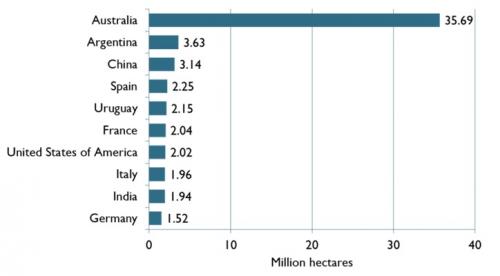
India was among the top 10 countries with 1.94 million hectares (mha) under organic cultivation in 2018, according to the survey by Switzerland-based Research Institute of Organic Agriculture (FiBL) and Germany-based International Federation of Organic Agriculture Movements — Organics International (IFOAM). Australia topped the list with 35.69 mha.
At more than a million, the country also had the most number of organic farmers — over a third of the nearly 2.8 million across the world.
Countries with the most area under organic agriculture in 2018

Source: FiBL survey 2020
Globally, 1.5 per cent of farmland was under organic cultivation in 2018, up from 0.3 per cent in 1999, found ‘The World of Organic Agriculture 2020’. The first-of-its-kind survey collated data from 186 countries for 2018.
IFOAM defines organic agriculture as:
A production system that sustains the health of soils, ecosystems and people. It relies on ecological processes, biodiversity and cycles adapted to local conditions, rather than the use of inputs with adverse effects. Organic agriculture combines tradition, innovation and science to benefit the shared environment and promote fair relationships and a good quality of life for all involved.
The IFOAM survey on standards and legislation found 84 countries had standards regarding organic farming by 2019, and 17 more were in the process of drafting legislation.
Liechtenstein had the most — 38.5 per cent — of its farmland under organic cultivation, followed by Samoa (34.5 per cent) and Austria (24.7 per cent). Sixteen countries had at least a tenth of their agricultural land under organic cultivation.
Source: FiBM- IFOAM survey 2020, based on national data sources and data from certifiers
|
The growth
There has been a steady increase in area under organic cultivation over the years. In 2018, the last year for which the survey collated data, the world added 2.02 mha to organic cultivation — a 2.9 per cent increase. The sharpest spikes were in Asia (8.9 per cent) and Europe (8.7 per cent), followed by North America (3.5 per cent), Oceania (0.3 per cent) and Africa and Latin America (0.2 per cent each). France (16.7 per cent) and Uruguay (14.1 per cent) reported significant increases.
Increase in organic agricultural land and organic share (1999-2018)

Source: FiBL-IFOAM-SOEL surveys 2001-2020
Increase in organic agricultural land by continents (2010-2018)

Source: FiBL-IFOAM survey 2012-2020
Of the 2.8 million organic producers in 2018 — a decrease of 150,000 (5 per cent) over 2017 — 47 per cent were in Asia, followed by Africa (28 per cent), Europe (15 per cent) and Latin America (8 per cent). FiBL estimated nearly 80 per cent of the world’s organic producers to be smallholders in 58 low- and middle-income countries.
The agency estimated organic food and drink sales at more than 95 billion euros in 2018, with the United States the single-largest market (42 per cent share), followed by the European Union (38.5 per cent) and China (8.3 per cent).
The highest market share of organic produce within a country was in Denmark: At 11.5 per cent, it was the first country to cross the 10 percentage mark, followed by Switzerland (9.9 per cent) and Sweden (9.6 per cent).
Countries with largest market for organic food 2018

Source: FiBL-AMI survey 2018
India’s status
- 1.1% land of total farmland under organic cultivation in 2018
- 1.14 mln organic producers — 41% of the 2.8 mln global total
- 1.9 mha under organic agriculture (including in-conversion areas) — 2.7% of the 71.5 mha global total.
- 64% growth in organic acreage in decade through 2018; 8.9% growth from 2017 to 2018
- 1.4 mha of wild collection area
- 0.13 mha of oilseed organic area — 0.5% of global total
- 0.14 mln organic cotton farmers over 0.22 mha certified organic cotton area
- 47% of world’s organic cotton production
Organic farming was native to India. Indian farmers, in the past, practiced nature-friendly farming but after the Green Revolution, they started using agro-chemicals exceesively. High-input intensive agriculture harmed the environment, humans and animals.
The current agrarian crisis, agro-biodiversity loss, natural resource degradation and changing climate have aggravated the situation, raising questions on sustainability of this kind of agriculture.
Organic and natural farming present a new opportunity. However, funds allocated to organic agriculture were miniscule: Combined budget allocated to flagship schemes such as Paramparagat Krishi Vikas Yojana, Organic Value Chain Development for North East Region and National Project on Organic Farming was less than Rs 700 crore for 2020-21.
In contrast, central subsidies for chemical fertilisers were Rs 70,000-Rs 80,000 crore annually.
The central and state governments need to make a a paradigm shift and create an ecosystem for farmers to support organic and natural farming. This can help achieving several of the United Nations-mandated sustainable development goals by helping with food and nutrition security, tackling climate change, rural development, employment generation, increasing farm income, conserving natural resource, improving biodiversity and health.
We are a voice to you; you have been a support to us. Together we build journalism that is independent, credible and fearless. You can further help us by making a donation. This will mean a lot for our ability to bring you news, perspectives and analysis from the ground so that we can make change together.







