

OLD SAYBROOK — According to the Connecticut Department of Energy and Environmental Protection, the town has only two options to resolve a water pollution issue dating to the 1970s: either install a water treatment and community septic system, or install sewers and a sewage treatment facility that would drain into the Connecticut River.
“The final combination will mean some properties can be upgraded conventionally [with septic systems], but the majority of properties will likely funnel waste to another property in town or the river,” said Carlos Esquerra, a sanitary engineer at DEEP. “This is a tough choice for the town, and there are lots of things to consider.”
Any solution eventually adopted by the town will require the approval of DEEP.
In 1997, the Supreme Court of Connecticut in Keeney v. Old Saybrook affirmed a trial court decision that the town “had intentionally failed to abate the public nuisance created by pollution emanating from septic systems in the town,” and had failed to meet its obligations under the Water Pollution Control Act and Environmental Protection Act.
“The trial court grounded this finding in Old Saybrook’s failure to implement the sewer avoidance program set forth in [various pollution abatement orders]. Specifically, despite its acquiescence in the validity of these orders, Old Saybrook has failed to implement the appropriate programs to inspect area septic systems, monitor contamination of area groundwater and surface waters, regulate the pumping of septic systems through a permit system, effect maintenance of septic systems by residential property owners through an enforcement system, and has failed to report its compliance with these orders to the commissioner.”
A subsequent court case in 2009 was settled by the state on the condition that Old Saybrook would hold a referendum requiring residents to choose between constructing a wastewater treatment facility at an estimated cost of $72 million or upgrading grading residential septic systems at a cost of $43 million.
Town residents voted in favor of upgraded septic systems.
Now, after an almost decade long review between 2011 and 2019 of more than 2000 septic systems in Old Saybrook, pollution of the groundwater and of nearby bodies of water remains a problem, and residents will need to make a decision once again.
“We are looking toward the future and trying to figure out what’s the best way to deal with this issue and also what works for the town. Sewers are on the table again because they have to be,” said Jason Becker, chair of the Old Saybrook Water Pollution Control Authority. “We are trying to find a solution that is going to address the problem. The push for sewers is an issue that we have with DEEP. We had a lawsuit over it, but we still want to maintain the character of the town… to maintain these areas.”
The authority was established in 1980 with the stated purpose of implementing a sewer avoidance program.
Fifteen designated areas
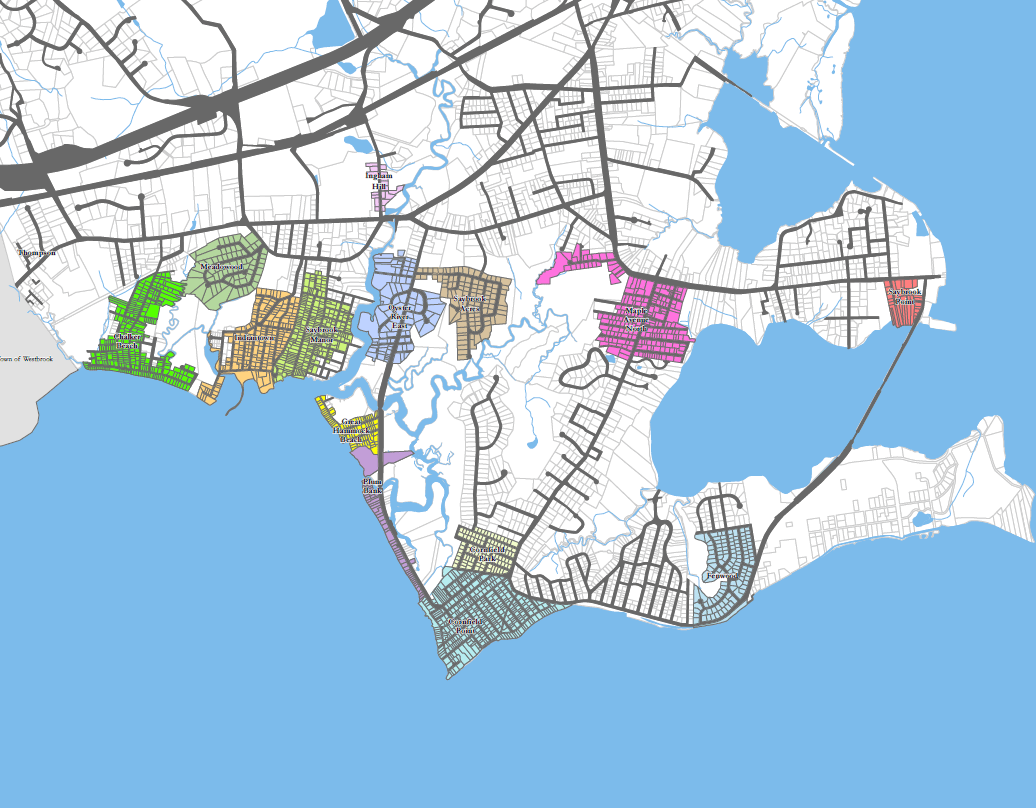
Of the more than 2,000 septic systems surveyed in 15 designated areas between 2011 and 2019, more 1,100 have been replaced, and about 840 remain unresolved.
Of those 840, 740 were identified in the survey as unsuitable for a conventional septic solution in a January 2019 report by Wright-Pierce based on prior work for the Old Saybrook Water Pollution Control Authority.
The 840 parcels are located in Chalker Beach, Indiantown, Saybrook Manor, Great Hammock Beach and Plum Beach. A few additional parcels are on Plum Bank Road and Cornfield Point.

The Wright-Pierce report had been tasked with determining the most cost-effective approach to bringing these parcels into compliance with the state.
According to the report, the type of septic system that may be appropriate for these densely-populated lots, in areas with shallow groundwater, requires an advanced treatment device currently being studied by DEEP and not yet approved for use in Connecticut.
“[The Town of Old Saybrook is] not going to be pursuing [septic] updates on these five sites,” said Esquerra. “There is very shallow groundwater and putting money into the septic system might not be a long-term solution.”
The Choices
Given the lack of approved residential septic solutions, the Wright-Pierce report considered two choices for 740 of the 840 unresolved parcels: either a community septic solution — collecting, treating, and discharging wastewater into a leach field at an undetermined location in Old Saybrook — or collecting, treating and discharging wastewater into the Connecticut River.
The report concluded that the best option for the town — given the relatively high density of development, and the numerous waterways and wetlands — would be a sewer system discharging into the Connecticut River.

“The results indicate that a community wastewater system with a discharge to the Connecticut River is a technically feasible, cost-effective alternative to completing the current program. This alternative provides additional benefits to the Town including locating the wastewater treatment facilities outside of areas that are subject to coastal impacts and sea level rise. The community system will also provide additional environmental benefits to Long Island Sound over the current program relative to the amount of nitrogen that would be removed.”

The report also concluded that a community septic alternative was not feasible after considering 43 sites in Old Saybrook as potential locations for a septic leach field and determining that while five sites were potentially feasible based on capacity and location, no one site offered an adequate solution.
“While the total estimated capacity of these five sites is considered feasible as part of this desktop evaluation for the 740 parcels to be served by a community wastewater system, no one site is adequate. The capacity of some sites is not assured and would require significant additional field
investigations and in-situ hydraulic loading tests to verify capacities. In addition, some of the sites may not be available to the Town for use as dispersal sites.”

Rather than abandoning the possibility of community septic, at the end of 2019 the town decided to request Fuss & O’Neill to complete a peer review of the Wright-Pierce report to refine and further review the feasibility of sites for a dispersal option.
Any decision now waits on the results of that report.
According to Wright-Pierce, the current estimated cost of the treatment and leach field option is $48.2 million and the cost of treating and discharging into the river is $41.2 million.
The Timeline
The timeline for a decision by the town is still unclear.
“Fuss & O’Neill are figuring out what the next steps should be. They are going to have to do soil tests and determine what makes sense and what is feasible,” Becker said.
According to Esguerra, the peer review will also help refine the alternatives and determine whether the community septic solution — which the Wright-Pierce report concluded would not be feasible — might still be a viable option in Old Saybrook.
“It’s a big change for the town, a huge shift from where they’re at,” Esguerra said. “We are in a holding pattern until we get this report and then us and the town need to discuss and move forward with the best option.”
At present, the town does not have a deadline to make a decision.
“It’s going to be a process. It’s a complicated issue and it needs a lot of study in order to come up with a way that would work for everyone in a cost-effective manner,” Becker said. “Everybody loves the idea of putting in a community system, but then when you put a price-tag on that … we don’t necessarily love that anymore.”
No town-wide discussions have been held yet on the issue, according to First Selectman Carl Fortuna, “the review is still underway and discussions to date have only been held in executive session so there is not a lot to share at this juncture.”
Environmental costs
For the past fifty years, while the town has fought court battles and debated the benefits and drawbacks of constructing sewers or maintaining septic systems, significant levels of nitrogen have continued to collect in the groundwater, runoff, the inlets and coves of Long Island Sound.
For the Old Saybrook residents originally under an order by the Department of Energy and the Environmental Protection, who are now supplied with piped-in water, the impact of this continuing pollution to drinking water has been resolved.
“What they did to address the problem with drinking water was bring in drinking water, avoiding the problem by piping in water supply from elsewhere,” said Holly Drinkuth, director of outreach and watershed programs at the Nature Conservancy in Connecticut. “It reduces the human health risk, but does not address the environmental risk at all, it actually might compound it.”
Drinkuth compared the situation in Old Saybrook to similar choices made previously by the town of East Lyme.
“In the town of East Lyme, they put in sewers and turned off the nitrogen from wastewater coming into the area and you see recovery of the ecological condition. The longer we wait, the longer until that recovery and the more impacts we will see,” Drinkuth said.
Post Views:
121







