


TOKYO — Around half of some 500 male prisoners in their 20s and 30s have been on the receiving end of abuse at home, according to the results of a survey by a research group which includes staff at Chiba University.
The survey is reportedly the first large scale study in Japan to address a possible link between childhood abuse and later lawbreaking. The data suggests that there is often a history of childhood trauma behind criminal behavior.
Kyoko Hazama, a professor in delinquency and criminal psychology at Chiba University, distributed questionnaires to 580 men in prisons in eastern Japan’s Kanto region between May and October 2017. In total, 498 responded.
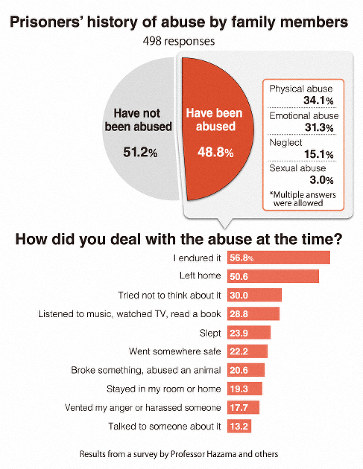
Among them, 243 (48.8%) said they had experienced abuse. In subsequent questions which allowed for multiple answers, 34.1% of them said they had been subject to physical abuse such as being hit, 31.3% had been emotionally abused such as by being spoken to nastily, 15.1% had experienced neglect, and 3% had been sexually abused.
A 2002 survey by the Research and Training Institute of the Ministry of Justice asked 15,000 ordinary people whether they had been abused by family members before the age of 18. Of them, 21.7% said they had. Because the ministry’s and the research team’s survey formats differ, it’s difficult to make clear comparisons, but it appears the abuse rate is higher among people in prison.
When asked how they dealt with the abuse, the most commonly chosen answer at 56.8% was that they endured it. Among the other responses, 50.6% said they left home, and 30% said they tried not to think about it. Just 13.2% said they talked to someone about it.
When the data on inmates who had committed serious crimes such as murder were considered separately, an even larger proportion of this group had a history of being abused mentally than the survey group as a whole.
According to professor Hazama, there is data in the West pointing to a link between physical abuse and violent criminal acts, but there needs to be further investigation into whether the results in Japan are specific to this country or not.
The research group also conducted face-to-face interviews with 18 prisoners who had committed serious crimes and who had suffered abuse. Only one of them said they had sought support when they were being abused. Another 13 said they either didn’t or couldn’t look for help. Their reasons why included not wanting to show weakness, and that they couldn’t trust anyone.
Whilst acknowledging there are many people who suffer abuse that do not go on to commits crimes, professor Hazama speculated on the process that starts from experiencing abuse to serious criminal acts, saying, “The suppressed emotions (of those who commit crimes after being abused in childhood) may suddenly emerge explosively after people are unable to escape abuse and are forced to endure it without help.”
She said that improving counselling support and other initiatives that keep in mind that experiences of being abused have led prisoners and those released from incarceration to distrust others and act problematically will lead to preventing some from re-offending.
Hiroshi Ogiso, a professor in children’s welfare at Tokyo Management College and an expert in issues around childhood abuse, said, “In Japan, measures to prevent abuse of children, delinquency and criminality are not cohesive, so they should be brought together. Support that prevents both adults and children from becoming isolated is necessary.”
One former inmate in his 30s who was released in 2018 after serving a sentence for trespass and robbery, spoke with the Mainichi Shimbun about his history of abuse. When he was arrested, he said the first thing he felt was vengefulness toward his mother.
From a young age he was subject to mental abuse from his parents. His father, who had extreme mood swings, would go immediately from laughing to screaming at his son with a hellish expression on his face. His mother would meddle excessively in what her son was doing, and verbally abuse him if he didn’t do as she said.
Believing that whatever he said to his parents, they would never understand him, he moved out when he started university. Soon after, however, he became afraid of meeting other people and withdrew socially. There was also a period where he lived with a woman he was dating, but his mother objected to the relationship and would relentlessly send messages and make calls to her work phone and his cell phone.
He became unable to bear the pressure, and went on to overdose on tranquilizers. “I committed my crimes in a state where I couldn’t see right from wrong anymore,” he said.
It was once he began life in prison that he came to realize he had always seen himself as a victim, and put all the blame on his parents. He said he began to think instead that “if you don’t recognize the crimes as the consequences of your decisions, then you can’t understand the hurt victims feel.”
He said that in prison there were others who thought like he used to, saying things like, “My past has been hard, so even if I commit these crimes I am forgiven,” while some wondered why others didn’t understand their situations.
Voicing his apprehensions, the man continued, “To awaken to the idea that you too have harmed people, you have to recognize your own pain. If you only receive harsh treatment without that understanding of yourself, a warped sense of your own victimhood gets stronger.”
The man is now getting support from a group that aids people restart their lives. While looking for a full-time job with the help of the group, he is trying to learn how to interact with others and control his emotions. With his thoughts to the future, he said, “I have a way to go yet, but now more than before I can imagine the pain of those who have been hurt.”
(Japanese original by Kaoru Yamadera, Lifestyle and Medical News Department)







