

When
high school junior Chloe McMurray logs onto the websites she needs to finish
her homework, she usually isn’t at home.
“I
have to come to the church if I want to write an essay that I can share with my
teacher,” McMurray said.
That’s
because “homework” at the McMurray house is done the old
fashioned way — on paper. Their Calvert County home has no access to high-speed
internet.
“It’s
extremely frustrating,” said Samantha McMurray, Chloe’s mother. “You sit there
for five minutes waiting for it to load, and it never does.”
She
and her husband, Scott, cannot log in to check their kids’ grades, sign a
permission slip or even send a note to a teacher.
They
use a hotspot that’s painfully slow, or cellphone data, which isn’t much
faster.
When
the family bought the house, they thought they’d be able to get internet access
later. It just never came. Service stops about half a mile up the road.
“Just
to tell people that you don’t have internet, they don’t believe you,”
Scott McMurray said. “We’re thinking, isn’t it mandatory that places have internet?”
Turns
out, it isn’t. The I-Team found nearly 1 million people in Maryland and
Virginia face the same problem : Families and business owners have no access to
cable lines, fiber or any high-speed internet. It’s a problem Rick Gordon, director
of Maryland’s Rural Broadband program, is working to fix.
“There
is not a state in the country that doesn’t have an unserved population,”
Gordon said. “I still have people on dial up.”
His
office is giving $10 million to internet service providers partnering with
local communities to combat the problem. Gordon said Gov. Larry Hogan’s plan to
expand broadband includes similar grant funding every year for the next five
years.
But
Gordon has to prioritize which areas have the greatest need and which broadband
providers are willing to deliver service in those areas. He said he can’t even
be sure exactly where coverage stops and starts or how many people don’t have
access, because maps maintained by the Federal Communications Commission are
woefully inaccurate.
“The
way the data is collected is really skewed toward the providers, and it’s
relying on the providers to be honest,” Gordon said.
Plus,
on the FCC maps, providers have traditionally been counted as providing service
in an entire census block if they serve just one home in that area. Last
August, the FCC began ordering internet service providers to submit maps.
Logic
suggests broadband providers would want as many customers as possible, but
expanding service in rural areas is expensive. Gordon estimates it costs at
least $35,000 per mile.
Mike
and Patrick Jamison said that’s certainly too much to pay out of pocket to
connect their farm in Poolesville. The brothers have watched the family
business change tremendously over three generations.
“We’re
dealing in an industry that sometimes it’s very slim profit margins, and so any
way you can to increase that productivity, just a little bit, adds up over
time,” Mike Jamison said.
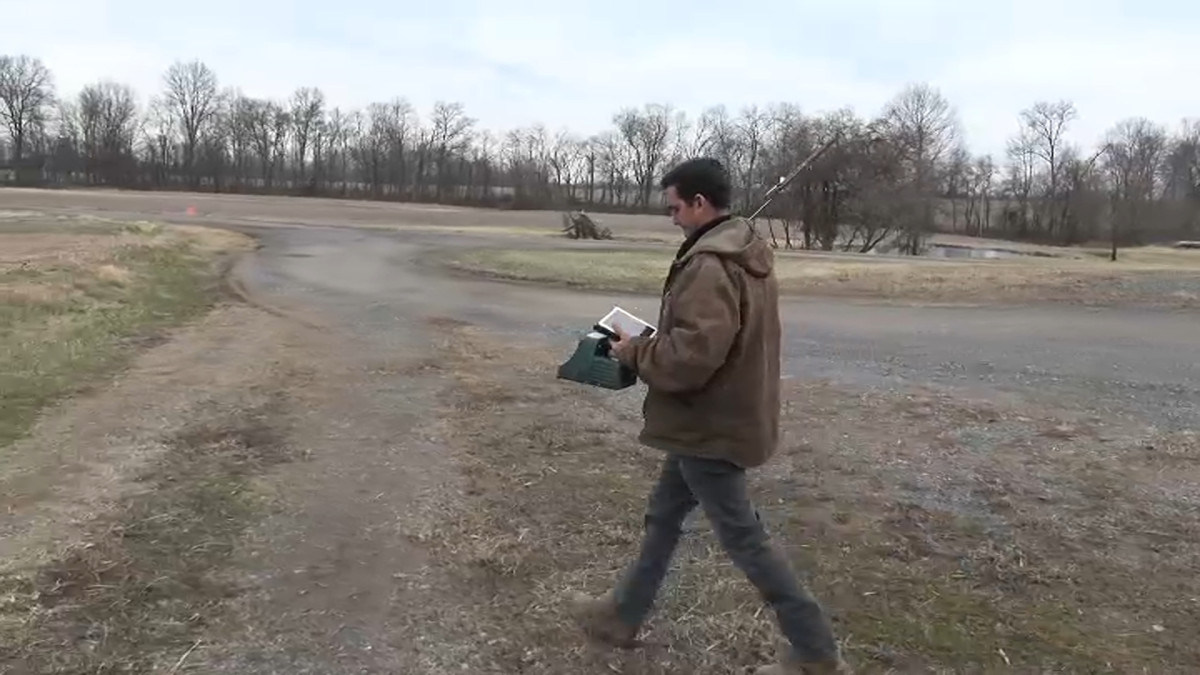
He
showed the I-Team how they utilize precision agriculture through a series of
high-tech computer programs that illustrate their 5,000 acres plotted into
half-acre grids. By assessing the specific needs of each section of the field,
they maximize how much corn, soybeans, wheat and turf they can harvest, which
increases profits while lowering costs.
But
it all depends on the speed of his internet access.
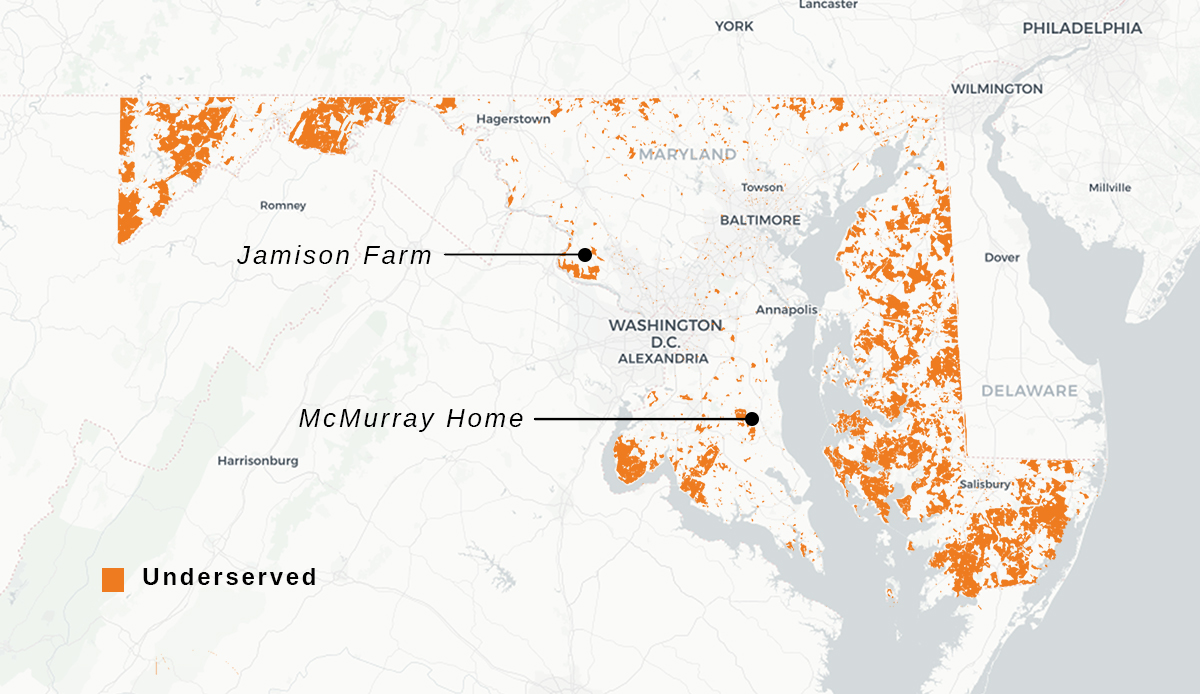
Underserved Broadband Areas in Maryland
Areas where advertised broadband service has upload speeds lower than 3mbps and download speeds lower than 25mbps.
For
example, he can use his iPad to direct him to the exact spot where he wants a
soil sample, which he can then have analyzed to determine how much seed,
fertilizer, lime or water he should use in each location.
“It
tells you where the latitude and longitude points are, where it’s good and bad.
I’ll create a prescription and put it on my thumb drive,” Jamison
said.
The
thumb drive plugs into his equipment out in the field and automatically drops
the right amount of each product in each place.
“The
problem is you’re always dropping signal,” Jamison said. “Time is
money in this business.”
He
said his hotspot is so slow, he’s often forced to drive to his brother’s house
to upload the data to the computer and download data to the thumb drive.
He
said it is even more frustrating because Comcast’s broadband service area
currently stops at the golf course right across the street from the farm.
Comcast told the I-Team it would send a representative to survey the site and
determine an updated cost estimate for expansion.
“I
don’t think people realize how big the agricultural reserve is, almost one
third of the county,” Montgomery County Executive Mark Elrich said.
He
told the I-Team expanding broadband service is a priority. In January,
Montgomery County sent postcards to approximately 32,000 homes and businesses
asking if they have service, need service for business or education, and
whether they would buy broadband service if it becomes available in their area.
County leaders plan to use that information to apply for a federal grant to
help provide service.
The
FCC recently designated more than $20 billion over the next 10 years to help
expand broadband service in rural America.
“It’s
really important for all these folks to have the kind of modern connections
that you’d expect everybody else to have,” Elrich said, adding that
it isn’t always easy to convince the internet service providers to expand
into an area.
When
four homes in the Barley Field subdivision requested Verizon service in 2015,
the company said no. Last March, the county sent a letter citing its cable
franchise agreement with the company and demanded that service be provided to
all residents who request service in that area.
“We’ve
had a dispute over what the exact language is,” Elrich said. “This is the kind
of thing where how you read the comma determines how you interpret something,
but we think they were wrong.”
Verizon
told the I-Team it is meeting its obligations per the franchise agreement.
The
company eventually did decide to provide service to those four homes but did
not answer questions regarding the change of heart or whether that is
indicative of a larger policy change in that part of Montgomery County.
“It’s
not a luxury anymore, it’s a necessity. It’s critical infrastructure for
business today,” said Buddy Rizer, economic development director for
Loudoun County, Virginia.
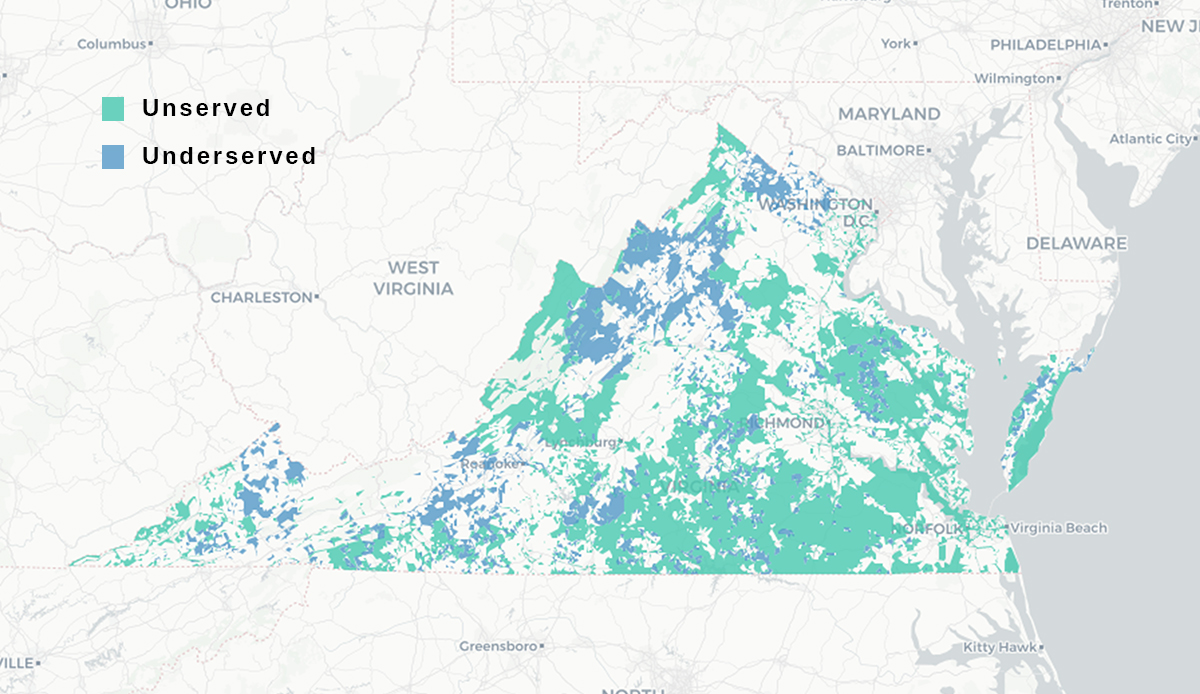
Underserved and Unserved Broadband Areas in Virginia
Underserved: Areas where advertised broadband service has download speeds between 10-25 mbps and upload speeds between 1-3 mbps.
Unserved: Areas where advertised broadband service has download speeds under 10 mbps and upload speeds under 1 mbps.
Loudoun
County is known for having the largest concentration of data centers in the
world with miles of fiber running through the eastern half of the county. But
western Loudoun is better known for its wineries and other agricultural
businesses.
“I
think any county that has any sort of rural part of their county really has to
address this,” Rizer said.
Loudoun
County Information Technology Director Wendy Wickens said most residents and
businesses in the west have some service, but it’s often low speed and poor
quality.
“[They’re]
underserved, but not necessarily unserved,” Wickens said. “And that
makes it extremely difficult for us to qualify for grant funding.”
She
said, in Virginia, the grants are reserved for unserved areas with no internet
access rather than the underserved areas.
“I
would like to see more grant funding available for places like western Loudoun
County that have underserved areas that can be improved,” Wickens said.
In
Maryland, anyone without a high-speed connection is considered unserved.
Scott
McMurray said simple things most city residents take for granted like ordering
something from Amazon, online banking or teleworking from home are nearly
impossible.
“Just
go without internet for a little while, I bet it would drive you crazy, and
that’s how we live,” he said.
The
I-Team reached out to Comcast, the sole provider in Calvert County and the
parent company of NBC. The company’s franchise agreement with Calvert County
requires service be provided to all residents who request it in an area with 15
homes or more per mile.
The
company sent a representative to take another look at the McMurrays’
neighborhood and realized it does now meet that density requirement.
The
McMurrays and other neighbors on their street should have broadband service
available by June.
In
a statement to News4, Comcast said, “We want to serve as many
customers as is geographically and economically feasible, and continuously
evaluate opportunities to deliver our innovative technology to new and existing
customers. However, there are some low-density areas where it is not economical
for Comcast or any provider to build out.”
“As we continue to evaluate these opportunities for network expansions, especially in rural areas where there can be significant infrastructure challenges, we are partnering with local municipalities to apply for grants,” a spokesperson said. “That helps change the economics so that private providers, like Comcast, are able to expand networks in the most cost-efficient manner.”
Reported by Jodie Fleischer, produced by Rick Yarborough, and shot and edited by Steve Jones.







