
GLOBAL RESEARCH SYNDICATE
No Result
View All Result
  • Login
  • Latest News
  • Consumer Research
  • Survey Research
  • Marketing Research
  • Industry Research
  • Data Collection
  • More
    • Data Analysis
    • Market Insights
  • Latest News
  • Consumer Research
  • Survey Research
  • Marketing Research
  • Industry Research
  • Data Collection
  • More
    • Data Analysis
    • Market Insights
No Result
View All Result
globalresearchsyndicate
No Result
View All Result
Home Data Analysis

The alliance of data, human experts, and machines to design better medicinal drugs

globalresearchsyndicate by globalresearchsyndicate
February 6, 2020
in Data Analysis
0
The alliance of data, human experts, and machines to design better medicinal drugs
0
SHARES
3
VIEWS
Share on FacebookShare on Twitter

Share


Tweet


Share


Email


Drugs are usually small
organic molecules that bind to disease-causing proteins in order to neutralize their
harmful effects. These proteins can be described at the atomic level, and the
resulting information can be used to generate mathematical models able to guide
the design of better drug candidates.

Until recently,
these models employed classical linear regression, which limited their
accuracy. As the sizes of relevant datasets grow, algorithms able to learn from
them are achieving models of increased accuracy and broader applicability. Devising
and applying such algorithms is the object of a research area known as “machine
learning” (ML), the most successful subdivision of artificial intelligence.
This approach is particularly timely given the amount of relevant data now
available along with the maturity of ML algorithms.
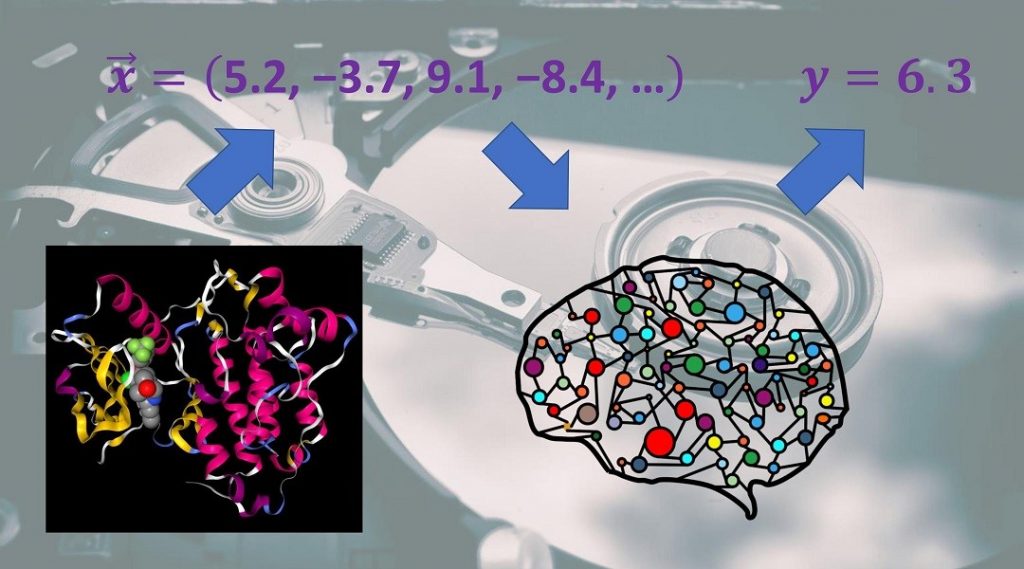
Machine learning algorithms predict potential drug candidates based on the protein–drug interaction .

In a recent publication in WIREs Computational Molecular Science, Hongjian Li, Kam-Heung Sze, and Gang Lu from the Chinese University of Hong Kong, in collaboration with Pedro Ballester from INSERM in France, review the state of the art in ML research.

The performance
gap between classical and ML-based models, which was already large, has now widened
owing to further methodological improvements. This is also the case for target-specific
models, although there are a few exceptions that might be due to having insufficient
data for that target. Also, against the expectations of
many experts, deep-ML algorithms have not always been more predictive than
those based on more-established ML techniques.

Instead, the
most successful strategies to generate predictive models have been those
identifying better combinations of ML algorithms with numerical descriptions of
the protein–drug interaction. There are also more of these models that are
freely available for others to use, which is important for promoting their
application to real-world problems.

For example, it is often the case that initial drug candidates do not bind sufficiently tightly to the protein and thus are unable to neutralize its effects completely.

A way to increase the potency of a candidate is to make and experimentally test a wide range of its chemical derivatives. Often, the number of derivatives that need to be considered is such that one cannot test all of them experimentally due to time and cost constraints. In this case, a predictive ML model would greatly shorten the time and cost of identifying potent drug candidates by only testing those derivatives predicted to bind most tightly to the protein.

Studies intended to elucidate which type of numerical description works better for a given target are expected to increase in the future. Another probable future trend will be to investigate which targets can be better modelled when their datasets are complemented with datasets from other targets — for example, by exploiting inter-target similarities.

Kindly contributed by the authors

Research article found at: P. Ballester, et al. WIREs Computational and Molecular Science, 2020, doi.org/10.1002/wcms.1465







Related Posts

How Machine Learning has impacted Consumer Behaviour and Analysis
Consumer Research

How Machine Learning has impacted Consumer Behaviour and Analysis

January 4, 2024
Market Research The Ultimate Weapon for Business Success
Consumer Research

Market Research: The Ultimate Weapon for Business Success

June 22, 2023
Unveiling the Hidden Power of Market Research A Game Changer
Consumer Research

Unveiling the Hidden Power of Market Research: A Game Changer

June 2, 2023
7 Secrets of Market Research Gurus That Will Blow Your Mind
Consumer Research

7 Secrets of Market Research Gurus That Will Blow Your Mind

May 8, 2023
The Shocking Truth About Market Research Revealed!
Consumer Research

The Shocking Truth About Market Research: Revealed!

April 25, 2023
market research, primary research, secondary research, market research trends, market research news,
Consumer Research

Quantitative vs. Qualitative Research. How to choose the Right Research Method for Your Business Needs

March 14, 2023
Next Post
Astronomers Discover A Very Rare Double Nucleus In The Cocoon Galaxy

Astronomers Discover A Very Rare Double Nucleus In The Cocoon Galaxy

Categories

  • Consumer Research
  • Data Analysis
  • Data Collection
  • Industry Research
  • Latest News
  • Market Insights
  • Marketing Research
  • Survey Research
  • Uncategorized

Recent Posts

  • Ipsos Revolutionizes the Global Market Research Landscape
  • How Machine Learning has impacted Consumer Behaviour and Analysis
  • Market Research: The Ultimate Weapon for Business Success
  • Privacy Policy
  • Terms of Use
  • Antispam
  • DMCA

Copyright © 2024 Globalresearchsyndicate.com

Welcome Back!

Login to your account below

Forgotten Password?

Retrieve your password

Please enter your username or email address to reset your password.

Log In
This website uses cookies to improve your experience. We'll assume you're ok with this, but you can opt-out if you wish. Cookie settingsACCEPT
Privacy & Cookies Policy

Privacy Overview

This website uses cookies to improve your experience while you navigate through the website. Out of these cookies, the cookies that are categorized as necessary are stored on your browser as they are essential for the working of basic functionalities of the website. We also use third-party cookies that help us analyze and understand how you use this website. These cookies will be stored in your browser only with your consent. You also have the option to opt-out of these cookies. But opting out of some of these cookies may have an effect on your browsing experience.
Necessary
Always Enabled
Necessary cookies are absolutely essential for the website to function properly. This category only includes cookies that ensures basic functionalities and security features of the website. These cookies do not store any personal information.
Non-necessary
Any cookies that may not be particularly necessary for the website to function and is used specifically to collect user personal data via analytics, ads, other embedded contents are termed as non-necessary cookies. It is mandatory to procure user consent prior to running these cookies on your website.
SAVE & ACCEPT
No Result
View All Result
  • Latest News
  • Consumer Research
  • Survey Research
  • Marketing Research
  • Industry Research
  • Data Collection
  • More
    • Data Analysis
    • Market Insights

Copyright © 2024 Globalresearchsyndicate.com