

When I was 7 years old, I won my county’s earthquake safety poster contest. I remember going to a special award luncheon with the mayor, who complimented my work and gave me an “Earthquake in a Can” toy. Little did I know how much that event would influence my life.
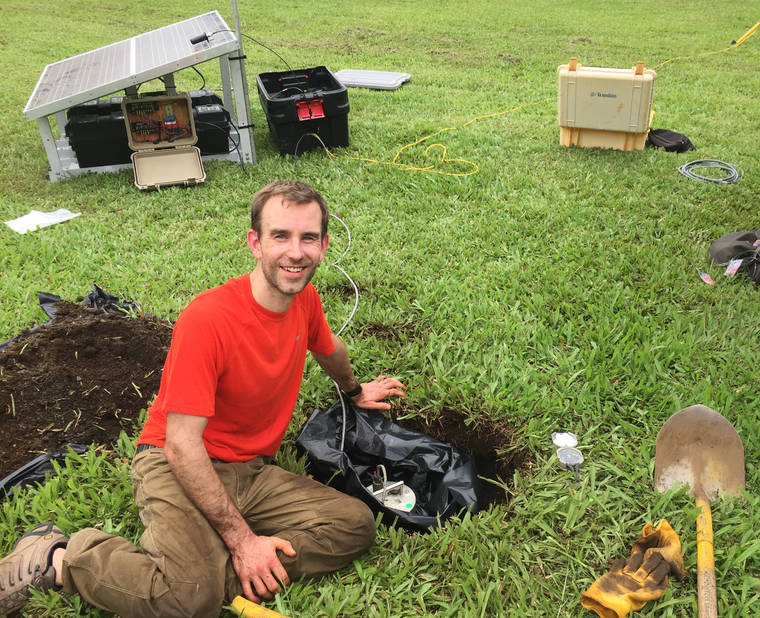
Flash forward almost 35 years later. I am now part of the seismic team at the U.S. Geological Survey’s Hawaiian Volcano Observatory (HVO). As a professional seismologist, I monitor and study earthquakes to understand volcanoes and help keep people safe. It’s a profoundly rewarding job.
HVO seismologists take turns being on-call each week. The on-duty seismologist tracks earthquake activity each day and must be ready to respond to hazardous earthquakes or to significant changes in seismic activity at our volcanoes.
A typical response might involve an alarm that goes off in the middle of the night for a Hawaii earthquake that is magnitude-4.0 or greater. As part of the local community, I am just as affected by seismic hazards as any resident, so I quickly roll out of bed, communicate with colleagues, and get to work analyzing the earthquake.
Although computers automatically detect earthquakes, a human must review the data to ensure accurate characterization of the event. With many data streams to check, the duty seismologist spends up to an hour reviewing data before updating the earthquake solution online. This is why the magnitude and location for an earthquake can sometimes change from the initial posting. See our past Volcano Watch article about this for more info (https://volcanoes.usgs.gov/observatories/hvo/hvo_volcano_watch.html?vwid=458).
It’s important to get earthquake information accurate as quickly as we can, especially if an event poses a shaking or volcanic hazard. During Kilauea’s 2018 eruption, I was glued to my chair analyzing earthquakes in near-real time as magma moved eastward towards Leilani Estates and later erupted from multiple fissures. The reviewed earthquake locations helped us pinpoint where eruptions were more likely — and less likely — to occur.
The day-to-day office work between volcanic crises varies depending on each seismologist’s particular responsibilities and the current volcanic or seismic activity. Some of us primarily analyze and publish earthquake information, while others are mainly involved with interpretation and research.
HVO seismic analysts spend most of their time sifting through the earthquakes that occur each day, manually evaluating them, and publishing them to the USGS online earthquake catalog (https://earthquake.usgs.gov/earthquakes/search/). It takes a keen eye to “pick” the arrival times of the P- and S-waves recorded at each seismic station and re-calculate the hypocentral parameters (location, depth, and magnitude) for each earthquake.
Over HVO’s decades-long history, the way seismologists have gone about this task has evolved a lot. My pre-computer forebears measured seismic wave arrival times and amplitudes on paper seismograph records and figured out the location of earthquakes on a map using a ruler and string. Although the physics has not changed, our tools certainly have. We’ve traded paper and rulers for computer monitors and mice.
The art of “timing” earthquakes in this fashion develops over years of experience. It forms from a combination of knowing how seismic waves travel through the Earth, acquiring requisite computer skills, and practicing to consistently identify signals properly. I first learned how to do this 20 years ago in graduate school but am always learning new things as science progresses.
In my role as HVO’s seismic network manager, I also monitor the state of health of the seismic stations operating in the field. If a station goes down, I try to figure out why and address the problem. As a manager, I also spend a lot of time on administrative tasks like planning, writing reports, purchasing equipment, and coordinating with outside partners.
Being part of a multidisciplinary team monitoring dynamic volcanoes is both challenging and exciting for me. As the field of volcano seismology continues to develop, we continually learn new things to advance our understanding and improve public safety.
Just as our tools have changed with time, our methods continue to evolve. In the future, artificial intelligence algorithms will likely help us characterize earthquakes, but there will always be a seismologist to develop and implement these tools.
Perhaps a 7-year-old child today will be that future seismologist.
This article is the fourth in a series of articles about HVO’s people and jobs during Volcano Awareness Month 2020. Next week, HVO geologists write about their work.
Visit https://volcanoes.usgs.gov/hvo for past Volcano Watch articles, Kilauea and Mauna Loa updates, volcano photos, maps, recent earthquake info, and more. Email questions to [email protected].
Volcano Watch is a weekly article and activity update written by U.S. Geological Survey Hawaiian Volcano Observatory scientists and affiliates. Today’s article was by HVO seismologist Brian Shiro.
Volcano Activity Updates
Kilauea Volcano is not erupting. Its USGS Volcano Alert level remains at NORMAL (https://volcanoes.usgs.gov/vhp/about_alerts.html). Updates for Kilauea are now issued monthly.
Kilauea monitoring data showed no significant changes in seismicity and ground deformation. Sulfur dioxide emission rates remain low. The water lake at the bottom of Halema’uma’u continues to slowly expand and deepen.
Mauna Loa is not erupting. Its USGS Volcano Alert level remains at ADVISORY. This alert level does not mean that an eruption is imminent or that progression to an eruption is certain.
This past week, 107 small-magnitude earthquakes were recorded beneath the upper elevations of Mauna Loa; the strongest was a M2.3 on Jan. 23. Deformation indicates continued slow summit inflation. Fumarole temperature and gas concentrations on the Southwest Rift Zone remain stable.
Mauna Loa updates are issued weekly. For more info, please go to: https://volcanoes.usgs.gov/volcanoes/mauna_loa/status.html
Four earthquakes with three or more felt reports occurred in the Hawaiian Islands this past week: a magnitude-3.3 quake 9 miles southeast of Volcano at 3 miles depth on Jan. 30 at 1:51 a.m.; a magnitude-3.8 quake 10 miles southwest of Leilani Estates at 4 miles depth on Jan. 29 at 12:23 p.m.; a magnitude-2.8 quake 9 miles southeast of Honaunau-Napoopoo at 3 miles depth on Jan. 25 at 10:22 a.m.; and a magnitude-2.8 quake 3 miles northeast of Pahala at 21 miles depth on Jan. 24 at 4:52 a.m..
HVO continues to closely monitor both Kilauea and Mauna Loa for any signs of increased activity.
Visit https://volcanoes.usgs.gov/hvo for past Volcano Watch articles, Kilauea and Mauna Loa updates, volcano photos, maps, recent earthquake info, and more. Email questions to [email protected].
Volcano Watch is a weekly article and activity update written by U.S. Geological Survey Hawaiian Volcano Observatory scientists and affiliates. Today’s article was by HVO seismologist Brian Shiro.







