

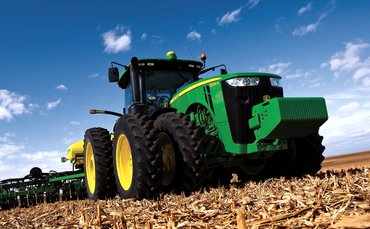

Farmers lacking state support for low carbon transition, campaigners argue | Credit: John Deere
Poll finds British public feel farmers aren’t doing enough to tackle the environmental impact of their industry
Campaigners have called for more state support to help farmers implement climate-friendly practices, after new polling today suggests the British public believe farmers aren’t doing enough to tackle the country’s environmental challenges.
A YouGov poll published this morning reveals 92 per cent of the public think it is important that farmers “take action” to “tackle climate change and nature’s decline.” But only a fifth of respondents felt the farming sector has actually reduced its environmental impact in the last five years. More than half – 54 per cent – believed the UK agriculture sector has made either no improvement or has increased its negative impact through that time.
Agriculture currently accounts for around nine per cent of UK greenhouse gas emissions, and have barely falled since 1990. Some 70 per cent of England’s land area used for agriculture, and campaigners argue there is significant scope for the sector to contribute solutions to the climate crisis.
The survey, which questioned 2,140 UK adults, was carried out in December last year on behalf of environmental coalition Wildlife and Countryside Link. Responding to its findings, CEO Richard Benwell argued farmers need more support from the government to take action on emissions.
“That means guaranteeing long-term funding for public goods beyond this Parliament,” he said. “It also means a clear roadmap for agricultural transition, starting in 2021 and ending in 2028 with a system that will be generous in its support for environmental public goods, so that farmers can plan now for a net zero carbon future.”
The National Farmers’ Union has set a target for net zero carbon emissions from agriculture by 2040, ten years ahead of the UK government’s target for the whole UK.
However, Wildlife and Countryside Link research last year which found that action on the environment within the farming sector was limited. Despite the fact 80 per cent of farmers believed the health of the natural environment was important for their business, a third reported taking no environmental action to deal with problems on their farm. Just a fifth undertook three or more actions, while 44 per cent undertook one or two. Farmers told researchers the main reasons for their not taking greater action were a lack of access to capital and uncertainty caused by Brexit.







