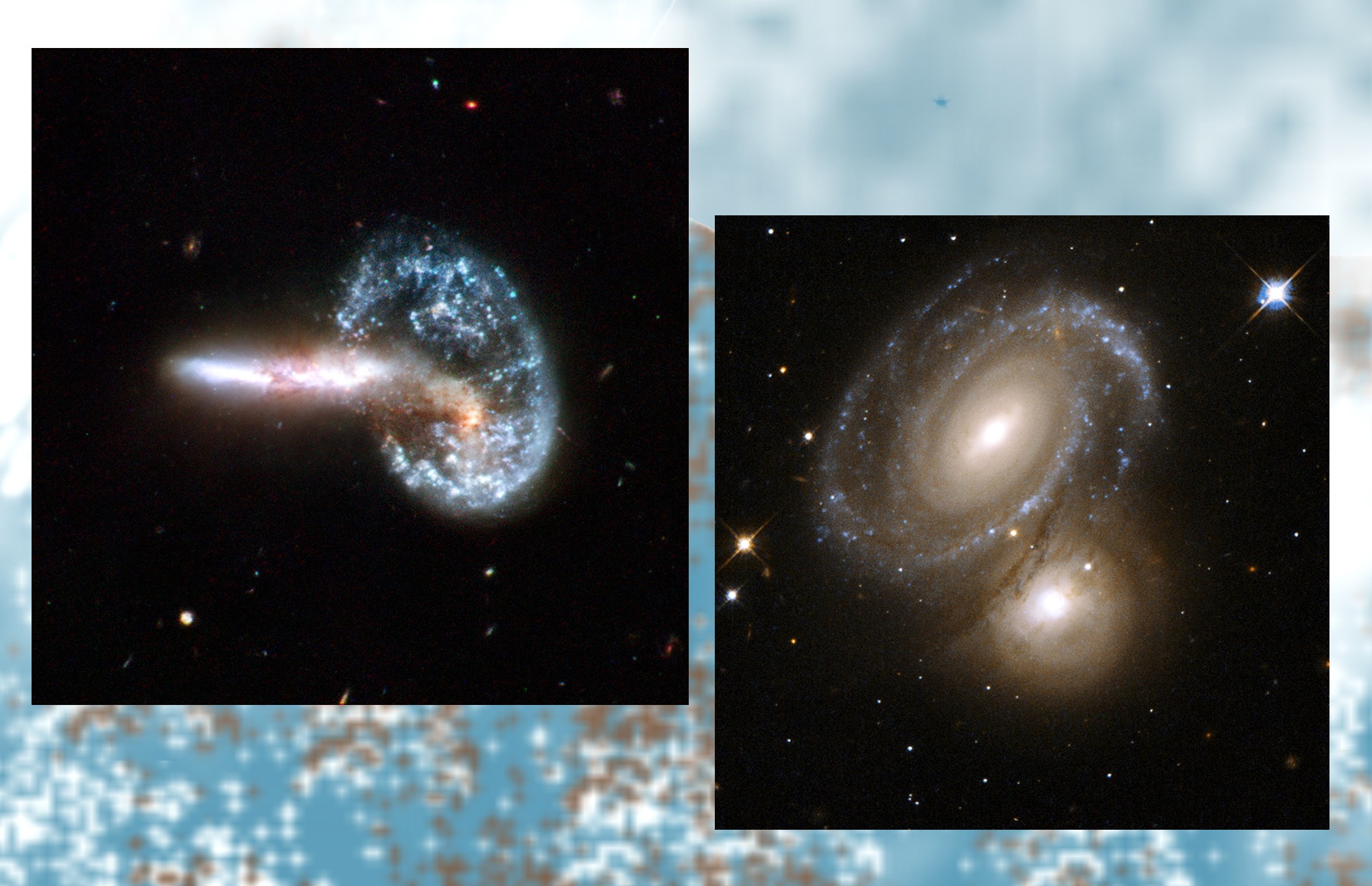
Galaxies are typically presented as solitary and stationary majestic worlds of glittering stars. But sometimes they collide, resulting in a baby boom of new stars. The morphing galaxies become somewhere new entirely. NASA and the ESA’s Hubble Space Telescope captured such events over the years – glorious images of mindbogglingly massive galaxy mergers. To celebrate the beginning of 2021, the agencies published six of these rare views. They are part of a compilation of 56 galaxy collisions released a few years ago.
“Fifty nine new images of colliding galaxies make up the largest collection of Hubble images ever released together. As this astonishing Hubble atlas of interacting galaxies illustrates, galaxy collisions produce a remarkable variety of intricate structures. Most of the 59 new Hubble images are part of a large investigation of luminous and ultraluminous infrared galaxies called the GOALS project (Great Observatories All-sky LIRG Survey). This survey combines observations from Hubble, the NASA Spitzer Space Observatory, the NASA Chandra X-Ray Observatory and NASA Galaxy Explorer. The Hubble observations are led by Professor Aaron S. Evans from the University of Virginia and the National Radio Astronomy Observatory (USA).” (Credit: NASA / ESA)“Interacting galaxies are found throughout the Universe, sometimes as dramatic collisions that trigger bursts of star formation, on other occasions as stealthy mergers that result in new galaxies. A series of 59 new images of colliding galaxies has been released from the several terabytes of archived raw images from the NASA/ESA Hubble Space Telescope to mark the 18th anniversary of the telescope’s launch. This is the largest collection of Hubble images ever released to the public simultaneously. This poster shows the best 12 images of the 56 images collection.” (Credit: NASA / ESA)
The six merging systems were part of a HiPEEC survey to investigate new star formation rates when galaxies collide.
These interactions are a key aspect of galaxy evolution and are among the most spectacular events in the lifetime of a galaxy.
“To celebrate a new year, the NASA/ESA Space Telescope has published a montage of six beautiful galaxy mergers. Each of these merging systems was studied as part of the recent HiPEEC survey to investigate the rate of new star formation within such systems. These interactions are a key aspect of galaxy evolution and are among the most spectacular events in the lifetime of a galaxy. Top left: NGC 3256This image of NGC 3256 was taken with the Wide Field Camera 3 (WFC3) and the Advanced Camera for Surveys (ACS), both installed on the NASA/ESA Hubble Space Telescope. The galaxy is about 100 million light-years from Earth and provides an ideal target in which to investigate starbursts that have been triggered by galaxy mergers. Credit: ESA/Hubble, NASA Top Middle: NGC 1614The galaxy system NGC 1614 has a bright optical centre and two clear inner spiral arms that are fairly symmetrical. It also has a spectacular outer structure that consists principally of a large one-sided curved extension of one of these arms to the lower right, and a long, almost straight tail that emerges from the nucleus and crosses the extended arm to the upper right. Credit: NASA, ESA, the Hubble Heritage Team (STScI/AURA)-ESA/Hubble Collaboration and A. Evans (University of Virginia, Charlottesville/NRAO/Stony Brook University) Top Right: NGC 4194NGC 4194 is also known as the Medusa merger. An early galaxy consumed a smaller gas-rich system, throwing out streams of stars and dust out into space. These streams, seen rising from the top of the merger galaxy, resemble the writhing snakes that Medusa, a monster in ancient Greek mythology, famously had on her head in place of hair, lending the object its intriguing name. The Medusa merger is located about 130 million light-years away in the constellation of Ursa Major (The Great Bear). (Credit: NASA / ESA)
Galaxies undergo dramatic changes during merging events in their stellar content and appearance. Analyzing them is an excellent way to trace star clusters’ formation (groups of stars) under extreme physical conditions.
The ESA said:
The Milky Way typically forms star clusters with masses that are 10 thousand times the mass of our sun. This doesn’t compare to the masses of the star clusters forming in colliding galaxies, which can reach millions of times the mass of our sun.
These dense star clusters emit immense amounts of light and continue to do so even when the collision is over and the resulting galactic system begins to calm.
Galaxy mergers, which were more common in the early universe than they are today, are thought to be one of the main driving forces for cosmic evolution, turning on quasars, sparking frenetic star births, and explosive stellar deaths. Even apparently isolated galaxies will show signs in their internal structure that they have experienced one or more mergers in their past. Each of the various merging galaxies in this series of images is a snapshot of a different instant in the long interaction process.
Our own Milky Way contains the debris of the many smaller galaxies it has encountered and devoured in the past, and it is currently absorbing the Sagittarius dwarf elliptical galaxy. In turn, it looks as if our Milky Way will be subsumed into its giant neighbor, the Andromeda galaxy, resulting in an elliptical galaxy, dubbed “Milkomeda”, the new home for the Earth, the Sun, and the rest of the Solar System in about two billion years. The two galaxies are currently rushing towards each other at approximately 500,000 kilometers per hour.
“ESO 99-4 is a galaxy with a highly peculiar shape that is probably the remnant of an earlier merger process that has deformed it beyond visual recognition, leaving the main body largely obscured by dark bands of dust. ESO 99-4 lies in a rich field of foreground stars, in the constellation of Triangulum Australe, the Southern Triangle, about 400 million light-years away.” (Credit: NASA / ESA)
The merging galaxy views are part of the Hubble Heritage Project. They were processed by a group of astronomers and image specialists at the Space Telescope Science Institute between 1998 and 2016. The team used the Hubble Space Telescope’s immense archive of imagery and new observation data to produce scientifically accurate and aesthetically impactful color images of our universe. The collection of views has inspired people globally and instilled a deeper appreciation of astronomy within the public.
This image, taken with the Wide Field Camera 3 (WFC3) and the Advanced Camera for Surveys (ACS), both installed on the NASA/ESA Hubble Space Telescope, shows the peculiar galaxy NGC 3256. The galaxy is about 100 million light-years from Earth and is the result of a past galactic merger, which created its distorted appearance. As such, NGC 3256 provides an ideal target to investigate starbursts that have been triggered by galaxy mergers.” (Credit: NASA / ESA)“Arp 272 is a remarkable collision between two spiral galaxies, NGC 6050 and IC 1179, and is part of the Hercules Galaxy Cluster, located in the constellation of Hercules. The galaxy cluster is part of the Great Wall of clusters and superclusters, the largest known structure in the Universe. The two spiral galaxies are linked by their swirling arms. Arp 272 is located some 450 million light-years away from Earth.” (Credit: NASA / ESA)“This beautiful pair of interacting galaxies consists of NGC 5754, the large spiral on the top and NGC 5752, the smaller companion in the bottom left corner of the image. NGC 5754’s internal structure has hardly been disturbed by the interaction. The outer structure does exhibit tidal features, as does the symmetry of the inner spiral pattern and the kinked arms just beyond its inner ring. In contrast, NGC 5752 has undergone a starburst episode, with a rich population of massive and luminous star clusters clumping around the core and intertwined with intricate dust lanes. The contrasting reactions of the two galaxies to their interaction are due to their differing masses and sizes. NGC 5754 is located in the constellation Boötes, the Herdsman, some 200 million light-years away.” (Credit: NASA / ESA)“Arp 240 is an astonishing galaxy pair, composed of spiral galaxies of similar mass and size, NGC 5257 and NGC 5258. The galaxies are visibly interacting with each other via a bridge of dim stars connecting the two galaxies, almost like two dancers holding hands while performing a pirouette. Both galaxies harbour supermassive black holes in their centres and are actively forming new stars in their discs. Arp 240 is located in the constellation Virgo, approximately 300 million light-years away, and is the 240th galaxy in Arp’s Atlas of Peculiar Galaxies. With the exception of a few foreground stars from our own Milky Way all the objects in this image are galaxies.” (Credit: NASA / ESA)“NGC 520 is the product of a collision between two disc galaxies that started 300 million years ago. It exemplifies the middle stages of the merging process: the discs of the parent galaxies have merged together, but the nuclei have not yet coalesced. It features an odd-looking tail of stars and a prominent dust lane that runs diagonally across the centre of the image and obscures the galaxy. NGC 520 is one of the brightest galaxy pairs on the sky, and can be observed with a small telescope toward the constellation of Pisces, the Fish, having the appearance of a comet. It is about 100 million light-years away and about 100,000 light-years across. The galaxy pair is included in Arp’s catalogue of peculiar galaxies as ARP 157.” (Credit: NASA / ESA)“Located in the constellation of Hercules, about 230 million light-years away, NGC 6052 is a pair of colliding galaxies. They were first discovered in 1784 by William Herschel and were originally classified as a single irregular galaxy because of their odd shape. However, we now know that NGC 6052 actually consists of two galaxies that are in the process of colliding. This particular image of NGC 6052 was taken using the Wide Field Camera 3 on the NASA/ESA Hubble Space Telescope. A long time ago gravity drew the two galaxies together into the chaotic state we now observe. Stars from within both of the original galaxies now follow new trajectories caused by the new gravitational effects. However, actual collisions between stars themselves are very rare as stars are very small relative to the distances between them (most of a galaxy is empty space). Eventually things will settle down and one day the two galaxies will have fully merged to form a single, stable galaxy. Our own galaxy, the Milky Way, will undergo a similar collision in the future with our nearest galactic neighbour, the Andromeda Galaxy. Although this is not expected to happen for around 4 billion years so there is nothing to worry about just yet. This object was previously observed by Hubble with its old WFPC2 camera.” (Credit: NASA / ESA)“CGCG436-030, the eye-catching spiral galaxy in the image, shows a very pronounced curling tail. The companion galaxy, located to the bottom-right of the image, displays an intricate structure, including a number of trails that extend quite far out from its core. The bright star that appears between the two galaxies does not belong to the interacting system and is located within the Milky Way. IRAS 01173+1405 is located in the constellation of Pisces, the Fish, about 400 million light-years away.” (Credit: NASA / ESA)“Arp 148 is the staggering aftermath of an encounter between two galaxies, resulting in a ring-shaped galaxy and a long-tailed companion. The collision between the two parent galaxies produced a shockwave effect that first drew matter into the centre and then caused it to propagate outwards in a ring. The elongated companion perpendicular to the ring suggests that Arp 148 is a unique snapshot of an ongoing collision. Infrared observations reveal a strong obscuration region that appears as a dark dust lane across the nucleus in optical light. Arp 148 is nicknamed “Mayall’s object” and is located in the constellation of Ursa Major, the Great Bear, approximately 500 million light-years away. This interacting pair of galaxies is included in Arp’s catalogue of peculiar galaxies as number 148.” (Credit: NASA / ESA)“AM1316-241 is made up of two interacting galaxies – a spiral galaxy (on the left of the frame) in front of an elliptical galaxy (on the right of the frame). The starlight from the background galaxy is partially obscured by the bands and filaments of dust associated with the foreground spiral galaxy. The Hubble image unravels the fine detail in the patchy clumps of dust confined to the spiral arms of the spiral galaxy. This dust reddens the light from the background just as the intervening dust in the Earth’s atmosphere reddens sunsets here. AM1316-241 is located some 400 million light years away toward the constellation of Hydra, the Water Snake.” (Credit: NASA / ESA)“AM0500-620 consists of a highly symmetric spiral galaxy seen nearly face-on and partially backlit by a background galaxy. The foreground spiral galaxy has a number of dust lanes between its arms. The background galaxy was earlier classified as an elliptical galaxy, but Hubble has now revealed a galaxy with dusty spiral arms and bright knots of stars. AM0500-620 is 350 million light-years away from Earth in the constellation of Dorado, the Swordfish.” (Credit: NASA / ESA)
The Hubble Space Telescope is still in service today. It whirls around the Earth at 17,500 miles an hour, taking pictures of planets, stars, and galaxies. It generates and archives approximately two terabytes of data per month and sends it to astronomers worldwide. These space scientists use the data to publish scientific papers. Over 7,500 have been written already, making Hubble one of the most productive scientific instruments ever made.
The Hubble Legacy Field, the biggest ever image of the universe, was made using 16 years’ worth of Hubble Space Telescope observations. It contains 265,000 galaxies and is essentially a mosaic of almost 7,500 individual exposures stitched together.
This website uses cookies to improve your experience. We'll assume you're ok with this, but you can opt-out if you wish. Cookie settingsACCEPT
Privacy & Cookies Policy
Privacy Overview
This website uses cookies to improve your experience while you navigate through the website. Out of these cookies, the cookies that are categorized as necessary are stored on your browser as they are essential for the working of basic functionalities of the website. We also use third-party cookies that help us analyze and understand how you use this website. These cookies will be stored in your browser only with your consent. You also have the option to opt-out of these cookies. But opting out of some of these cookies may have an effect on your browsing experience.
Necessary cookies are absolutely essential for the website to function properly. This category only includes cookies that ensures basic functionalities and security features of the website. These cookies do not store any personal information.
Any cookies that may not be particularly necessary for the website to function and is used specifically to collect user personal data via analytics, ads, other embedded contents are termed as non-necessary cookies. It is mandatory to procure user consent prior to running these cookies on your website.