

By Christopher Monckton of Brenchley
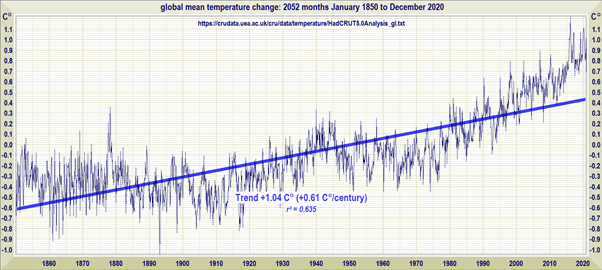
They’re at it again. The old lady of temperature datasets – HadCRUT, the only global dataset to reach back to 1850 – has released its revised monthly global mean surface temperature anomalies for 1850-2020. The earlier dataset (HadCRUT4) showed a least-squares linear-regression trend of 0.91 K on the monthly anomalies from 1850-2020 – only just over half a degree per century equivalent.
This was not enough. Like the endlessly-adjusted GISS, RSS and NCEI datasets, HadCRUT5 hikes the trend – and does so by a startling 14%. The usual method is adopted: depress the earlier temperatures (we know so much better what the temperature was a century and a half ago than the incompetents who actually took the measurements), and elevate the later temperatures with the effect of steepening the trend and increasing the apparent warming.
Of course, elaborate justifications for the alterations are provided. It is beyond my pay-grade to evaluate them. However, it is fascinating that the much-manipulated GISS, HadCRUT, RSS and NCEI datasets are managed by climate fanatics, while the UAH dataset – the only one of the big five to have gone the other way – is managed by climate skeptics.
I know the two skeptics who keep the UAH dataset. They are honorable men, whose sole aim is to show, as best they can, the true rate of global warming. But I do not trust the GISS dataset, which has been repeatedly and reprehensibly tampered with by its keepers. Nor do I trust RSS: when Ted Cruz displayed our graph showing the 18 years and 9 months of the last great Pause in global temperature to the visible discomfiture of the “Democrats” in the Senate I predicted that the keeper of the RSS dataset, who describes skeptics as “climate deniers”, would tamper with it to make the Pause go away. A month or two later he announced that he was going to do just that, and then he did just that. As for HadCRUT, just read the Harry-Read-Me file to see what a hopeless state that is in.
And the NCEI dataset was under the influence of the unlamented Tom Karl for many years. I once testified alongside him in the House of Representatives, where he attempted to maintain that my assertion that there had been nearly a decade of global cooling was unfounded – when his own dataset (as well as all the others) showed precisely that.
HadCRUT5 shows a 1.04 K trend from 1850-2020, or three-fifths of a degree per century equivalent, up 14% from the 0.91 K trend on the HadCRUT4 data:

From the HadCRUT5 trend, one can calculate how much warming would eventually be expected if we were to double the CO2 in the air compared with 2020. One also needs to know the net anthropogenic forcing since 1850 (2.9 W m–2); the planetary energy imbalance caused by the delay in feedback response (0.87 W m–2); the doubled-CO2 radiative forcing (3.52 W m–2 taken as the mean in the CMIP6 models); the anthropogenic fraction of observed warming (70%); the exponential-growth factor allowing for more water vapor in warmer air (7% per degree of direct warming); and the Planck sensitivity parameter (0.3 K W–1 m2).
All of these values are quite recent, because everyone has been scrambling to get the data shipshape for IPCC’s next multi-thousand-page horror story, due out later this year. The calculations are summarized in the table. I selected the seven input parameters using three criteria: they should be up-to-date, midrange, and mainstream: i.e., from sources that the climate fanatics would accept.
The industrial era from 1850-2020 is the base period for calculating the feedback response per degree of reference sensitivity over the period. This turns out to be 0.065. Then one finds the unit feedback response for the 100-to-150-year period from 2020 (415 ppmv CO2) to 830 ppmv CO2 by increasing the unit feedback response to allow for extra water vapor in warmer air.
Finally, one multiplies the 1.053 K reference sensitivity to doubled CO2 by the system-gain factor, which is the unit feedback response plus 1: midrange equilibrium doubled-CO2 sensitivity, known as ECS, turns out to be just 1.1 K. If one were to use the HadCRUT4 warming trend, ECS would be less than 1 K. I had previously guessed that the HadCRUT5 trend would be 1.1 K, which implied 1.2 K ECS.
Compare these small and harmless midrange values with the official CMIP6 predictions: lower bound 2 K; midrange 3.7 K; upper bound 5.7 K; lunatic fringe 10 K.
One can work out how many times greater the unit feedback response after 2020 would be when compared with the unit feedback response from 1850-2020 if these absurdly inflated predictions from the latest generation of models were correct: lower bound 14, midrange 19, upper bound 67, lunatic fringe 130.
These revealing numbers demonstrate how insanely, egregiously exaggerated are the official global-warming predictions. There is no physical basis for assuming that the unit feedback response from 2020 onward will be even 14 times the unit feedback response from 1850-2020. At most it might be about 1.1-1.2 times the earlier unit feedback response. Therefore, even the 2 K lower-bound global warming predicted by the models, which implies X = 14, is way over the top.
This is the most straightforward way of showing that the models’ global-warming predictions are without a shred of legitimacy or credibility. They are elaborate fictions. They suffer from two defects: they are grossly excessive, and they are accordingly ill-constrained.
For, as the graph shows, the ECS response to feedback fractions is rectangular-hyperbolic. The feedback fraction (the fraction of ECS represented by feedback response) implicit in the models’ ludicrous predictions generally exceeds 0.5: but there is absolutely no way that the feedback fraction could be anything like 0.5 in the near-perfectly thermostatic climate. When I first showed this graph to a group of IPCC lead authors, they suddenly stopped the sneering to which they had subjected most of my lecture. Suddenly, the lead sneerer fell silent, and then said: “Have you published this?”
No, I said, for at that time I had not worked out what climatologists had gotten wrong. “Well, you must publish,” he said. “This changes everything.”
So it does. But publication is going to be very difficult, not because we are wrong about this but because we are right. If there is going to be little more than 1 K anthropogenic warming over the next century or so, there is absolutely no need to do anything to prevent it. The flight of major manufacturing industries to China, which profiteers mightly from the climate scam sedulouosly promoted in the West by the fawning front groups that it subsidizes, can and should be reversed.
We are taking steps to compel HM Government to pay attention to the truth that global warming will be no more than a third of current official midrange predictions and that, therefore, no net harm will come from it. Watch this space.
5
17
votes
Article Rating
Like this:
Loading…







