

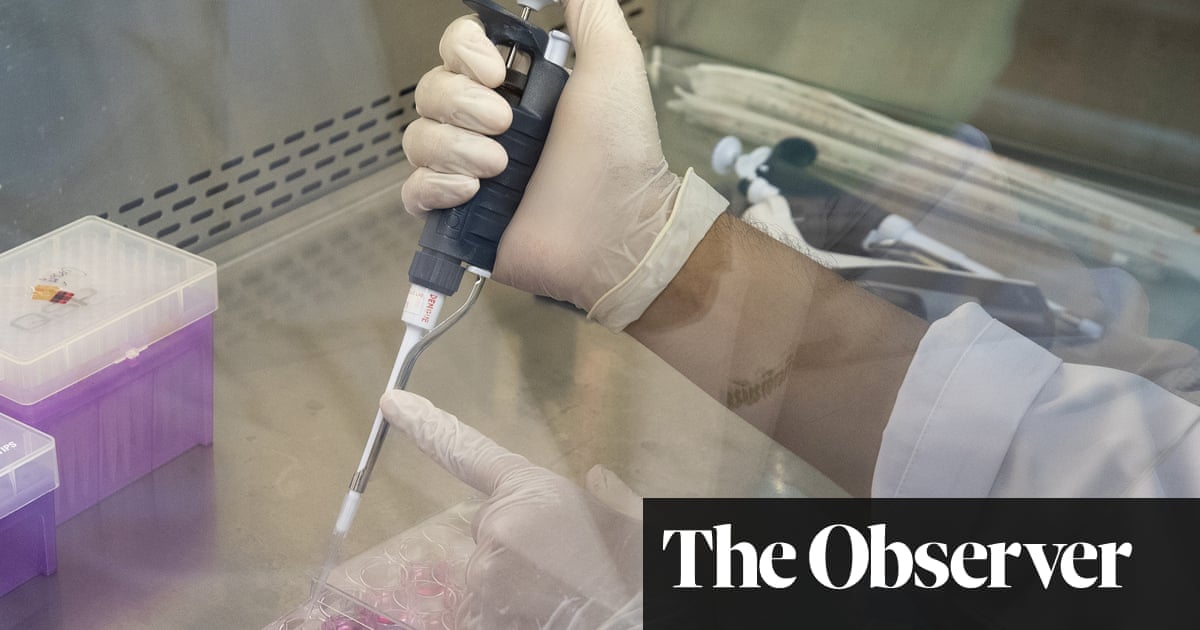
The hunt for new medicines has often been more like a game of roulette than high-end science. But now the pharmaceutical sector is on the cusp of a transformation, as it delves into cutting-edge technology to come up with new treatments for diseases such as cancer, rheumatoid arthritis and Alzheimer’s.
Artificial intelligence (AI) is set to improve the industry’s success rates and speed up drug discovery, potentially saving it billions of dollars, a recent survey by the analytics firm GlobalData has found. AI topped a list of technologies seen as having the greatest impact on the sector this year. Almost 100 partnerships have been struck between AI specialists and large pharma companies for drug discovery since 2015.
AI uses automated algorithms – sets of instructions that computers follow – to perform tasks previously done by humans. It can sift quickly through large datasets (from clinical studies and scientific literature) to detect hidden patterns, and perform tasks within seconds that would usually take months. A study in the Lancet found AI software could identify breast cancers that were missed by doctors in mammograms.
In a process known as machine learning, AI systems run through millions of possibilities, improving each time, until they are able to perform acceptably. The output of that training is an algorithm.
“Drug discovery is being transformed through the use of AI, which is reducing the time it takes to mine the vast amounts of scientific data to enable a better understanding of disease mechanisms and identify new potential drug candidates,” says Karen Taylor, director of the Centre for Health Solutions at accounting and consultancy group Deloitte. “Traditional drug discovery has been very fragmentary, very hit and miss,” she adds.
Taylor says the rapid progress of Covid-19 vaccines and potential treatments has been aided by the use of AI techniques. “It allows you to cross-reference a lot of published literature with other data within seconds.”
Kitty Whitney, director of thematic research at GlobalData, says the Covid-19 crisis could be a “tipping point” for widespread adoption across the pharma industry.
About 90% of large pharmaceutical firms initiated AI projects last year, according to the US research firm Trinity Life Sciences. AstraZeneca and GSK, Britain’s two biggest drugmakers, committed in November to a five-year partnership with Cambridge University to fund the Cambridge Centre for AI in Medicine. The 15-strong team will develop AI and machine-learning technologies to improve clinical trials, personalised medicine and drug discovery.

GSK had previously opened a £10m AI research base in King’s Cross, central London, near Google’s DeepMind AI lab. Its global team of AI experts has grown to 50 people, which it wants to double to 100.
Functional genomics – a new area of science that looks at why small changes in a person’s genetic make-up can increase the risk of diseases – deals with huge datasets. Each person has about 30,000 genes, which can be combined with others, as Hal Barron, GSK’s chief scientific officer, explains. “You start to realise you’re dealing with trillions and trillions of data points, even per experiment, and no human can interpret that, it’s just too complicated.”
Large pharmaceutical companies have been criticised for being slow to embrace technological advances. Drug discovery has a woefully low success rate – of 10 drugs in development, nine will typically fail; it takes 10-12 years on average, and comes with a high cost, of more than $2bn, to take a medicine through research and development and regulatory approval.
Conventional drug discovery has been compared to a “molecular casino” by Alex Zhavoronkov, an expert in the use of AI for developing new drugs, who runs Hong Kong-based Insilico Medicine.
GSK’s Barron reckons the use of AI technologies could at least double the success rate to 20%, which would save billions of dollars spent on drug development. Others, like Zhavoronkov, hope the success rate could improve much more, potentially to 50%.
All of the world’s top 10 drugmakers – the Swiss firms Novartis and Roche; the US companies Pfizer, Johnson & Johnson, Merck, AbbVie and Bristol Myers Squibb; France’s Sanofi; and the UK’s AstraZeneca and GSK – are now investing in AI, mainly through collaborations, or by acquiring technologies.
Kim Branson, GSK’s global head of AI and machine learning, says AI is being used in the search for treatments for infectious diseases, as well as for diseases that are harder to crack such as cancer, rheumatoid arthritis and autoimmune disorders such as Crohn’s. Alzheimer’s– “the hardest of the hard targets” – is on GSK’s radar but will be tackled at a later stage.
Zhavoronkov says the problem with Alzheimer’s and the brain disorder Parkinson’s disease is that there is not enough data available to study them, hence the large number of drug failures to date.
Zhavoronkov and Barron have expressed confidence that a major breakthrough in one of the harder-to-research diseases can be achieved with AI technologies. Barron compares the potential to having a new microscope. “Within the next year or two we might find a target that really can make a difference.”







