

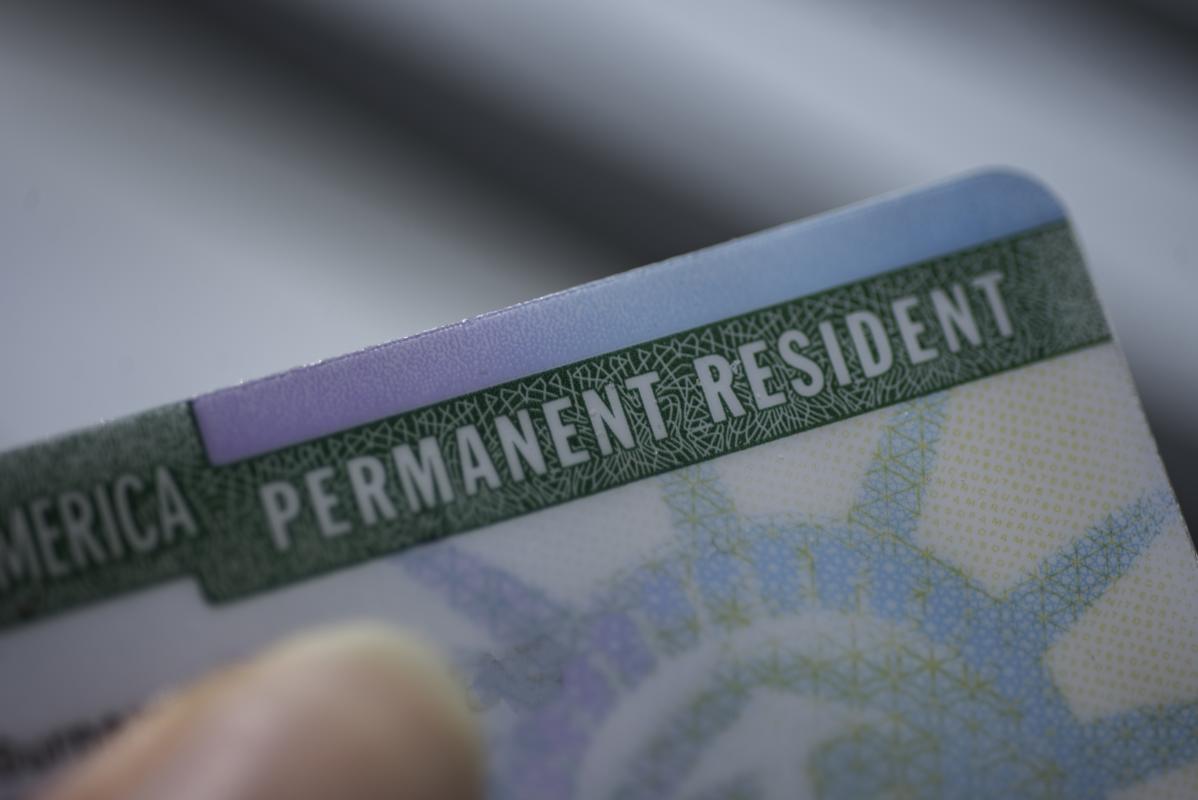
International students who earn Ph.Ds. in science, technology, engineering and mathematics fields from American research universities often take an “inefficient pathway” to permanent residency in the United States, two researchers argue in a new article published in Science that bolsters President Biden’s case for making it easier for STEM Ph.D.s to get green cards granting them permanent status.
Using data from a survey they conducted of STEM doctorates from 39 leading research universities along with data from the Department of Labor, the researchers conclude that the H-1B visa — a temporary skilled worker visa open to workers with a bachelor’s degree or higher — “has become the predominant first step for STEM Ph.D.’s employed in industrial [research and development], not because it is legally required or the most suitable visa, but because of inefficiencies and delays on the path to permanent residency.”
Michael Roach, the J. Thomas and Nancy W. Clark Assistant Professor of Entrepreneurship at Cornell University, said most foreign doctoral students say they want permanent residency.
“So the question is why not go straight to a green cards?” asked Roach, who co-authored the article, “Rethinking Immigration Policies for STEM Doctorates,” with John Skrentny, a professor of sociology at the University of California, San Diego.
“Part of it is there are these country quotas for how long they take to get a green card,” Roach said. “Because of the uncertainty and delay in how long it takes to get a green card, they want to get another visa to give them a buffer.”
After graduating, Ph.D. students with STEM degrees can stay in the U.S. to work for up to three years while remaining on their student visas through a program known as optional practical training (OPT). But after three years, they are legally required to transition to an employment-based visa category. They can either apply for a work visa category that offers permanent residency, such as EB-1 visas for workers with “extraordinary ability,” or the EB-2 visas for workers with advanced degrees or “exceptional ability.” Or they can apply for the H-1B temporary work visa, which is open to a far broader swath of applicants with bachelor’s degree or higher.
The authors found that while international Ph.D. graduates are eligible to apply directly for permanent residency, many use the H-1B visa, which allows them to remain in the U.S. for three years with the possibility of a three-year extension, as “a bridge between OPT and a green card.” This was especially true for international Ph.D. graduates from China and India, who face years-long waits for green cards due to per-country quotas built into the immigration system.
Wait times are shorter for the more competitive “extraordinary ability” EB-1 visas, but current data from the U.S. Department of State show wait times approaching five and 10 years, respectively, for Chinese and Indian citizens applying for permanent residency through the EB-2.
Importantly, the majority of foreign STEM Ph.D. graduates in Roach and Skrentny’s survey sample do in fact succeed in getting permanent residency, but only after passing through an H-1B — and only after costing their employers thousands of extra dollars associated with sponsoring them for not one, but two, visas. The researchers found that after three years of employment, 68 percent of those with doctorates in their survey had either received or been sponsored for permanent residency. Just over three-quarters of those who were initially sponsored on an H1-B visa had transitioned to or were being sponsored for permanent residency.
The authors found no evidence that those starting jobs on H-1Bs were on the whole less qualified than those graduates who went directly to an EB visa. They found no significant difference between those with Ph.D.s sponsored for EB or H-1B visas in terms of their number of publications or patents prior to industry employment, and no significant difference in terms of starting salaries.
The researchers also found no significant difference in pay between U.S. citizen and foreign doctorates, finding instead that starting salary was driven primarily by field of study and proxies for worker ability.
“Though these comparisons do not allow for careful identification of the causal effects of immigration policies on wages, nor do they rule out the possibility that a greater number of foreign Ph.D.’s in the workforce could drive down wages for native Ph.D.’s, they provide suggestive evidence that often-cited concerns of foreign entry-level STEM workers being paid less than their native peers do not apply to STEM Ph.D.’s,” they wrote in the article.
Roach said in an interview that there “is broad bipartisan agreement” about the benefit of the U.S. retaining foreign Ph.D. graduates who hold STEM degrees from American universities.
“If we streamline the process for them to be able to apply for a green card and remove the country quotas for the Ph.D., that would be something that I think would allow them to be able to bypass the H-1B, and that would help us retain them,” Roach said.
Along those lines, President Biden is proposing to make it easier for STEM Ph.D. graduates to get green cards, according to a fact sheet about his proposed immigration bill released by the White House last week. His campaign website specifically proposed exempting STEM Ph.D. graduates from visa caps.
“He will also exempt from any cap recent graduates of PhD programs in STEM fields in the U.S. who are poised to make some of the most important contributions to the world economy,” the campaign website says. “Biden believes that foreign graduates of a U.S. doctoral program should be given a green card with their degree and that losing these highly trained workers to foreign economies is a disservice to our own economic competitiveness.”
Stephen Yale-Loehr, a professor of immigration practice at Cornell University who reviewed an earlier draft of the Science article, said Roach and Skrentny’s research provides proof that Biden’s approach “makes sense.”
“These people have very specialized qualifications, and the companies need this kind of specialized talent to be able to compete in the global marketplace,” Yale-Loehr said.
“The authors make a good case that the current U.S. immigration system does not work any better for individuals with Ph.D.s in STEM fields than it works for anyone else,” added Stuart Anderson, executive director of the National Foundation for American Policy, a research organization focused on immigration and trade. “Providing exemptions from the annual limits for both H-1B visas and employment-based green cards for individuals with a master’s or a Ph.D. in a U.S. STEM field would be a great benefit for U.S. universities and the competitiveness of American companies and the U.S. economy.”
Ronil Hira, an associate professor of political science at Howard University who studies high-skilled visas, warned, however, of the risk of unintended consequences.
“The recommendations need to be further fleshed out,” Hira said. “The principle of giving preferential treatment to STEM doctorates (field and level of education) when it comes to immigration policy is widely supported. But as in most immigration policy issues, the details matter. Permanent residence is a significant benefit that many people will pay for.”
Hira described a need to define what fields are included in STEM — specifically, whether it includes fields in social and behavioral sciences like political science and psychology — and warned of the likelihood that some doctoral programs “will be created not for education but instead to sell green cards.” (Roach and Skrentny briefly acknowledge this risk in their paper, noting the need for “oversight to avoid fraudulent dissertations and job offers.” Roach said in an interview that while there is a risk of unintended consequences, he believes the system would be far less prone to abuse at the doctoral level as compared to the master’s level, where programs are shorter and less specialized.)
Hira also noted that not all STEM labor markets are the same, with the life sciences, for example, having a glut of recent graduates.
“Providing preferential immigration treatment to STEM doctorates makes sense, but stapling a green card to every doctorate will create many unwanted distortions,” Hira said. “These could be mitigated with some refinements and adding criteria for eligibility such as a job offer at a certain wage. A faster path to permanent residence is preferable to the current long-term guest worker status many face with the H-1B.”







