

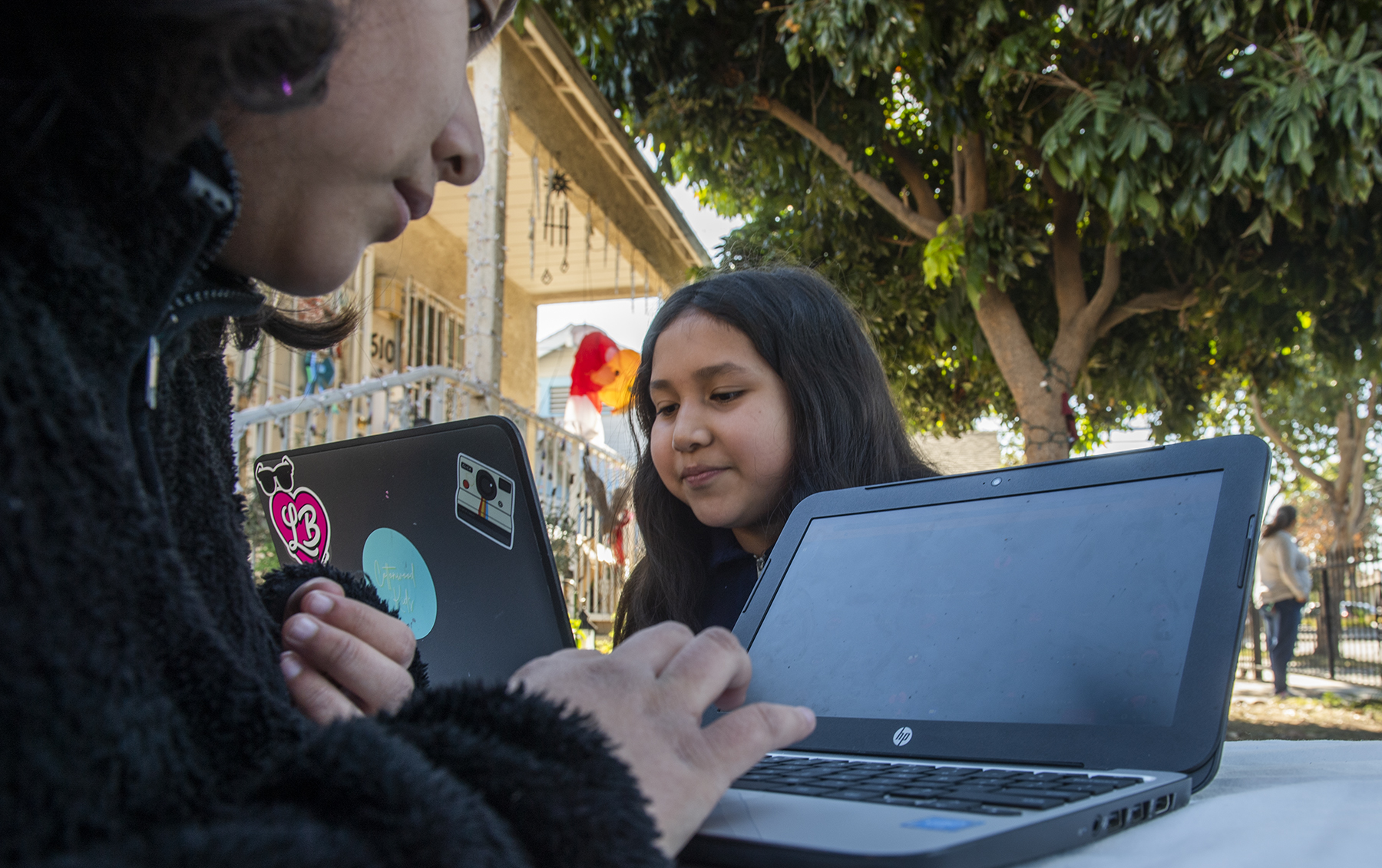
On many school days, Maria Teresa Loeza said her elementary and middle school kids wave their Chromebooks around the house on Walnut Avenue and 15th Street in Long Beach, searching for a stronger internet connection.
Sometimes her 13-year-old stays up late at night to submit assignments, growing frustrated when the signal cuts off while documents upload.
Her 9-year-old’s grades, meanwhile, are dropping.
“It makes me sad; it makes me angry,” Loeza, 45, said in Spanish.

Gabriela Alvarez-Loeza, 13 left and her sister Daniela Alvarez-Loeza 9, sit outside their home while on their school Chromebooks in Long Beach Wednesday, Dec. 16, 2020. Photo by Thomas R. Cordova.
Loeza’s family is among many struggling amid an unprecedented 10-month shutdown of schools in Long Beach intended to halt the spread of the coronavirus. But for students of color from disadvantaged neighborhoods, the consequences of the closure might be especially dire, as officials worry they are losing gains in academics made before the pandemic arrived last March.
This month, the heads of seven urban school districts across California, including Long Beach, wrote a pointed letter to the governor, calling out the disparities and urging the state to craft a uniform plan for reopening that won’t leave districts—and students—further behind wealthier areas that may be able to open sooner and get a boost in state money because of it.
“Affluent communities where family members can work from home will see schools open with more funding,” they wrote on Jan. 6. “Low-income communities bearing the brunt of the virus will see schools remain closed with lower funding.”
‘I’m failing my students’
Prior to the pandemic, students of color had shown improvements, with increases in graduation rates for Latinx (a gender-neutral term the district uses instead of Latino) and African American students by 11% and 10%, respectively, within the past decade, according to Long Beach Unified School District data.
Latinx students make up 58% of the district’s population, which serves as an indicator how the district performs overall. African American students make up 12%.
LBUSD is currently analyzing data in key assessment areas such as math readiness for the past 11 months, with concrete data on how the pandemic may have affected academic progress across all groups to be revealed in February, said Chris Brown, assistant superintendent of research and school improvement.
But anecdotally, officials say they are hearing from parents and teachers that students of color, as well as those with special needs, are falling behind, Brown said.
In early October, parents and teachers gave emotional testimony before the school board, detailing myriad struggles students are having, including lack of support at home; not having a quiet, safe place to study; lack of internet access; and stress from being logged on to a computer all day.
Cubberley Elementary School teacher Debi Bober, a 2018 Teacher of the Year in Los Angeles County, said bluntly: “I cannot meet the needs of my students right now. I’m failing my students and I’m trying my hardest.”
A survey conducted in June by the local district showed no one is particularly pleased with virtual learning. On a question about “frequent challenges,” 42% of students reported regularly feeling unmotivated, 33% were dealing with caring for a sibling, 30% had no quiet place to work, and 17% had internet issues.
National, state and regional studies paint a similar picture, with students of color and in high-poverty communities falling further behind their peers.
A survey in the Los Angeles Unified School District, a neighboring district, showed that between March 16 and May 22, Black and Hispanic students participated 10 to 20 percentage points less than White and Asian students in distance learning. The study measured participation based on how often middle and high school students submitted assignments, took tests or posted messages.
On the state level, a Los Angeles Times survey of 45 Southern California school districts revealed that on average, about half the students in low-income-serving districts had computers available for distance learning when campuses closed. In the largest districts, the survey shows, nearly two-thirds of students had them.
By contrast, in the most affluent-serving districts, an average of 87% of students had computers when campuses closed, and 98% had them about three weeks later, according to the survey.
Nationally, one recent study by McKinsey & Co. found that White students were held back by one to three months in math, and students of color lagged by three to five months. The study also found that Black and Hispanic students were 20% more likely to study remotely than White students when schools were reopening.
This stark disparity led one local legislator, Assemblyman Patrick O’Donnell, D-Long Beach, to state in mid-November that the closures have amounted to “state-sanctioned segregation.”
It wouldn’t be wise to open schools now given the high rates of coronavirus in the community, he said at the time. “But going forward we need to ensure that districts are ready to open without delay once we drop out of that.”
The Long Beach district announced last month that classes will remain virtual until at least March 1, with the rollout on teacher vaccinations set to begin on Jan. 25.
But Long Beach officials have said districts are not on a level playing field when it comes to the ability to reopen. And funding that the state is promising needs to take into account the unique challenges that urban districts such as Long Beach face.
‘Safe Schools for All’
Gov. Gavin Newsom in late December announced a $2 billion “Safe Schools for All” plan to encourage more schools to reopen for in-person instruction this year.
The plan notes that kids are contracting COVID-19 less often than adults and do not seem to be major sources of transmission. With the right precautions, officials are not seeing many outbreaks in schools, according to the governor’s memo.
Districts that restart in-person learning will receive additional funding of at least $450 per student, plus an additional amount as high as $250 per student based on the number of high needs students (low-income students, English learners, foster and homeless children) each district has.
But the money will only be provided if schools reopen, with a target date of Feb. 1.
The coronavirus, however, is far more rampant in urban areas such as Long Beach and Los Angeles, neither of which are anywhere near meeting the state’s criteria for reopening.
Under the plan, districts could open if they are in counties where the rate of coronavirus cases is 28 per 100,000 residents or less; in Long Beach alone, that number is currently 141 per 100,000 residents.
That means districts hardest hit by the virus will lose out on funding, while those in more affluent areas are likely to move faster toward reopening—again putting students of color at a disadvantage, they argue.
The seven district superintendents instead ask the state to help them mitigate the spread of the virus, and in the meantime, help provide the support needed to keep students from falling further behind.

Gabriela Alvarez-Loeza, 13 left and her sister Daniela Alvarez-Loeza 9, sit outside their home while on their school Chromebooks in Long Beach Wednesday, Dec. 16, 2020. Photo by Thomas R. Cordova.
So far, the Long Beach district has doled out thousands of hotspots and Chromebooks, and officials have said that anyone who wants or needs a Chromebook, internet or any other type of school-related help should call the district immediately. The district is also set to receive nearly $100 million from the federal government to help pay for COVID-related expenses this year.
But even if families have the equipment, one of the greatest barriers for virtual learning is simple internet connection.
Parents constantly complain about the poor reception, seemingly affecting certain neighborhoods more than others.
LBUSD Board Member Juan Benitez said that if parents communicate with teachers or school administrators that their internet connection is poor, teachers shouldn’t punish students for it.
Language is another barrier.
“A lot of parents I speak to, they don’t know how to support their students because they don’t have high levels of English understanding,” Benitez said.
Before the pandemic, Loeza didn’t have internet service. Not tech savvy, she frequently asks her college-educated neighbor for help. While Loeza studied at community colleges only to learn English, she said her neighbor is more familiar with computers after studying at Cal State Long Beach.
“As a parent, I wish I could help them more…” she said in Spanish. “None of us were ready for something virtual like this.”
In an already low-income household, the funds between Loeza and her husband dwindled this year, not even reaching a $10,000 household income. Now, she sees a new monthly bill of $30 for the internet during a time when only her husband is working—as a mechanic.
Last winter, Loeza wanted to bring in more money as a housekeeper for Airbnbs to support the growing needs of her daughters, but the pandemic cut those prospects short.
While she navigates around hardships, Loeza is reminded that her two daughters have their own.
To deal with stress, she said that her 13-year-old started a new hobby of making earrings, and the 9-year-old draws.
“Or she’s simply laying down with her eyes closed,” she said about her younger daughter.







