

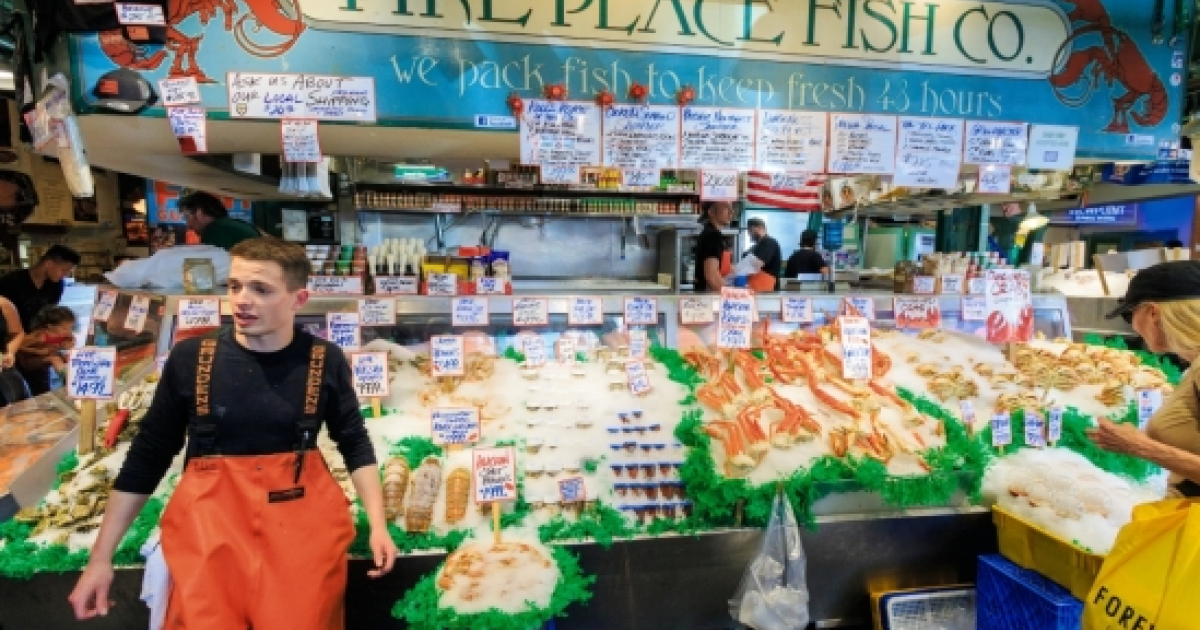
The United States’ seafood industry declined precipitously in the months following the emergence of the COVID-19 pandemic, and research shows that targeted federal assistance will be necessary to bring it back.
UC Santa Barbara aquaculture and fisheries professor Halley Froehlich and colleagues suspected as much early on in the pandemic, but for something as large and complex as the seafood industry, the trends were not so obvious. As a result, financial assistance in that direction has been slow.
“Seafood is part of the narrative that I would say doesn’t get as much attention as something like agriculture,” said Froehlich, an author of a study published in the journal Fish and Fisheries. “And that certainly appears to be the case when we’re looking at something like the CARES Act, the federal funding source specifically passed to provide economic relief in the U.S.”
That is, in large part, due to the fact that policymakers lack sufficient real-time data to see how the seafood industry is faring in the time of lockdowns and social distancing, said the study’s lead author, University of Vermont ecologist Easton White.
Get the top stories in your inbox by signing up for our daily newsletter, Indy Today.
“One difficulty is that a lot of this data isn’t released until months and years later,” he said. From the boat to the table, data is generated that must be gathered and processed before it gets released, he explained.
The pandemic is a rapidly evolving situation, and the seafood industry can’t afford to wait. So, to get a big-picture look at the early effects of COVID-19 on U.S. fisheries and seafood consumption, Froehlich, White, and fellow fisheries data experts synthesized multiple sources from across the seafood supply chain, including some unconventional real-time data sets.
“We looked for different indicators of the effects of COVID on seafood and fisheries in general,” White said. In addition to federal fisheries reports and customs data, the researchers looked to news reports and Google search trends for seafood and seafood market foot traffic.
Lessons Learned
As had happened for virtually every industry at the start of the pandemic, the lockdowns and closures caused a huge drop in economic activity for the seafood sector, from which many still struggle to recover. Using data from January to September 2020, the researchers calculated a 40 percent decline in fresh seafood catches, a 37 percent decline in imports, and a 43 percent drop in exports relative to the same time last year. These impacts are expected to reverberate across the globe, as the U.S. is one of the top exporters and importers of seafood.
Closer to home, demand from restaurants — the main driver of seafood spending in the U.S. — virtually disappeared as establishments locked down. Seafood market foot traffic declined steeply as well.
The effects were uneven across fisheries and aquaculture operations.
“Large-scale production systems that have large networks were able to pivot really fast,” Froehlich said. “And so if they couldn’t sell in one location, they were more easily able to sell to a different location. They felt the impacts, but not as much as the small-scale fisheries that then had to depend on looking for local buyers.”
Frozen seafood products, according to the paper, “were generally less affected.”
One interesting development has been the uptick in seafood delivery and takeout, which has been picking up some — but not all — of the slack in restaurant demand.
“It’s unclear to us the level of substitution and what it means in the long term, especially how people are consuming seafood at home,” said Froehlich, who is interested in how this consumption pattern might influence the demand for certain species over time.
Because of COVID-19’s variable effects across the entire seafood industry, according to the researchers, future federal support should be aimed at locations and sub-sectors “most affected by the pandemic: fishery-dependent communities, processors, and fisheries and aquaculture that focus on fresh products.”
“A lot of communities are dependent on fisheries,” White said. “There are fisheries for tourism, for livelihoods, and a lot of indigenous communities focus on fishing. And it’s not just fishing but also fish processing, all the different people that are involved. If you have COVID popping up just when you’re about to go fishing and make all the money you’re going to have for the year, now you can’t make any of that.”
The pandemic has highlighted some of the stress points in the U.S.’s seafood supply chain, the researchers said. Preserving a diversity of the sub-sectors within the seafood industry — for instance, small local operations as well as large fisheries — will keep the entire system resilient to shocks.
“If you have locally sourced seafood, if you have aquaculture and fisheries, if you have small-scale and large-scale, this is a little more robust,” White said.
This study is the first to be produced from the wealth of data the researchers gathered. A parallel study will publish in the journal Marine Policy that examines how policy, particularly the new federal seafood acts and executive orders, can support more integrated management and diversification of the U.S. seafood sector. The researchers hope the information will help guide the rebuilding of the flagging U.S. seafood industry to be more resilient to future shocks, including climate change impacts.
“As new mandates and legislation around fisheries and aquaculture are being rolled out during COVID-19 at the national and state levels, we have an opportunity to really think about what the actual targets and goals are. How do we build in more resilience now, instead of retroactively, when the system gets disrupted again,” Froehlich said. “Because it will.”
Research in this study was conducted also by Richard S. Cottrell at UCSB, Jessica A. Gephart at American University, Trevor A. Branch at University of Washington, Rahul Agrawal Bejarano at University of Michigan, and Julia K. Baum at University of Victoria.
This article was reprinted with permission from UCSB’s Office of Public Affairs and Communications.
Every day, the staff of the Santa Barbara Independent works hard to sort out truth from rumor and keep you informed of what’s happening across the entire Santa Barbara community. Now there’s a way to directly enable these efforts. Support the Independent by making a direct contribution or with a subscription to Indy+.







