

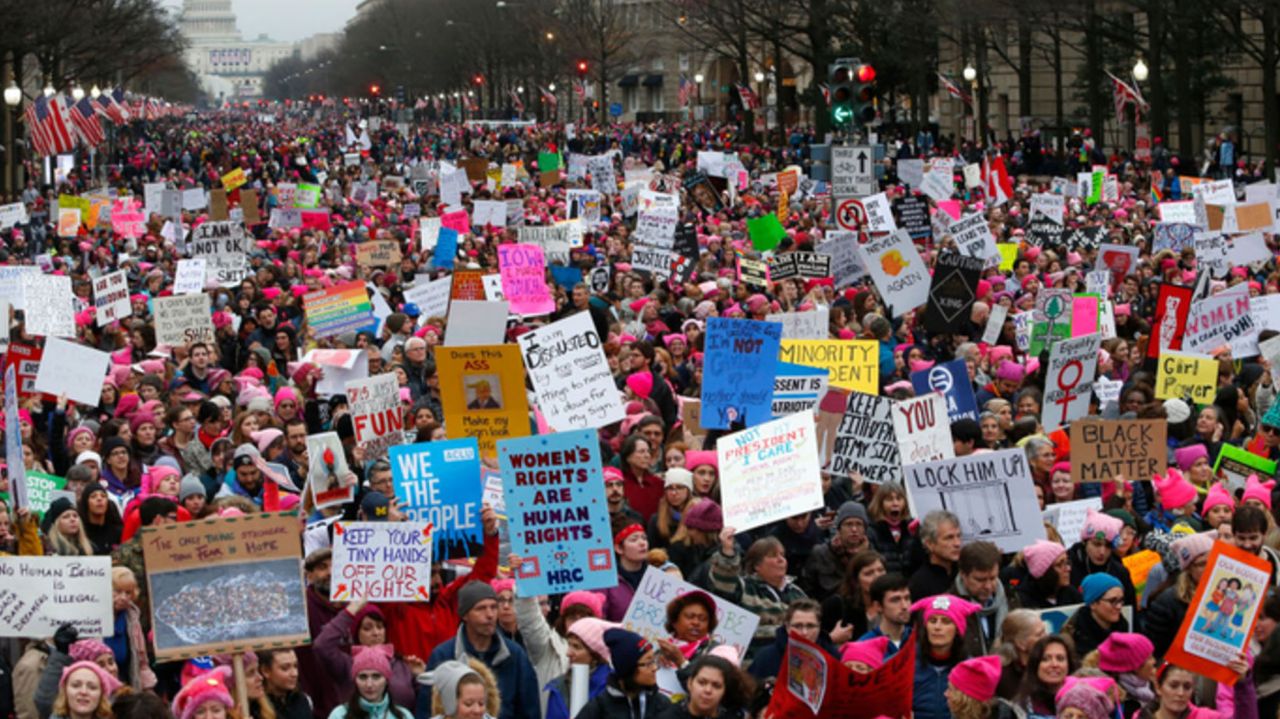
Almost four years ago, millions of people — mostly White women — attended the 2017 Women’s March, making it the largest single-day demonstration in recorded U.S. history. (While that remains a high as a single day, this summer’s sustained Black Lives Matter protests were the broadest and most diverse in U.S. history). That march ignited the anti-Trump resistance, which mobilized left-leaning Americans to march in the streets at numerous demonstrations that were focused on a range of progressive issues. Since 2017, I have followed a random sample of those marchers, who channeled their outrage into activism to become the backbone of much of what I call the “American Resistance.” Here’s what they’ve been up to since the midterm elections in 2018 — and what they’re likely to do no matter who wins the election.
To study this group, I collected data from participants at all the large-scale demonstrations that took place since the inauguration of President Donald Trump in January 2017 through the Women’s March in January 2019, after the 2018 midterm elections. My research team snaked through the crowds sampling every fifth person at designated increments within the staging areas to gather a field approximation of a random sample at every event that attracted more than 25,000 people in Washington, D.C. Over the course of the project, I amassed a data set of 2,130 protest participants from eight protest events that were focused on a range of progressive issues, including women’s rights, climate change, family separation and gun control. The majority were highly educated, middle-aged White women.
I followed up with this sample early last month to see how these resisters were participating in politics during the pandemic and what was motivating their activism. By the time the survey closed last week, 216 participants from the original wave of data collection had completed the follow-up study, representing a 29% response rate. Given the time that has lapsed between some of the protests where respondents were surveyed and now, this response rate is better than I expected and higher than the response rate for my follow-up survey with the same sample right after the midterm elections in November 2018. With less than a third participating, it is likely that survey respondents are more politically engaged than non-respondents.
When originally surveyed while protesting in the streets, few participants identified racial justice and police brutality as among their top motivations. At the 2017 Women’s March, respondents were asked to write in their reasons for attending, as many as they wanted. Those data were coded into issues and counted. Racial justice and police brutality/Black Lives Matter emerged as distinct categories. In subsequent protests, participants were asked to check off what issues were motivating them from the list of 14 issues that emerged from that first march, plus an “other” write-in category. These data make it possible to understand the most common motivations and to assess patterns of motivations across the marches.
When we surveyed participants at that first Women’s March, 61% named women’s rights as a motivation for taking to the streets, and only 18% mentioned police brutality or Black Lives Matter. That percentage has changed since this summer’s mass Black Lives Matter demonstrations. In the more recent survey this fall, when asked what motivated their activism and political work, 71% of that group mentioned police brutality/Black Lives Matter. Similarly, of the protesters we sampled at the 2018 March for Our Lives, which was coordinated by the Parkland school shooting’s young survivors, only 36% said they were motivated by police brutality/Black Lives Matter. But in this more recent survey, 82% listed this as a motivation.
In the two years since I last contacted them, these resisters have continued to be very civically engaged. Fully 74% say they have contacted an elected official in the past year; 38% say they attended a town hall meeting, which includes online town hall meetings, since the pandemic began. Eighty-one percent report having voted in the past year, which includes ballots cast in primary elections and in this week’s election. That’s an even higher voting rate than the 75% reported by participants at the January 2019 Women’s March, just after midterm elections; nationally, 53% of the voting-age population participated in those elections. Almost all respondents (98%) report they are supporting Joe Biden for president.
About half of these resisters (48%) report working on the election in a variety of ways: with the Democratic Party, with individual campaigns and with political groups like Swing Left. Given the pandemic, very few reported any involvement in face-to-face meetings or door-to-door canvassing. However, their involvement has included donating money, phone banking, text banking and registering voters.
Notably, these resisters have found ways to stay engaged during the pandemic, despite the fact that, with a median age of 51, many are at higher risk for contracting COVID-19. This level of participation in the election suggests that these activists will continue to be politically involved well past the 2020 election, no matter who wins.
Fisher is a professor of sociology at the University of Maryland and author of “American Resistance” (Columbia University Press, 2019). This piece was written for The Washington Post.







