
GLOBAL RESEARCH SYNDICATE
No Result
View All Result
  • Login
  • Latest News
  • Consumer Research
  • Survey Research
  • Marketing Research
  • Industry Research
  • Data Collection
  • More
    • Data Analysis
    • Market Insights
  • Latest News
  • Consumer Research
  • Survey Research
  • Marketing Research
  • Industry Research
  • Data Collection
  • More
    • Data Analysis
    • Market Insights
No Result
View All Result
globalresearchsyndicate
No Result
View All Result
Home Data Collection

Trump’s Trade War Failed to Restore Manufacturing Jobs, New Analysis Shows 

globalresearchsyndicate by globalresearchsyndicate
October 28, 2020
in Data Collection
0
Trump’s Trade War Failed to Restore Manufacturing Jobs, New Analysis Shows 
0
SHARES
5
VIEWS
Share on FacebookShare on Twitter

President Trump was elected on an anti-trade agenda in 2016, and promised that tariffs and protectionist measures could restore the US manufacturing sector. After winning the White House, the president imposed tariffs on hundreds of billions of dollars worth of Chinese goods meant to discourage imports in pursuit of this goal. He has described himself as a “tariff man” and said that “trade wars are good and easy to win.”

How is this rhetoric holding up?

Well, a new Wall Street Journal data analysis sheds light on the trade war’s results so far. They aren’t pretty.

“President Trump’s trade war against China didn’t achieve the central objective of reversing a US decline in manufacturing, economic data show,” reads the report.

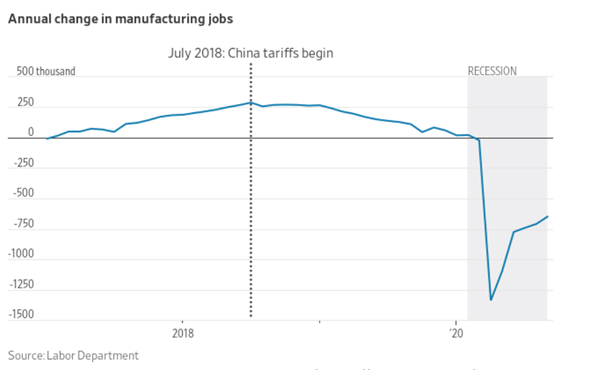
“Another goal—reshoring of US factory production—hasn’t happened either,” the Journal continues. “Job growth in manufacturing started to slow in July 2018, and manufacturing production peaked in December 2018.”

This graph shows pretty clearly that Trump’s tariffs did not successfully promote employment in the manufacturing sector. Much of the manufacturing job gains that did occur during the president’s tenure happened before the tariffs even took effect.

Image Credit: Wall Street Journal

This news is dismaying, but it’s hardly surprising. 

Economists overwhelmingly agree that tariffs, which are basically taxes on American consumers, don’t work. In a 2016 survey of economists, zero agreed that adding tariffs on certain goods would successfully encourage domestic production. A whopping 93 percent disagreed or strongly disagreed, while 7 percent did not answer.

“Tariffs that save jobs in the steel industry mean higher steel prices, which in turn means fewer sales of American steel products around the world and losses of far more jobs than are saved,” famed free-market economist Thomas Sowell explained in one example of how tariffs backfire.Populist-sounding politicians can boast about ‘protecting American jobs’ and seem to the untrained eye to be telling the truth.

“The benefits of a tariff are visible,” Nobel laureate Milton Friedman similarly noted. “Union workers can see they are ‘protected.’ The harm which a tariff does is invisible. It’s spread widely. There are people that don’t have jobs because of tariffs but they don’t know it.”

This is why populist-sounding politicians can boast about “protecting American jobs” and seem to the untrained eye to be telling the truth. 

Yet as economists agree, the problem with tariffs generally speaking is that they kill more jobs than they create. For every job that is “protected” by a tariff, other jobs are lost in related industries that use the targeted good as an input and see their costs raised. But even within the manufacturing sector, these tariffs failed. 

Why? It’s simple: The tariffs helped some manufacturers by hurting others via raised prices, and (predictably) triggered retaliatory tariffs from China that together outweighed any benefits.The problem with tariffs generally speaking is that they kill more jobs than they create.

“An industry-by-industry analysis by the Federal Reserve showed that tariffs did help boost employment by 0.3%, in industries exposed to trade with China, by giving protection to some domestic industries to cheaper Chinese imports,” the Journal reports.

“But these gains were more than offset by higher costs of importing Chinese parts, which cut manufacturing employment by 1.1%,” the analysis continues. “Retaliatory tariffs imposed by China against US exports, the analysis found, reduced US factory jobs by 0.7%.”

Many Americans of good faith might be earnestly surprised by how tariffs have failed to restore the manufacturing sector. But students of economics shouldn’t be. 

Related Posts

How Machine Learning has impacted Consumer Behaviour and Analysis
Consumer Research

How Machine Learning has impacted Consumer Behaviour and Analysis

January 4, 2024
Market Research The Ultimate Weapon for Business Success
Consumer Research

Market Research: The Ultimate Weapon for Business Success

June 22, 2023
Unveiling the Hidden Power of Market Research A Game Changer
Consumer Research

Unveiling the Hidden Power of Market Research: A Game Changer

June 2, 2023
7 Secrets of Market Research Gurus That Will Blow Your Mind
Consumer Research

7 Secrets of Market Research Gurus That Will Blow Your Mind

May 8, 2023
The Shocking Truth About Market Research Revealed!
Consumer Research

The Shocking Truth About Market Research: Revealed!

April 25, 2023
market research, primary research, secondary research, market research trends, market research news,
Consumer Research

Quantitative vs. Qualitative Research. How to choose the Right Research Method for Your Business Needs

March 14, 2023
Next Post
Positive Material Identification Market Complete Survey 2020-2026 Insights, Demand, Analysis, Manufacturers, Type And Application

Fatty Esters Market Growth And Status Explored In A New Research By 2025 – The Think Curiouser

Categories

  • Consumer Research
  • Data Analysis
  • Data Collection
  • Industry Research
  • Latest News
  • Market Insights
  • Marketing Research
  • Survey Research
  • Uncategorized

Recent Posts

  • Ipsos Revolutionizes the Global Market Research Landscape
  • How Machine Learning has impacted Consumer Behaviour and Analysis
  • Market Research: The Ultimate Weapon for Business Success
  • Privacy Policy
  • Terms of Use
  • Antispam
  • DMCA

Copyright © 2024 Globalresearchsyndicate.com

Welcome Back!

Login to your account below

Forgotten Password?

Retrieve your password

Please enter your username or email address to reset your password.

Log In
This website uses cookies to improve your experience. We'll assume you're ok with this, but you can opt-out if you wish. Cookie settingsACCEPT
Privacy & Cookies Policy

Privacy Overview

This website uses cookies to improve your experience while you navigate through the website. Out of these cookies, the cookies that are categorized as necessary are stored on your browser as they are essential for the working of basic functionalities of the website. We also use third-party cookies that help us analyze and understand how you use this website. These cookies will be stored in your browser only with your consent. You also have the option to opt-out of these cookies. But opting out of some of these cookies may have an effect on your browsing experience.
Necessary
Always Enabled
Necessary cookies are absolutely essential for the website to function properly. This category only includes cookies that ensures basic functionalities and security features of the website. These cookies do not store any personal information.
Non-necessary
Any cookies that may not be particularly necessary for the website to function and is used specifically to collect user personal data via analytics, ads, other embedded contents are termed as non-necessary cookies. It is mandatory to procure user consent prior to running these cookies on your website.
SAVE & ACCEPT
No Result
View All Result
  • Latest News
  • Consumer Research
  • Survey Research
  • Marketing Research
  • Industry Research
  • Data Collection
  • More
    • Data Analysis
    • Market Insights

Copyright © 2024 Globalresearchsyndicate.com




