

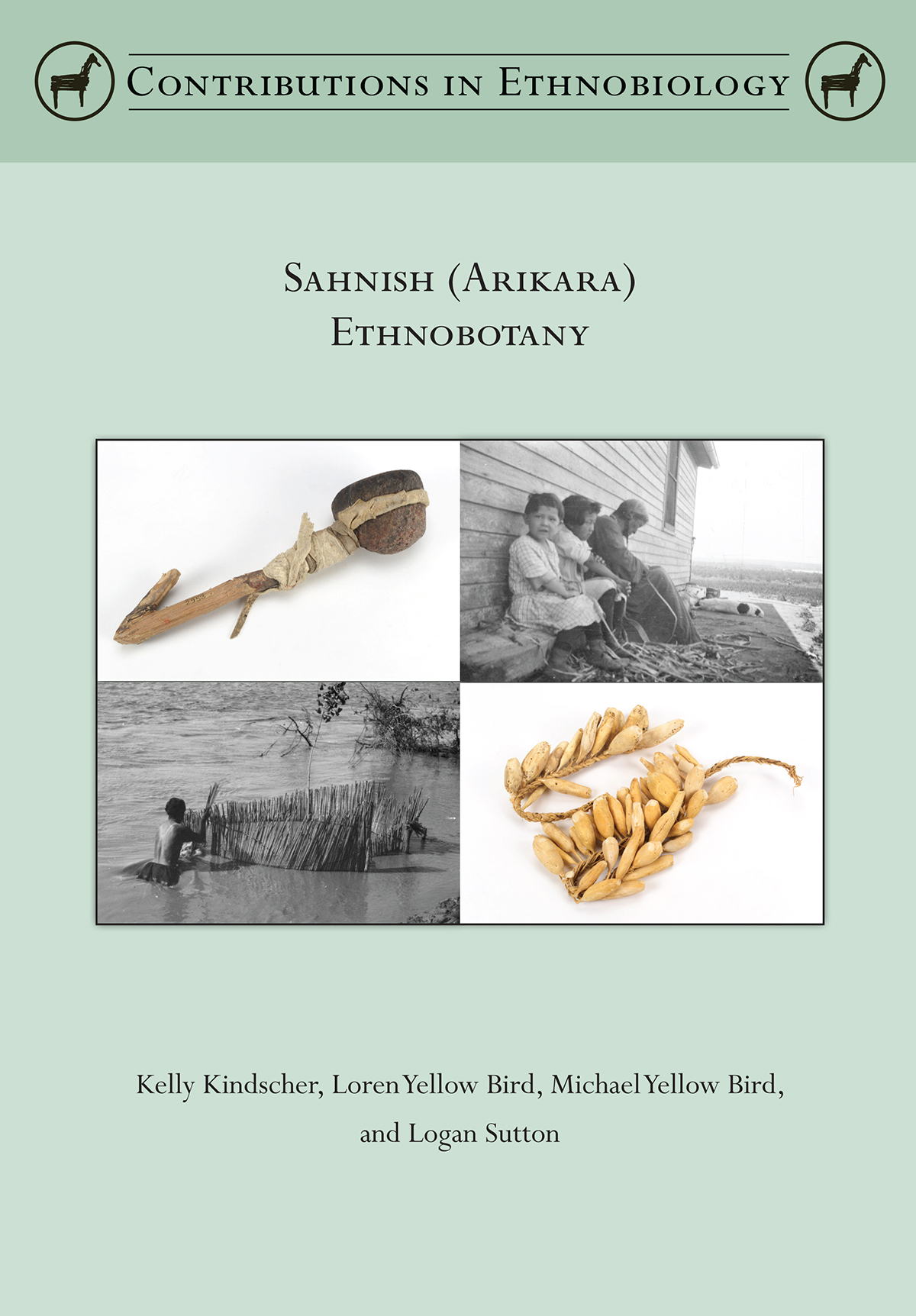
LAWRENCE — A new book by University of Kansas faculty member Kelly Kindscher and three co-authors is the first published compilation of traditional plant uses of the Arikara Tribe. The work, “Sahnish (Arikara) Ethnobotany,” serves as a regional ethnobotany of the Arikara, one of the most influential tribes on the Northern Great Plains.
 Kindscher, lead author and ethnobotanist, is a professor in the Environmental Studies Program and a senior scientist at the Kansas Biological Survey. Michael Yellow Bird, co-author and former director of KU’s Indigenous Studies Program, is professor and dean of the faculty of social work at the University of Manitoba and an Arikara tribal member.
The book, which had its beginnings more than 100 years ago, describes the traditional use of wild plants among the Arikara for food, medicine, craft,and other uses. The tribe grew corn, hunted, foraged and traded with other tribes in the region, but wild plants were key to their diet, medicine, craft and daily life. Their villages were located along the Missouri River in northern South Dakota and North Dakota. Today, many Arikara tribal members live at Fort Berthold Reservation, North Dakota, as part of the MHA (Mandan, Hidatsa, Arikara) Nation.
“The importance of this book cannot be overstated,” Yellow Bird said. “It provides compelling evidence of the traditional plant knowledge of the Arikara people, illuminates an important period in the history of the tribe and helps to restore an understanding of the Arikara ethnobotany that will be beneficial to ethnobotanists and members of the tribe.”
 The book documents the use of 106 species from 31 plant families, based primarily on the work of Melvin Gilmore, who recorded Arikara ethnobotany from 1916 to 1935. Gilmore interviewed elders for their stories and accounts of traditional plant use, collected material goods and wrote a draft manuscript but was not able to complete it due to debilitating illness.
Fortunately, his field notes, manuscripts and papers were archived, and they form the core of the new book. Gilmore’s detailed description is augmented with historical accounts of the Arikara gleaned from the journals of Great Plains explorers — Lewis and Clark, John Bradbury, Pierre Tabeau and others. Additional plant uses and nomenclature are based on the field notes of linguist Douglas Parks, who carried out detailed documentation of the tribe’s language from 1970 through 2001.
“It was exciting to know that Gilmore had studied the Arikara’s plant uses in the 1920s and 1930s,” Kindscher said. “The elders he visited with had memories that went back to the old ways and the times when they lived traditionally along the Missouri River and gathered wild plants for important uses.
“It was delightful to work with the manuscripts, notes and material goods, and to see all the details he recorded. The objects he collected and archived at the Smithsonian Institution, such as chokecherry pounders, dried juneberries, and reed mats bring the ethnobotany back to life.”
Although based on these historical sources, the new work features updated modern botanical nomenclature, contemporary spelling and interpretation of Arikara plant names, as well as color photographs and range maps of each species.
Kindscher collected and assembled the historical Gilmore materials. Co-author Logan Sutton contributed the Arikara spellings and linguistic analyses. Michael Yellow Bird and Loren Yellow Bird, who are brothers, provided the cultural context. The book is Kindscher’s fourth on human uses of wild plants.
Sutton is a research associate with the American Indian Studies Research Institute at Indiana University and language material developer with the Culture and Language Department of the MHA Nation. He served as primary curator of the Arikara language dictionary database under Douglas Parks and, since 2015, has served as an Arikara language consultant. He lives on the Fort Berthold Reservation.
Loren Yellow Bird Sr. is an Arikara historian, traditionalist and member of the Sahnish (Arikara) Nation. He has served as a subject matter expert in several articles and film documentaries and was the technical adviser for the 2016 Oscar-winning film “The Revenant,” where he advised actor Leonardo DiCaprio and director Alejandro Gonzalez Iñárritu. He has been active with the MHA Nation in helping to identify historical locations of uncovered human remains and has worked to help facilitate recovery and traditional burial practices of the Sahnish.
The new book was published by the Society for Ethnobiology, which also, through a grant, is providing copies to Arikara youths on the reservation.
The Kansas Biological Survey was established at KU in 1911. It houses a diverse group of ecological research and remote sensing/GIS programs. The survey also manages the 3,700-acre KU Field Station, established in 1947; it offers sites for faculty and student study in the sciences, arts, humanities and professional schools.
Top right image: A new book by University of Kansas faculty member Kelly Kindscher and three co-authors, “Sahnish (Arikara) Ethnobotany,” is the first published compilation of traditional plant uses of the Arikara Tribe.
Bottom right image: Melvin Gilmore, who recorded Arikara ethnobotany from 1916 to 1935, collected field notes and other research that formed the core of the new book.







