
GLOBAL RESEARCH SYNDICATE
No Result
View All Result
  • Login
  • Latest News
  • Consumer Research
  • Survey Research
  • Marketing Research
  • Industry Research
  • Data Collection
  • More
    • Data Analysis
    • Market Insights
  • Latest News
  • Consumer Research
  • Survey Research
  • Marketing Research
  • Industry Research
  • Data Collection
  • More
    • Data Analysis
    • Market Insights
No Result
View All Result
globalresearchsyndicate
No Result
View All Result
Home Data Analysis

Incidence of multiple sclerosis in China: A nationwide hospital-based study

globalresearchsyndicate by globalresearchsyndicate
August 6, 2020
in Data Analysis
0
Incidence of multiple sclerosis in China: A nationwide hospital-based study
0
SHARES
3
VIEWS
Share on FacebookShare on Twitter

Abstract

Background

Multiple sclerosis (MS) is a leading cause of disability among young adults and effects considerable social and economic burdens. Data of MS incidence in China at the national level is lacking. We conducted the first nationwide hospital-based study to estimate the incidence and hospitalization burden of MS in China.

Methods

This study is based on an administrative database of the National Hospital Quality Monitoring System, which covers all 1665 tertiary hospitals in mainland China. The “Medical Record Homepage” of all patients, including 346 variables including demographic characteristics, diagnoses, procedures, and expenses etc., were uniformly collected across each tertiary hospital via standard protocol. MS was defined by the 2010 International Panel criteria for MS and was identified by ICD-10 code (G35•0).

Findings

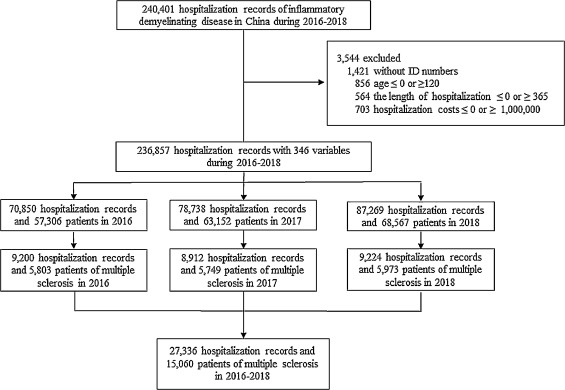
We identified 27,336 hospital admissions for 15,060 MS patients from 2016 to 2018; amongst these patients, 9,879 were newly diagnosed. The age- and sex-adjusted incidence per 100,000 person-years is 0•235 (95% confidence interval [CI] 0•230–0•240), with 0•055 (0•050–0•060) in children and 0•288 (0•282–0•294) in adults, respectively. The female to male ratio is 2•02; the peak disease onset is age of 40–49 years. Residents in high-latitude and high-altitude areas are more likely to develop MS (F = 8•99; p < 0•001). Prevalent comorbidities include hypertension (18•8%), diabetes (7•2%), stroke (14•7%), depression or anxiety (3•7%), and autoimmune disease (2•3%). Through 2016–2018, 104 adults and 2 children died, with a hospital mortality rate of 9•9 per 1,000 person-years.

Interpretation

For the first time, we obtain the national incidence of MS as 0.055 in children and 0.288 in adults per 100,000 in China. The geographical distribution of MS incidence presented a north-south latitude gradient and a west-east altitude gradient.

Funding

National Science Foundation of China (81801199, 91642205, and 81830038); Advanced Innovation Center for Human Brain Protection, Capital Medical University, Beijing.

1. Introduction

Multiple sclerosis (MS) is a classical immune mediated demyelinating disease of the central nervous system, and it is a leading cause of disability amongst young adults worldwide, affecting considerable social and economic burden [

1

A global perspective on the burden of multiple sclerosis.

]. Nearly 1 million MS patients were confirmed with associated costs of over $24 billion annually in the United States [

2

  • Wallin MT
  • Culpepper WJ
  • Campbell JD
  • et al.
The prevalence of MS in the United States: A population-based estimate using health claims data.

]. In 2020, Public Health England revealed about 4950 people are diagnosed with MS each year in United Kingdom [

3

Public Health England
Multiple sclerosis: prevalence, incidence and smoking status – data briefing.

].

MS Atlas, as compiled by the MS International Federation estimated a global median prevalence rate of 35/100,000 and a median incidence rate of 4 per 100,000 [

4

  • Browne P
  • Chandraratna D
  • Angood C
  • et al.
Atlas of Multiple Sclerosis 2013: A growing global problem with widespread inequity.

]. However, the worldwide prevalence of MS varies substantially between the continents due to geographical and environmental characteristics. The landmark epidemiological studies from Kurtzke and colleagues assumed the frequency of MS was related to latitude with three; high, moderate, and low “zones” [

5

  • Koch-Henriksen N.
  • Sorensen P.S.
The changing demographic pattern of multiple sclerosis epidemiology.

]. The highest age-standardized MS prevalence was 164•6 in high-income North America, 127 in western Europe, and 91•1 in Australasia, and the lowest were 3•3 in eastern sub-Saharan Africa, 2•8 in central sub-Saharan African, and in Oceania, 2 per 100,000 persons [

6

Collaborators GBDMS
Global, regional, and national burden of multiple sclerosis 1990-2016: a systematic analysis for the Global Burden of Disease Study 2016.

].

Asians have a lower risk of MS as the prevalence estimates in Asians are amongst the lowest in the world [

7

Demyelinating diseases in Asia.

]. The nationwide Japanese survey conducted in 2004 estimated the prevalence of MS at 7•7 per 100,000 [

8

  • Osoegawa M
  • Kira J
  • Fukazawa T
  • et al.
Temporal changes and geographical differences in multiple sclerosis phenotypes in Japanese: nationwide survey results over 30 years.

]. The age-standardized prevalence per 100,000 persons was 3•23 in Korea [

9

  • Kim JE
  • Park SH
  • Han K
  • Kim HJ
  • Shin DW
  • Kim SM
Prevalence and incidence of neuromyelitis optica spectrum disorder and multiple sclerosis in Korea.

] and 2•73 in Malaysia [

10

A nationwide epidemiological study on the prevalence of multiple sclerosis and neuromyelitis optica spectrum disorder with important multi-ethnic differences in Malaysia.

]. However, in China, which accounts for 21•6% of Asia’s land area and 18•8% of the world’s population, the epidemiological data on MS is absent or extremely sparse. The two epidemiological studies available are regionally narrow; one showed the MS prevalence rate of 1•39 per 100,000 in Shanghai, the other in Shandong Province estimated an incidence rate of 0•20 per 100,000 for females and 0•12 for males [

11

  • Cheng Q
  • Miao L
  • Zhang J
  • et al.
A population-based survey of multiple sclerosis in Shanghai, China.

,

12

Estimating epidemiological data of Multiple sclerosis using hospitalized data in Shandong Province, China.

].

In this study, we estimate the incidence of MS in mainland China between 2016 and 2018 using a nationwide administrative database of Hospital Quality Monitoring System (HQMS), which is maintained by the National Health Commission (NHC).

4. Discussion

This is the first study initiated to estimate the incidence of multiple sclerosis in a population-based health care administrative data-set in mainland China. The age- and sex-adjusted incidence of MS in China is 0•235 per 100,000 person-years, comparable to other East Asian countries. Originally postulated by J.F. Kurtzke [

5

  • Koch-Henriksen N.
  • Sorensen P.S.
The changing demographic pattern of multiple sclerosis epidemiology.

], geographical distribution of MS risk can be generally distributed in three zones, with North American and northern European countries considered as a high-risk prevalence zone. Asia has been among the low-risk areas, although incidence has been recently increasing [

15

  • Eskandarieh S
  • Heydarpour P
  • Minagar A
  • Pourmand S
  • Sahraian MA
Multiple sclerosis epidemiology in East Asia, South East Asia and South Asia: a systematic review.

]. According to the 2013 Atlas of MS launched by the Multiple Sclerosis International Federation, MS prevalence is highest in Middle East and lowest in East Asia [

4

  • Browne P
  • Chandraratna D
  • Angood C
  • et al.
Atlas of Multiple Sclerosis 2013: A growing global problem with widespread inequity.

]. The incidence of MS in Iran reached 6•7/100,000, similar to continental Europe [

16

  • Hosseinzadeh A
  • Baneshi MR
  • Sedighi B
  • Kermanchi J
  • Haghdoost AA
Incidence of multiple sclerosis in Iran: a nationwide, population-based study.

]. However, the incidence of MS in East Asian countries is at comparable levels range from 0•2 to 0•8 per 100,000 persons. In the present study, the incidence of MS in Inner Mongolia and Shanxi Province, which are in the same latitude zone as Japan and South Korea, were 0•33 and 0•54 /100,000. The age-standardized incidence of MS was 0•50 per 100,000 in Korea [

9

  • Kim JE
  • Park SH
  • Han K
  • Kim HJ
  • Shin DW
  • Kim SM
Prevalence and incidence of neuromyelitis optica spectrum disorder and multiple sclerosis in Korea.

], In Japan, the incidence is on the rise from 0•04 in 1980s to 0•78 /100,000 in 2004 [

8

  • Osoegawa M
  • Kira J
  • Fukazawa T
  • et al.
Temporal changes and geographical differences in multiple sclerosis phenotypes in Japanese: nationwide survey results over 30 years.

]. Malaysia, with 23.4% ethnic Chinese, observed a crude annual incidence of 0•55 per 100,000 [

10

A nationwide epidemiological study on the prevalence of multiple sclerosis and neuromyelitis optica spectrum disorder with important multi-ethnic differences in Malaysia.

]. In addition to estimating at the national incidence, a map of MS incidence in 31 provinces and municipalities was compiled. We found that the incidence of MS in Shandong Province is 0•29/100,000 for female and 0•12 for male, which is broadly consistent with a hospital-based study on MS incidence in Shandong Province in 2013 [

12

Estimating epidemiological data of Multiple sclerosis using hospitalized data in Shandong Province, China.

].

The distribution of incidence rate of MS risk in China where the expansive latitude range and stepwise topography can reveal clues of certain environmental risk-factors. Topographically, the landform of China is low in the east and high in the west; the land surface ascends like a three-step staircase. The plains and lowlands in the east and southeast constitute the first step, occupying about 12 percent of the land. This natural altitude gradient presents an ideal model for interrogating the risk of developing MS and altitude. We find higher incidence rates of MS in high-latitude provinces, such as Inner Mongolia (44° N) and Heilongjiang (47° N). MS incidence is higher in provinces at higher latitudes than those closer to the equator. Additionally, we further confirm that the descending altitude from west to east corresponds with decreased incidence of MS in China. Geographical location is a well-established contributor to the risk of developing multiple sclerosis; [

17

  • Olsson T
  • Barcellos LF
  • Alfredsson L
Interactions between genetic, lifestyle and environmental risk factors for multiple sclerosis.

] a strong latitude gradient was detected for the prevalence of MS, with a 1•03 times increase in prevalence per latitude degree [

6

Collaborators GBDMS
Global, regional, and national burden of multiple sclerosis 1990-2016: a systematic analysis for the Global Burden of Disease Study 2016.

]. Moreover, residents living at higher latitude are associated with a younger age of MS onset [

18

  • Tao C
  • Simpson Jr., S
  • van der Mei I
  • et al.
Higher latitude is significantly associated with an earlier age of disease onset in multiple sclerosis.

]. Differential exposure to sunlight has been posited as an environmental cause accounting for the positive association between MS incidence and latitude, as ultraviolet (UV) light stimulates the production of vitamin D in the body [

17

  • Olsson T
  • Barcellos LF
  • Alfredsson L
Interactions between genetic, lifestyle and environmental risk factors for multiple sclerosis.

,

18

  • Tao C
  • Simpson Jr., S
  • van der Mei I
  • et al.
Higher latitude is significantly associated with an earlier age of disease onset in multiple sclerosis.

]. The link between vitamin D insufficiency and increased risk of MS is well identified [

19

  • Laursen JH
  • Sondergaard HB
  • Sorensen PS
  • Sellebjerg F
  • Oturai AB
Vitamin D supplementation reduces relapse rate in relapsing-remitting multiple sclerosis patients treated with natalizumab.

]. Although higher altitudes generally correspond to increased UV radiation exposure, vitamin D levels do not necessarily increase. A study to compare serum vitamin D levels of plateau Tibetan peoples with Han peoples in Sichuan basin, showed lower serum 25-hydroxy vitamin D in highland Tibetan [

20

  • He Q
  • Zhu K
  • Chen D
  • Zhou X
  • Tang C
  • Gao X
Comparison of serum vitamin D levels of plateau Tibetan people and basin Han people in Sichuan province.

]. Temperature and UV are both factors that stimulate vitamin D production. The climate in the plateau is marked by low temperature. The exposure of the skin is less during outdoor activities in the highland area [

21

  • Tremlett H
  • Zhu F
  • Ascherio A
  • Munger KL
Sun exposure over the life course and associations with multiple sclerosis.

]. Temperature, exposure, diet, and supplements are all confounding factors which obscure vitamin D3s role in manifestation of MS incidence.

A predilection of Asians developing neuromyelitis optica spectrum disorder (NMOSD) has been well recognized. We recently completed a survey for age- and sex-adjusted incidence of NMOSD to be 0•278 per 100,000 person-years (submitted for publication). The annual incident cases of MS to NMOSD in China was 1:1•2. Overall, the ratios of NMOSD to MS are higher in Asia as compared with Western countries [

7

Demyelinating diseases in Asia.

]. The incidence of NMOSD and MS in Korea was 0•73 and 0•50 per 100,000 persons, respectively [

9

  • Kim JE
  • Park SH
  • Han K
  • Kim HJ
  • Shin DW
  • Kim SM
Prevalence and incidence of neuromyelitis optica spectrum disorder and multiple sclerosis in Korea.

]. The ratio of NMOSD to MS among the Chinese Malaysians was 2•0:1•0 [

10

A nationwide epidemiological study on the prevalence of multiple sclerosis and neuromyelitis optica spectrum disorder with important multi-ethnic differences in Malaysia.

]. A female predominance was observed in the incidence of both NMOSD and MS, but the difference was more pronounced in NMOSD. In our study, the female to male sex ratio of MS and NMOSD was 2•02 and 4•71. The sex ratio of MS varied among different studies with an estimated 3•4:1 in East Asia, following 2•1 in Japan, 1•6 in Korea, 3•2 in Hong Kong, and 3•4 in Taiwan [

15

  • Eskandarieh S
  • Heydarpour P
  • Minagar A
  • Pourmand S
  • Sahraian MA
Multiple sclerosis epidemiology in East Asia, South East Asia and South Asia: a systematic review.

]. The female propensity for NMOSD was evident in the Chinese Malaysians rather than for MS by a female to male ratio at 5:1 versus 12:1 in Malaysia [

22

  • Viswanathan S
  • Rose N
  • Arip M
  • et al.
Multiple sclerosis and neuromyelitis optica spectrum disorders in Malaysia: A comparison in different ethnic groups.

].

In our study, the peak incidence of MS occurred at the age of 40–49 years. Recently, a shift in peak incidence was found from those aged 40 to 49 years to those aged 30 to 34 years [

23

  • Mayr WT
  • Pittock SJ
  • McClelland RL
  • Jorgensen NW
  • Noseworthy JH
  • Rodriguez M
Incidence and prevalence of multiple sclerosis in Olmsted County, Minnesota, 1985-2000.

]. This is likely attributable to the 2010 McDonald diagnostic criteria for MS, which facilitates earlier diagnosis. Adults developed MS at a later age in China. this could be related to our study method which defines incidence based on new diagnoses rather than time of symptom manifestation, due to the restriction in HQMS information logging.

In our study, prevalent comorbidities are hypertension (18•8%), hyperlipidemia (12•5%), diabetes (7•2) and osteoporosis (2•5%). These are consistent with comorbidities reported in other MS cohorts; hypertension (18•6%) and hyperlipidemia (10•9%) [

24

Comorbidity in multiple sclerosis: implications for patient care.

]. Few well-designed population-based studies have assessed the incidence or prevalence of autoimmune diseases, cancers, and stroke among patients with MS. Our data report these comorbidities in MS patients as: autoimmune diseases (2•3%), cancers (1•3%), and stroke (14•7%). Depression is the most common associated mental disorder in patients with MS on hospital-based clinics survey [

25

  • Feinstein A
  • Magalhaes S
  • Richard JF
  • Audet B
  • Moore C
The link between multiple sclerosis and depression.

]. A population-based study evaluated the prevalence of comorbidity at the time of diagnosis in 16,803 Canadian MS patients, wherein a large proportion of patients with MS developed major depression (19•1%) and anxiety (11•1%) [

26

  • Marrie RA
  • Patten SB
  • Tremlett H
  • et al.
Sex differences in comorbidity at diagnosis of multiple sclerosis: a population-based study.

]. However, the incidence of depression was a relatively low 3•7% in our study. This may be attributed to HQMS only collecting inpatient information and the majority of patients with depression or anxiety are followed up in the clinic. We noticed a high frequency of stroke in MS, in part due to the very high prevalence of stroke in China (1114.8 to 2370/100,000 in China vs 434.86 to 502.32/100,000 the rest of the world) [

27

  • Wang W
  • Jiang B
  • Sun H
  • et al.
Prevalence, incidence, and mortality of stroke in China: results from a nationwide population-based survey of 480 687 adults.

,

28

  • Feigin VL
  • Forouzanfar MH
  • Krishnamurthi R
  • et al.
Global and regional burden of stroke during 1990-2010: findings from the Global Burden of Disease Study 2010.

].

China’s basic health insurance, including the Urban Employee Basic Medical Insurance, the Urban Resident Basic Medical Insurance, and the New Rural Cooperative Medical Insurance, covered 70% of MS hospitalization. The burden of hospitalization in MS patients is gradually decreasing by the year. In our cohort, 104 adults and 2 children died, and the hospital mortality rate was 7•0 deaths per 1000 person-years from 2016–2018. The most common causes of death here were respiratory failure (32•8%) and lung infection (24•1%). Several observational studies on MS mortality report inconsistent and competing results. A meta-analysis covering all available mortality studies evaluated the all-cause, cause-specific and gender-specific standard mortality rates. All-cause standard mortality rates per 1000 person-years were 2•56 in males and 3•06 in females [

29

  • Manouchehrinia A
  • Tanasescu R
  • Tench CR
  • Constantinescu CS
Mortality in multiple sclerosis: meta-analysis of standardised mortality ratios.

]. Mortality rates due to infectious diseases and diseases of the respiratory system were higher within the MS population [

30

  • Marrie RA
  • Elliott L
  • Marriott J
  • et al.
Effect of comorbidity on mortality in multiple sclerosis.

].

Our study has several limitations. First, we did not have access to outpatient records. Certain patients with mild symptoms may be diagnosed with clinically isolated syndrome and followed by outpatient visits. The actual incidence may be higher than our current data. Second, results of oligoclonal IgG bands and MRI findings were not collected in this study. Third, we were unable to calculate the prevalence of MS in this study. Prevalence is the product of the incidence rate and the average duration of a condition. The prevalence of MS in China can be well estimated when HQMS contains decades of data in the future.

For the first time, our study captures the incidence for multiple sclerosis across all age groups in almost all Chinese patients. The unique administrative national database enhances the accuracy and rigor of these estimates. The geographical distribution of MS incidence not only correlates to the north-south latitude gradient but also to west-east altitude gradient. Our study fills in the blank of epidemiologic data for approximately 1.4 billion Chinese and enriches the global outlook for this disease. The reported disease burden calls for ramping up regional and global efforts to care for MS patients and investment in research for this devastating and pervasive disease.

Contributors

F.-D.S. and Y.W. conceived and designed this study; F.-D.S., D.-C. T., Z. L., C. Z., M.Y. and X. Y. acquired and analyzed the data; and F.-D.S., D.-C.T., C. Z., drafted the manuscript and prepared the figures; H. G. was involved in statistics analysis; F-D.S. obtained funding; F.-D. S. made critical revisions of the manuscript and important intellectual contributions. All authors reviewed the manuscript.

Data sharing

The study protocol, statistical analysis plan, and deidentified data that underlie the results of this article will be available for investigators after approval by the Institutional Review Board of China National Clinical Research Center for Neurological Diseases (Beijing, China). Please email the corresponding author for more information.

Acknowledgements

We thank colleagues from National Center for Quality Control of Neurological Diseases for technical and logistic support; Samuel X. Shi for English editing; Yingyu Jiang for statistical analysis.

Editor note: The Lancet Group takes a neutral position with respect to territorial claims in published maps and institutional affiliations.


Related Posts

How Machine Learning has impacted Consumer Behaviour and Analysis
Consumer Research

How Machine Learning has impacted Consumer Behaviour and Analysis

January 4, 2024
Market Research The Ultimate Weapon for Business Success
Consumer Research

Market Research: The Ultimate Weapon for Business Success

June 22, 2023
Unveiling the Hidden Power of Market Research A Game Changer
Consumer Research

Unveiling the Hidden Power of Market Research: A Game Changer

June 2, 2023
7 Secrets of Market Research Gurus That Will Blow Your Mind
Consumer Research

7 Secrets of Market Research Gurus That Will Blow Your Mind

May 8, 2023
The Shocking Truth About Market Research Revealed!
Consumer Research

The Shocking Truth About Market Research: Revealed!

April 25, 2023
market research, primary research, secondary research, market research trends, market research news,
Consumer Research

Quantitative vs. Qualitative Research. How to choose the Right Research Method for Your Business Needs

March 14, 2023
Next Post
San Marco Updates Exploration on Its Buck Gold

San Marco Updates Exploration on Its Buck Gold

Categories

  • Consumer Research
  • Data Analysis
  • Data Collection
  • Industry Research
  • Latest News
  • Market Insights
  • Marketing Research
  • Survey Research
  • Uncategorized

Recent Posts

  • Ipsos Revolutionizes the Global Market Research Landscape
  • How Machine Learning has impacted Consumer Behaviour and Analysis
  • Market Research: The Ultimate Weapon for Business Success
  • Privacy Policy
  • Terms of Use
  • Antispam
  • DMCA

Copyright © 2024 Globalresearchsyndicate.com

Welcome Back!

Login to your account below

Forgotten Password?

Retrieve your password

Please enter your username or email address to reset your password.

Log In
This website uses cookies to improve your experience. We'll assume you're ok with this, but you can opt-out if you wish. Cookie settingsACCEPT
Privacy & Cookies Policy

Privacy Overview

This website uses cookies to improve your experience while you navigate through the website. Out of these cookies, the cookies that are categorized as necessary are stored on your browser as they are essential for the working of basic functionalities of the website. We also use third-party cookies that help us analyze and understand how you use this website. These cookies will be stored in your browser only with your consent. You also have the option to opt-out of these cookies. But opting out of some of these cookies may have an effect on your browsing experience.
Necessary
Always Enabled
Necessary cookies are absolutely essential for the website to function properly. This category only includes cookies that ensures basic functionalities and security features of the website. These cookies do not store any personal information.
Non-necessary
Any cookies that may not be particularly necessary for the website to function and is used specifically to collect user personal data via analytics, ads, other embedded contents are termed as non-necessary cookies. It is mandatory to procure user consent prior to running these cookies on your website.
SAVE & ACCEPT
No Result
View All Result
  • Latest News
  • Consumer Research
  • Survey Research
  • Marketing Research
  • Industry Research
  • Data Collection
  • More
    • Data Analysis
    • Market Insights

Copyright © 2024 Globalresearchsyndicate.com



